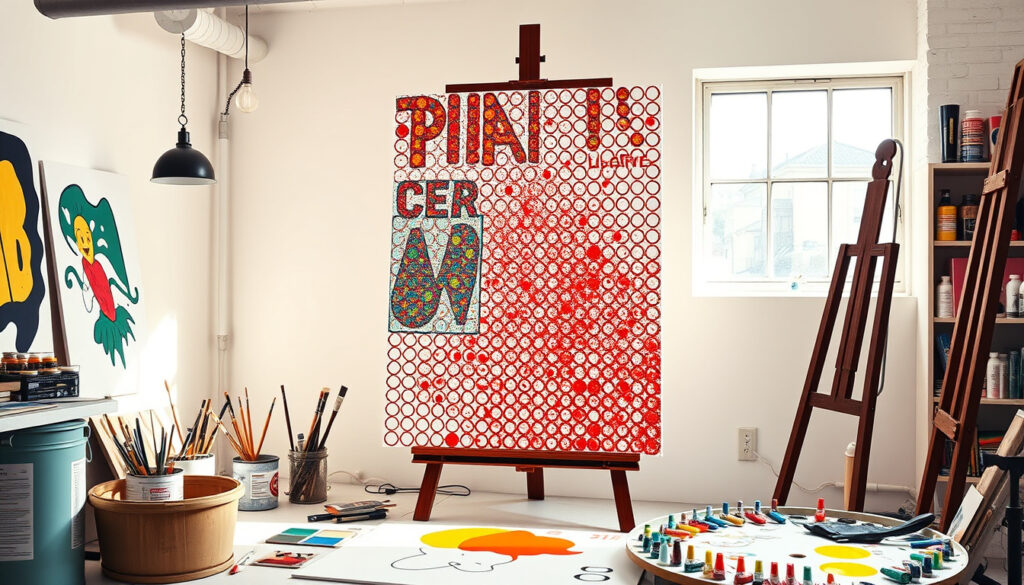
Roy Lichtenstein: Life, Pop Art Works & Techniques
Few artists have divided the art world quite like Roy Lichtenstein. In the early 1960s, he turned lowly comic strips into high art, sparking debates that still echo today. This guide traces his path from a New York City childhood to global fame, explores his most iconic works like Whaam!, and unpacks the techniques—Ben-Day dots, bold outlines, primary colors—that made his style unmistakable. Lichtenstein created more than 5,000 works across painting, printmaking, sculpture, and murals, according to the Roy Lichtenstein Foundation (artist estate and archive).
Born: October 27, 1923, New York City ·
Died: September 29, 1997, New York City ·
Movement: Pop Art ·
Known for: Comic-strip-inspired paintings, Ben-Day dots ·
Most famous work: Whaam! (1963)
Quick snapshot
- American pop artist (1923–1997) (Britannica (encyclopedia))
- Known for comic-strip paintings (Tate (leading UK art museum))
- Leading figure of Pop Art (Tate)
- Whaam! (1963) (Wikipedia (open encyclopedia))
- Drowning Girl (1963) (Tate)
- Look Mickey (1961) (Roy Lichtenstein Foundation)
- Influenced contemporary art (Roy Lichtenstein Foundation)
- Works sell for millions (Tate)
- Exhibited worldwide (Tate)
Seven key facts about Roy Lichtenstein, one pattern: his career spanned painting, printmaking, sculpture, and public murals.
| Label | Value |
|---|---|
| Full name | Roy Fox Lichtenstein (Britannica) |
| Born | October 27, 1923, New York City (Britannica) |
| Died | September 29, 1997, New York City (Britannica) |
| Nationality | American (Tate) |
| Movement | Pop Art (Tate) |
| Known for | Painting, sculpture (Tate) |
| Most famous work | Whaam! (1963) (Wikipedia) |
Who Is Roy Lichtenstein?
Early life and education
- Born October 27, 1923, in New York City (Britannica (encyclopedia))
- Studied at the Art Students League with Reginald Marsh (Smithsonian American Art Museum (national museum))
- Earned B.F.A. in 1946 and M.F.A. in 1949 from Ohio State University (Smithsonian American Art Museum)
Lichtenstein grew up on the Upper West Side of Manhattan, the son of a real estate broker and a homemaker. After high school he briefly attended the Art Students League before enlisting in the Army during World War II. His formal training at Ohio State exposed him to European modernism and American regionalism, but it was not until the early 1960s that he found his signature voice.
Rise to fame in the 1960s
- Rose to prominence in the 1960s with works inspired by popular advertising and comic-book imagery (Tate (leading UK art museum))
- First fully achieved pop paintings created in 1961, including Look Mickey (Roy Lichtenstein Foundation (artist estate and archive))
His first solo exhibition in New York in 1962 sold out, but the critical reception was mixed. Many dismissed his work as derivative copies of comic strips. Yet collectors and a younger generation of artists recognized something new—a deadpan satire of consumer culture that turned mass-produced images into fine art.
What Is Roy Lichtenstein’s Most Famous Piece of Art?
Whaam! (1963)
- Diptych painting based on a panel from DC Comics’ All-American Men of War (Wikipedia (open encyclopedia))
- First exhibited in New York in 1963 (MyArtBroker (art market specialist))
- On permanent display at Tate Modern (MyArtBroker)
Measuring 68 by 160 inches, Whaam! depicts a fighter jet firing a missile that explodes into a cartoonish red-and-yellow cloud. The onomatopoeic title fills the upper-left panel. It is widely regarded as one of the best-known works of Pop art.
Drowning Girl (1963)
- One of his most recognized works (Tate (leading UK art museum))
In Drowning Girl, a teary-eyed woman is engulfed by a wave, with the thought bubble “I don’t care! I’d rather sink—than call Brad for help!” The composition borrows from a DC romance comic, but Lichtenstein stripped away the original context, leaving only the cliché of melodrama. The work entered the collection of the Museum of Modern Art in 1971.
Look Mickey (1961)
- First pop painting, marking the shift to his signature style (Roy Lichtenstein Foundation (artist estate and archive))
Look Mickey is a small canvas showing Mickey Mouse and Donald Duck fishing. Lichtenstein painted it as a dare from one of his sons, who pointed to a comic book and said, “I bet you can’t paint that.” The result launched a career-defining method: flat colors, bold black outlines, and the early use of Ben-Day dots.
The trade-off: Lichtenstein’s reliance on pre-existing comic panels meant he constantly faced accusations of plagiarism. Yet collectors saw the value; in 2017, Masterpiece (1962) reportedly sold for $165 million in a private sale, a record for the artist.
Why Is Roy Lichtenstein So Famous?
Role in the Pop Art movement
- Founding figure of Pop Art alongside Andy Warhol, James Rosenquist, and others (Tate (leading UK art museum))
- Pop Art countered Abstract Expressionism by using images and techniques from popular culture (Britannica (encyclopedia))
While Abstract Expressionists celebrated spontaneous gesture, Lichtenstein mimicked mechanical reproduction. He made no secret of his sources—comics, newspaper ads, product packaging. That transparency was itself a statement: art could be about the everyday, not just the sublime.
Use of Ben-Day dots and comic book style
- His style is instantly recognizable for Ben-Day dots and bold outlines (Wikipedia (open encyclopedia))
- Ben-Day dots are a mechanical printing technique that Lichtenstein meticulously replicated by hand (Wikipedia)
The dots served a double purpose: they reproduced the look of cheap comic-book printing, and they forced the viewer to see the image as a construction of tiny circles rather than a seamless picture. That friction between illusion and process became Lichtenstein’s trademark.
Influence on contemporary art
- His work critiques mass production and consumer culture (Tate (leading UK art museum))
Later generations of artists, from Jeff Koons to Takashi Murakami, owe a debt to Lichtenstein’s ability to blur high and low. He proved that a painting could be both a commercial object and a serious artwork, a paradox that remains central to contemporary practice.
Lichtenstein’s Pop Art formula—take a mass-produced image, reproduce it with exaggerated precision, and present it as fine art—forced the art market to ask: if the object looks like a commodity, is it still art? The answer, proved by auction prices and museum acquisitions, was a resounding “yes.”
What Art Techniques Did Roy Lichtenstein Use?
Ben-Day dots
- Mimics commercial printing process; Lichtenstein used stencils and hand-painted dots (Wikipedia (open encyclopedia))
- Enlarged and exaggerated dots to evoke comic-book printing (Wikipedia)
Lichtenstein did not simply copy the printing press; he manipulated the scale and density of the dots to create light, shadow, and texture. In early works he used a perforated metal screen to stamp the dots, but soon switched to a plastic stencil that gave him more control. Each dot was painted by hand onto the canvas, a painstaking process that contradicted the “machine-made” look of the final image.
Bold outlines and primary colors
- Used bold black outlines and primary colors (red, yellow, blue) to emulate comic-strip panels (Wikipedia)
His palette was deliberately limited. By reducing color to three primaries plus black and white, he stripped away the nuance of traditional painting and forced the viewer to read the image quickly, the way one reads a comic strip.
Parody and appropriation
- Often enlarged comic book panels, isolating a single dramatic moment (Tate (leading UK art museum))
His choice of source material mattered: he selected panels that were heavy with emotion—romance, warfare, despair—and then heightened the artificiality by exaggerating the Ben-Day dots and adding his own caption bubbles. The result was a parody not of the comic itself but of the way mass media packages emotion for easy consumption.
Lichtenstein’s method of appropriation drew early criticism for being derivative. Yet as art historians later noted, he wasn’t stealing comic panels—he was translating them into a formal language that exposed the mechanics of visual clichés.
What Are 5 Facts About Roy Lichtenstein?
He served in World War II
- Lichtenstein served in the U.S. Army from 1943 to 1946, stationed in Europe (Smithsonian American Art Museum (national museum))
He earned an MFA from Ohio State University
- After the war he completed a B.F.A. in 1946 and an M.F.A. in 1949 at Ohio State (Smithsonian American Art Museum)
He created sculptures and murals
- Beyond painting, Lichtenstein produced large-scale public sculptures, prints, and murals across the United States (Roy Lichtenstein Foundation (artist estate and archive))
His first pop painting was Look Mickey
- Painted in 1961, Look Mickey was his first fully realized pop work (Roy Lichtenstein Foundation)
He died of pneumonia in 1997
- Lichtenstein died on September 29, 1997, at NYU Medical Center from complications of pneumonia (Britannica (encyclopedia))
Timeline
Six key dates trace the arc of Lichtenstein’s life and career.
| Date | Event |
|---|---|
| 1923 | Born in New York City (Britannica) |
| 1943–1946 | Served in the U.S. Army during World War II (Smithsonian American Art Museum) |
| 1949 | Earned MFA from Ohio State University (Smithsonian American Art Museum) |
| 1961 | Created his first pop painting, Look Mickey (Roy Lichtenstein Foundation) |
| 1963 | Painted Whaam! and Drowning Girl (Wikipedia) |
| 1997 | Died of pneumonia in New York City (Britannica) |
The pattern: Lichtenstein’s creative burst in the early 1960s lasted barely three years, yet those years produced the works that would define Pop Art for decades.
Confirmed facts
- Born in 1923 in New York City (Britannica)
- Died in 1997 of pneumonia (Britannica)
- Whaam! is his most famous work (Wikipedia)
- He used Ben-Day dots extensively (Wikipedia)
What’s unclear
- Exact number of paintings Lichtenstein created (though the Foundation documents more than 5,000 works across all media)
- Private sale prices of some works (e.g., the reported $165 million for Masterpiece has not been independently confirmed)
“I’m not trying to make a comment on the world. I’m just trying to make a painting.”
— Roy Lichtenstein (cited in multiple exhibition catalogs)
“A leading figure of the Pop Art movement.”
— Tate (leading UK art museum)
“One of the most influential and innovative artists of the second half of the twentieth century.”
— Roy Lichtenstein Foundation (artist estate and archive)
Roy Lichtenstein took the disposable images of comic books and advertisements and transformed them into enduring works of art. His meticulous hand-painted Ben-Day dots and deadpan compositions didn’t just critique mass media—they became a visual shorthand for an entire movement. For aspiring artists today, the lesson is clear: Lichtenstein’s method of isolating and magnifying a single familiar image remains a blueprint for how to turn the everyday into the iconic.
youtube.com, bykerwin.com, singulart.com, news.masterworksfineart.com, szallodakalauz.com
His signature Ben-Day dots and bold outlines are explored in detail in Roy Lichtensteins Pop Art legacy.
Frequently asked questions
What is Roy Lichtenstein’s most expensive painting?
The highest publicly recorded price is Nurse (1964), which sold for $95.4 million at auction in 2015. Private sales, such as the reported $165 million for Masterpiece (1962), have not been independently confirmed.
Did Roy Lichtenstein paint all his works by hand?
Yes. Despite the machine-made look of his paintings, Lichtenstein painted everything by hand. He used stencils to apply Ben-Day dots but never employed assistants to do the actual painting.
How did Roy Lichtenstein create Ben-Day dots?
He initially used a perforated metal screen to stamp dots, then switched to a plastic stencil. Each dot was applied individually with a brush or roller, adjusting the size and density to create shading.
Was Roy Lichtenstein influenced by comic books?
Absolutely. His early pop works were directly based on panels from DC Comics war and romance titles. He admired the graphic clarity and emotional exaggeration of comic strips.
Where can I see Roy Lichtenstein’s art?
Major collections include the Museum of Modern Art (New York), Tate Modern (London), the Art Institute of Chicago, and the National Gallery of Art (Washington, D.C.). Whaam! is on permanent display at Tate Modern.
What materials did Roy Lichtenstein use?
He worked primarily with oil and acrylic paint on canvas, but also produced sculptures in metal and ceramic, and made prints using lithography and screenprinting.
How did Roy Lichtenstein die?
He died from complications of pneumonia on September 29, 1997, at NYU Medical Center in New York City.
Related reading: Frida Kahlo: Mexican Painter, Tragic Story & Death · Coco Chanel: Life, Struggles, WWII Ties, and Legacy
More related posts
 Aretha Franklin: Life, Biography, and Unanswered Mysteries
 Czechia or Czech Republic? Travel Guide & Tips
 Mimi Rogers: Age, Movies, Tom Cruise Marriage & Career Today
 Kiell Smith-Bynoe: Career, Ghosts, Taskmaster, Friday Night Dinner
 J.P. Morgan: Biography, Net Worth, Dark History & Legacy
 Nish Kumar: Biography, Career, Net Worth, and Personal Life
 Jools Holland: Biography, Wife, Net Worth, and Career
 Robert Black: Serial Killer Profile, Facts & Documentary