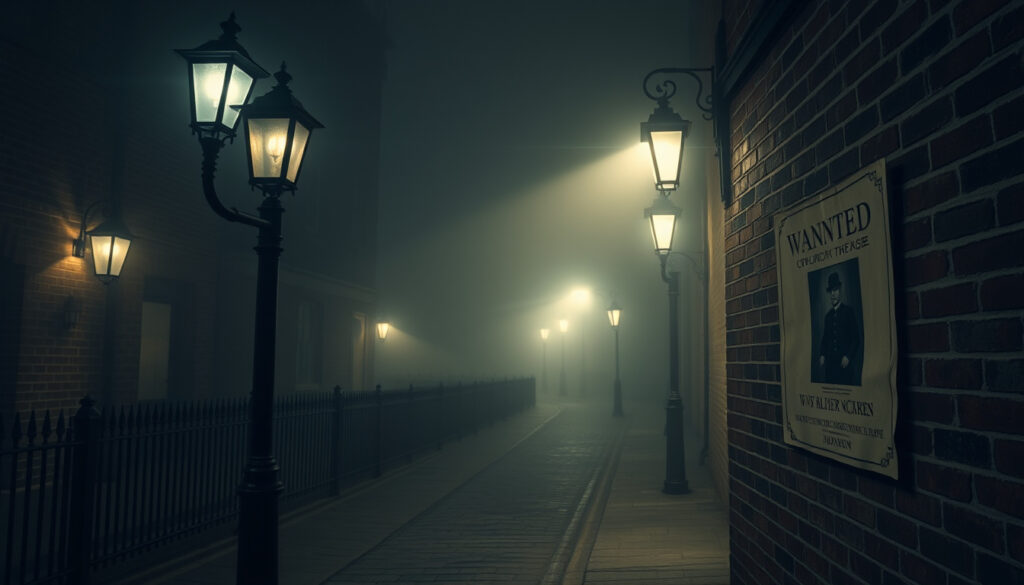
Jack Ripper: History, Victims, and Unsolved Mystery
More than 130 years after five women were killed in Whitechapel, the figure known as Jack the Ripper still haunts the imagination in a way almost no other criminal does. The case was never solved, and the space between documented fact and popular legend has only widened since. This article separates the record from the myths, introduces the five canonical victims, and explains why the killer was never caught.
Canonical Victims: 5 · Active Year: 1888 · Location: Whitechapel, London · Status: Unidentified · Duration of Attacks: August – November 1888
Quick snapshot
- The canonical five victims are Mary Ann Nichols, Annie Chapman, Elizabeth Stride, Catherine Eddowes, and Mary Jane Kelly (Encyclopaedia Britannica (reference publisher)).
- All five murders took place between 31 August and 9 November 1888 (BBC History (UK public broadcaster)).
- No one was formally charged, and the case remains officially unsolved, according to Wikipedia (open encyclopedia).
- The killer’s true identity has never been confirmed (Wikipedia (open encyclopedia)).
- Whether the “Dear Boss” and “From Hell” letters were genuine is still disputed by historians. (Wikipedia (open encyclopedia))
- No documented motive exists, and no verified reason explains why the murders stopped. (Wikipedia (open encyclopedia))
- 31 August 1888: Mary Ann Nichols murdered, the first canonical victim (Encyclopaedia Britannica (reference publisher)).
- 30 September 1888: Elizabeth Stride and Catherine Eddowes killed the same night — the “double event” (BBC History (UK public broadcaster)).
- 9 November 1888: Mary Jane Kelly killed; last canonical murder (Encyclopaedia Britannica (reference publisher)).
- The wider police file covered eleven killings between 1888 and 1891, so the victim-count debate stays open (Wikipedia (open encyclopedia)).
- More than 100 suspects have been proposed over the decades (Wikipedia (open encyclopedia)).
- The case is a live historical question, not an active police investigation. (Wikipedia (open encyclopedia))
The case rests on a surprisingly small set of agreed details; everything else is inference, rumor, or later reconstruction. That gap between documented fact and popular narrative is exactly where the Ripper legend was built.
| Fact | Detail |
|---|---|
| Real Name | Unknown |
| Active Period | 1888 |
| Canonical Victims | 5 |
| Location | Whitechapel, London, England |
| Murder Method | Knife (throat slash and abdominal mutilation) |
| Letters Sent | Two (Dear Boss, From Hell) |
| Status | Unsolved / Unidentified |
Who was Jack the Ripper after all?
Who was Jack the Ripper and what information is available about him?
- An unidentified serial killer active in Whitechapel, London, during 1888 (Encyclopaedia Britannica (reference publisher)).
- No arrest and no charge were ever made, according to Wikipedia (open encyclopedia).
- The public name came from a letter widely treated as a hoax (Encyclopaedia Britannica (reference publisher)).
Jack the Ripper is a label, not a biography. Police never found the person behind the murders, and no one was ever arrested. What survives is a thin documentary trail: inquest reports, police memos, witness statements, and two famous letters whose authenticity is still debated.
The canonical five — Nichols, Chapman, Stride, Eddowes, and Kelly — were linked by police and later historical convention as the work of one killer, but that attribution is not a solved case (Encyclopaedia Britannica (reference publisher)). The “five” became the standard list because it fits the documented timeline, not because a confession settled it.
Why is Jack the Ripper famous?
The most famous criminal of the Victorian era has no confirmed name, face, or biography: the fame rests entirely on the unsolved case and the name the press repeated.
The name was the engine of the legend. The “Dear Boss” letter, signed “Jack the Ripper” and received by the Central News Agency in 1888, turned an unknown attacker into a named monster — even though most historians read the letter as a hoax (Encyclopaedia Britannica (reference publisher)).
The Victorian press did the rest. Every new killing sold more papers, and by the time the case was closed unsolved in 1892, the name had outlived the chase (Wikipedia (open encyclopedia)). The implication: the Ripper is famous because the public watched an investigation fail in real time, with a marketable villain name attached — and the story never received an ending.
Why did Jack the Ripper start killing?
Who did Jack the Ripper target?
- All five canonical victims were women who worked as sex workers in Whitechapel (Encyclopaedia Britannica (reference publisher)).
- The attacks involved throat-cutting and, in most cases, abdominal mutilation.
- On 30 September 1888, two victims were murdered the same night — the “double event” (BBC History (UK public broadcaster)).
There is no documented motive for the Whitechapel murders. The theories offered since 1888 — personal trauma, severe mental illness, or misogyny — remain speculation because no suspect was ever tied to the evidence.
The victim profile is the strongest pattern the case offers: all five were women living and working on the margins of Whitechapel, and the attacks were exceptionally violent (Encyclopaedia Britannica (reference publisher)). The night of 30 September 1888 produced two murders — Elizabeth Stride and Catherine Eddowes, killed the same night in what police and historians call the double event (BBC History (UK public broadcaster)).
The double-event night is the clearest behavioral signal in the case: two killings in a single night show a killer growing more confident at the exact moment the investigation was getting more chaotic.
The pattern: the case gives us a motive question with no suspect to attach it to, so every generation reads its own fear into the killer.
How many kills did Jack the Ripper commit?
Who are the canonical five victims?
Canonical victims: 5 · Wider police file: 11 killings (1888–1891) · Last canonical murder: 9 November 1888
Five victims, one short season: the canonical list runs Mary Ann Nichols, Annie Chapman, Elizabeth Stride, Catherine Eddowes, and Mary Jane Kelly, with dates from 31 August to 9 November 1888 (Encyclopaedia Britannica (reference publisher); BBC History (UK public broadcaster)). Martha Tabram’s killing on 6 August 1888 appears below as a proposed but unconfirmed earlier case (BBC History (UK public broadcaster)).
| Victim | Date | Status in the case |
|---|---|---|
| Mary Ann Nichols | 31 August 1888 | First canonical victim |
| Annie Chapman | 8 September 1888 | Second canonical victim |
| Elizabeth Stride | 30 September 1888 | Third canonical victim; killed the same night as Eddowes |
| Catherine Eddowes | 30 September 1888 | Fourth canonical victim |
| Mary Jane Kelly | 9 November 1888 | Fifth and final canonical victim |
| Martha Tabram | 6 August 1888 | Proposed earlier victim; not part of the canonical five |
Why five and not more? The list was reinforced by two police-era documents — a letter from police surgeon Thomas Bond dated 10 November 1888 and an 1894 memorandum by Sir Melville Macnaghten — which helped fix the canonical set in later histories (Wikipedia (open encyclopedia)). The count debate has never closed: some researchers attach roughly a dozen murders between 1888 and 1892 to the same killer, while the wider Metropolitan Police file covered eleven killings between 1888 and 1891 (Encyclopaedia Britannica (reference publisher); Wikipedia (open encyclopedia)).
The catch: “five” is a historical convention, not a certified total; every candidate added to the list changes the shape of the case.
Why did Jack the Ripper call himself Jack?
How did Jack the Ripper get his name?
- The name first appeared in the “Dear Boss” letter, signed “Jack the Ripper” and received by the Central News Agency in 1888 (Encyclopaedia Britannica (reference publisher)).
- Most historians treat the letter as a hoax, likely the work of a journalist (Encyclopaedia Britannica (reference publisher)).
- The press adopted the name, and the public followed.
Before the letter, the press was covering the “Whitechapel murders” without a single culprit to name. The “Dear Boss” letter changed that: it ended with the signature “Jack the Ripper,” and the name was too memorable to drop (Encyclopaedia Britannica (reference publisher)).
The “From Hell” letter, sent to George Lusk, added to the mystique even though its authenticity is equally unproven. By then the name was already fixed in the public mind, and no later retraction could remove it. What this means: the most famous name in crime history probably came from a hoax, and the real killer may never have used it.
Why did Jack Ripper stop?
When did the Ripper stop killing?
Last canonical murder: 9 November 1888 · Case closed: 1892 · Reason for stopping: Unknown
The canonical series ended with Mary Jane Kelly on 9 November 1888 (Encyclopaedia Britannica (reference publisher)). After that, the killings that police linked to a single murderer stopped — but the case file did not close.
Theories for the stop include the killer’s death, imprisonment, relocation, or a deliberate choice to end the attacks. No evidence supports any one of them, according to Wikipedia (open encyclopedia). The police kept the file open for years, then closed it unsolved in 1892 (Wikipedia (open encyclopedia)). In practice, a sudden stop is as mysterious as the murders themselves: a killer who was never identified cannot be ruled out by an alibi, a death record, or a conviction. The trade-off: the lack of an explanation is itself evidence of how little the investigation ever pinned down.
Why was Jack Ripper never caught?
Did anyone see Jack the Ripper?
- Witnesses gave conflicting descriptions, and police never built one consistent profile, according to Wikipedia (open encyclopedia).
- The forensic tools that might have resolved the case — fingerprinting, blood analysis, DNA — did not exist in 1888 (Wikipedia (open encyclopedia)).
- The Metropolitan Police, City of London Police, and Whitechapel Vigilance Committee all worked the case, with mixed coordination (Wikipedia (open encyclopedia)).
Several people did report seeing a suspicious man near the murder sites, but the descriptions varied so widely that they confused the inquiry more than they helped it (Wikipedia (open encyclopedia)). Without trace evidence or a reliable identification, every sighting was uncorroborated.
The institutional picture was also messy. The murders crossed the boundary between the Metropolitan Police and the City of London Police, and the civilian patrols of the Whitechapel Vigilance Committee added another layer to an already complicated investigation (Wikipedia (open encyclopedia)).
Who is the biggest suspect of Jack the Ripper?
More than a century later, the leading suspects are still names on a list, not convictions: each was proposed, investigated, and never confirmed as the killer.
More than 100 suspects have been proposed over the decades; three names recur most often in popular histories, and all three share the same problem (Wikipedia (open encyclopedia)).
| Suspect | How the name surfaced | Why it remains unproven |
|---|---|---|
| Montague Druitt | Listed among the prime suspects in later histories | Never charged; modern forensics has not confirmed him |
| Aaron Kosminski | Listed among the prime suspects in later histories | Never charged; modern forensics has not confirmed him |
| George Chapman | Listed among the prime suspects in later histories | Never charged; modern forensics has not confirmed him |
| More than 100 additional candidates | Proposed by historians, writers, and researchers over the decades | None produced conclusive evidence or a conviction |
None of these names is a solution. Because no physical evidence links any suspect to the crime scenes, each candidacy rests on timing, proximity, or character — not on proof (Wikipedia (open encyclopedia)).
Timeline: the Whitechapel murders
Eight months of fear, five murders, and one closed file: the dates below show how quickly the case escalated and how suddenly it ended.
- — Mary Ann Nichols murdered; first canonical victim (Encyclopaedia Britannica (reference publisher)).
- — Annie Chapman murdered (BBC History (UK public broadcaster)).
- — Elizabeth Stride and Catherine Eddowes murdered the same night; the “double event” (BBC History (UK public broadcaster)).
- — Mary Jane Kelly murdered; last canonical victim (Encyclopaedia Britannica (reference publisher)).
- — Police investigation continues across the wider Whitechapel file (Wikipedia (open encyclopedia)).
- — Case officially closed unsolved (Wikipedia (open encyclopedia)).
The pattern: the entire known series fits into ten weeks; after that, the case goes quiet without a resolution.
Confirmed facts vs. what’s unclear
Confirmed facts
- Five canonical murders occurred between 31 August and 9 November 1888 (Encyclopaedia Britannica (reference publisher); BBC History (UK public broadcaster)).
- All five victims were women working as sex workers in Whitechapel.
- The killer was never identified, and no one was formally charged, according to Wikipedia (open encyclopedia).
- The name “Jack the Ripper” came from the “Dear Boss” letter (Encyclopaedia Britannica (reference publisher)).
- The murders stopped after November 1888.
What’s unclear
- The killer’s true identity.
- Whether the “Dear Boss” and “From Hell” letters were genuine.
- The exact number of victims.
- The reason the killer stopped.
- The killer’s motive.
- Whether any witness saw the killer clearly.
The balance is telling: the confirmed list is short, and the uncertain list is longer — a structure that keeps the case permanently open.
Voices from the case
The case produced few reliable words from the killer and even fewer from the police; the documents that survive speak in fragments.
“Jack the Ripper”
Author of the “Dear Boss” letter, 1888 — received by the Central News Agency
“From hell”
Author of the “From Hell” letter, 1888 — sent to George Lusk
“The five canonical murders were linked by police and later historical convention as the work of one killer, but the attribution is not equivalent to a solved case.”
Encyclopaedia Britannica (reference publisher) — on the canonical five
The silence in these voices is the point: no credible confession, no reliable eyewitness, no verified killer.
The takeaway
The Jack the Ripper case is a warning about what happens when fear, a hungry press, and pre-forensic policing collide. The documented record is narrow — five murders, two disputed letters, zero convictions — while the speculative record is enormous, and the two have blurred into one public memory. For modern true-crime readers, the discipline is clear: treat the canonical five as a starting point, not a verdict, or the Ripper will keep becoming whoever each storyteller needs him to be.
Frequently asked questions
Was Jack the Ripper on the Titanic?
No. The Titanic sank in 1912, more than two decades after the 1888 murders, and no primary source connects the two. The myth comes from later fiction and internet lore, not from the case files.
Did Jack the Ripper have children?
Unknown. Because the killer was never identified, no confirmed biography exists; any claim about his children is speculation.
How old would Jack the Ripper be if he was still alive?
Precisely impossible to say, since his identity is unknown. Anyone alive in 1888 would be well over 130 years old today, so the question is hypothetical.
What was Jack the Ripper’s real name?
Unknown. None of the names on the long suspect list has ever been conclusively tied to the murders (Wikipedia (open encyclopedia)).
What was the cause of death for Jack the Ripper?
Unknown. The killer’s fate — death, imprisonment, or relocation — remains one of the case’s open questions (Wikipedia (open encyclopedia)).
Why do people still care about Jack the Ripper?
The case combines an unsolved series of murders, a media-created name, and victims pushed to the margins of Victorian London — a combination that keeps the mystery alive.
Related reading
Two related pieces from the same archive: one on another crime figure buried in legend, one on separating biography from myth.
More related posts
 LaMelo Ball: Height, Trade, Net Worth & Lawsuit (2025)
 Fara Williams: Career, Partner, Net Worth & Biography
 Roald Dahl Books: Guide to Life, Works, Darkest Stories
 Mara Wilson: From Child Star to Writer and Mental Health Advocate
 Ella Langley: Verified Biography, Career & Relationship Facts
 Francis Bacon: Philosopher, Artist, and Lasting Legacy
 Nat West Log In – Step-by-Step Online Banking Guide