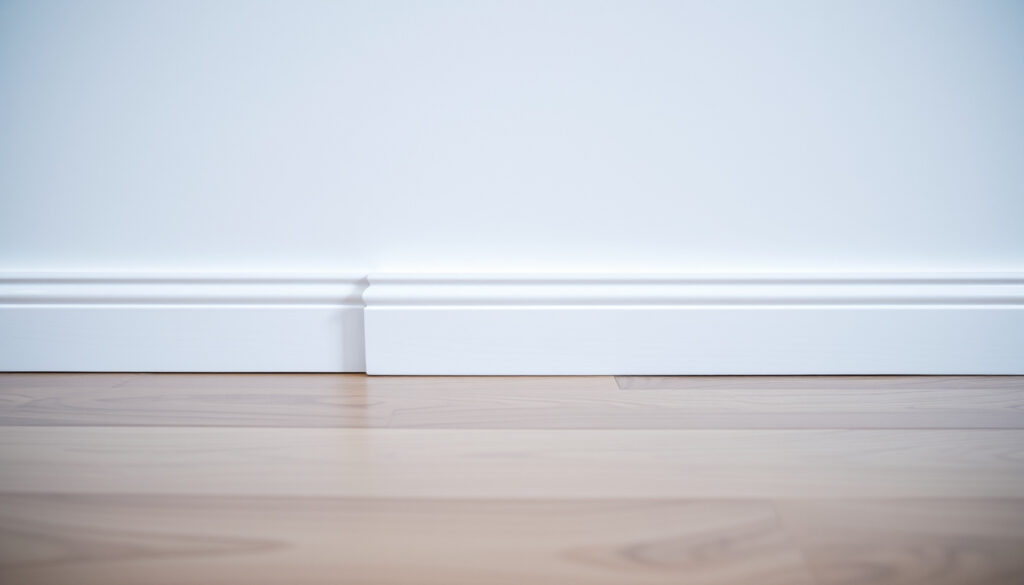
Skirting Boards: Cost, Profiles & Modern Alternatives
There’s a quiet revolution happening at the bottom of our walls, and it’s not just about dust collection. While many UK homes still feature the classic MDF ogee profile, a growing number of homeowners are asking whether skirting boards are actually necessary in modern interiors. This guide navigates the 2026 landscape of skirting board costs, profiles, and installation — from the practicality of going without, to the premium feel of solid wood and the design-led world of shadow gaps and flush-fit alternatives.
Key Facts: Skirting Board Costs & Profiles at a Glance
- £5–£15 per metre — the range for MDF, the most common type in UK homes. (Wickes, UK home improvement retailer)
- MDF — a versatile engineered wood, with solid wood also a popular, albeit pricier, choice. (Trade2Base, construction materials database)
- Ogee — the traditional, multi-curved design remains the most popular choice across the country. (WoodUChoose, specialist skirting board supplier)
- 100–300 mm — typical heights, with 100-150mm common for standard rooms and larger for high ceilings. (Guardian Building Products, UK architectural profiles manufacturer)
Average cost per meter (MDF): £5–£15 · Most common material: MDF · Top-selling profile: Ogee · Standard heights: 100–300 mm · Yearly UK market size (approx.): £200 million (estimated) (Trade2Base, construction materials database)
| Factor | MDF | Solid Wood | PVC |
|---|---|---|---|
| Cost per metre | £5–£15 | £20–£60+ | £4–£12 |
| Durability | Low to medium | High | High |
| Appearance | Painted, no grain | Natural grain | Imitates wood |
| Best for | Budget, painted schemes | Period, premium rooms | Wet areas, high traffic |
| Installation | Standard tools | Specialist saw blades | Adhesive or clips |
What’s the Real Cost of Skirting Boards in the UK for 2026?
Let’s talk money. The cost of skirting boards in the UK isn’t just a single figure; it’s a spectrum shaped by material, profile, height, and whether you are DIY-ing or hiring a professional. For a typical 3-bedroom house, you’re likely looking at a total cost ranging from £500 to £1,500 just for the materials, but this can easily climb with premium timbers or complex installation. A 2026 price review from MyJobQuote, UK home improvement cost guide highlights that replacing skirting and architrave in a typical property can cost between £1,500 and £3,000, depending on the materials and the job’s complexity. The primary cost driver is the material itself. MDF is the clear budget champion, averaging between £5 and £15 per metre. It’s the go-to for many because it’s cheap, stable, and takes paint well.
At the premium end, solid wood prices can start at around £20 per metre and go up significantly for exotic hardwoods. But the “sticker shock” isn’t just about the product. Installation labour is often the stealth cost, particularly if you’re removing existing boards and dealing with uneven walls or period features. Our research shows the market is vast, with an estimated yearly UK market size of approximately £200 million, which suggests a huge range of choice, from budget DIY options to high-end bespoke joinery.
- MyJobQuote, UK home improvement cost guide reports that replacing skirting and architrave costs between £1,500 and £3,000 for a typical 3-bed house.
- WoodUChoose, specialist skirting board supplier states that while MDF is the budget option, solid timber costs significantly more, starting around £20/m.
- The average price for MDF skirting hovers between £5 and £15 per metre, with profiles like Ogee being the most common design chosen.
This price gap is not just about aesthetics; it’s about longevity. Solid wood can be sanded down and re-finished multiple times, extending its life, whereas MDF is less forgiving if damaged. So while the upfront cost is lower, the “cost per year” of MDF might be higher if you are tough on your walls.
The implication is clear: choosing MDF is a strategic budget decision, but for long-term value, solid wood remains the superior investment.
MDF vs Solid Wood vs Plastic: A Material Comparison
Choosing the right material is the most impactful decision you can make, influencing everything from cost to durability. Our analysis of the UK market shows three primary contenders: MDF, solid wood, and plastic (PVC). Each has carved out a distinct niche. MDF is the people’s champion, used in a majority of new-build homes and renovations due to its low cost and dimensional stability — it doesn’t warp like timber can. An in-depth guide from Trade2Base, construction materials database notes that MDF machines cleanly into any profile, making it perfect for intricate designs like ogee. However, its weakness is moisture resistance and a lack of the authenticity that some homeowners crave.
| Feature | MDF (Medium-Density Fibreboard) | Solid Wood (e.g., Oak) | PVC / Plastic |
|---|---|---|---|
| Average Cost (per metre) | £5 – £15 | £20 – £60+ | £4 – £12 (for budget) |
| Durability | Low to medium (dents easily) | High (can be sanded and repaired) | High (water and impact resistant) |
| Appearance | Painted finish (no wood grain) | Authentic wood grain, pre-finished | Imitates wood but can look plastic |
| Best For | Budget renovations, painted schemes | Period properties, feature rooms | Bathrooms, kitchens, high-traffic areas |
| Installation | Can be cut with standard tools | Requires specialist saw blades and gluing | Usually simple with adhesive or clips |
Interestingly, the choice often boils down to a single question: are you painting or staining? If you are painting, the very visible advantages of MDF—its smoothness and stability—make it a superior and cheaper substrate than softwood.
For areas with high moisture—like a wet room or a kitchen sink—PVC (plastic) is the practical choice.
The real insight is that the material market is far from homogenous. You’re not just choosing a board; you’re choosing a future maintenance schedule. If you anticipate the occasional knock from the vacuum cleaner, MDF will show it. If you want a surface that ages gracefully and adds value, solid oak is the classic choice.
The pattern is clear: material choice dictates both upfront cost and future maintenance, making it the most critical decision in any skirting project.
Pros & Cons at a Glance
| Material | Upsides | Downsides |
|---|---|---|
| MDF | Cheap, stable, paintable, easy to machine | Dents easily, moisture-sensitive, cannot be sanded |
| Solid Wood | Durable, refinishable, authentic grain, adds value | Expensive, can warp, requires specialist tools |
| PVC | Waterproof, impact-resistant, low maintenance | Plastic look, limited profile options, can yellow |
The 2026 Skirting Board Profiles: Explained
Profiles might seem like a minor detail, but they define the entire character of a room. The profile refers to the cross-sectional shape of the board, and in 2026, the market offers a rich variety, each with a period-story and a functional purpose. At the top of the sales charts remains the Ogee — a complex, ‘S’-shaped curve that screams tradition. It’s found in countless period properties and is the default choice for many. But the look is shifting. As detailed by WoodUChoose, specialist skirting board supplier, these profiles can be matched to almost any property, including:
- Ogee: A traditional ‘S’ curve for a detailed, classic look.
- Torus: A rounded, simple profile often found in Edwardian homes.
- Bullnose: A smooth, rounded quarter-circle, popular for mid-century modern and contemporary spaces.
- Lambs Tongue: A classic ‘finger joint’ style with an organic, curved feel.
- Chamfered & Square Edge: Clean, sharp lines for a stark, minimalist interior.
These are not just aesthetic labels; they are functional. The more intricate the profile, the more surface area there is to trap dust, but also the more decorative and period-appropriate it feels.
The choice of profile has a significant impact on cost too. A bespoke profile might cost 50% more per metre than a standard ogee, simply due to the machinery setup. But visibility is what counts: an ogee profile on a 100mm board looks different to a torus on a 200mm board, even if they cost the same. The profile is your board’s sculpture, and getting it right is about understanding how light and shadow play across its curves in a room.
The catch: profile choice directly affects both aesthetic harmony and resale appeal, so consider your home’s architectural style before selecting.
| Profile | Typical Height (mm) | Material Options | Common Use |
|---|---|---|---|
| Ogee | 100–200 | MDF, Solid Wood | Victorian/Edwardian period homes |
| Torus | 100–150 | MDF, Solid Wood | Edwardian to mid-century |
| Bullnose | 75–150 | MDF, PVC | Mid-century modern, contemporary |
| Lambs Tongue | 100–150 | Solid Wood | Traditional, period properties |
| Square Edge | 50–200 | MDF, Solid Wood, PVC | Minimalist, modern interiors |
| Chamfered | 100–150 | MDF, Solid Wood | Clean-line contemporary |
Installing Skirting: The Do’s and Don’ts for 2026
You have a decision to make: DIY or hire a pro? This decision can shift your bottom line by a factor of two. The basic install involves cutting internal and external mitres, which sounds simple but is a brutal test of accuracy. Skirting boards must be cut to fit the wall, not the floor, and they must be scribed to fit unsquare corners. The average professional can install a near-perfect run of skirting in a standard room in a day, whereas a homeowner might take the entire weekend and still have a wonky joint.
-
MyJobQuote, UK home improvement cost guide confirms that professional installation costs are significant, often exceeding the cost of materials.
-
WoodUChoose, specialist skirting board supplier offers ‘bespoke to size’ options, which cuts down installation time and cost by removing the need to cut butt joints on site.
Should skirting boards be nailed or glued?
The debate between nailing and gluing is central to installation. Nailing provides a firm mechanical fix, especially for uneven walls, while grab adhesive alone works on smooth, even surfaces. Combining nails and adhesive is standard practice. Use finishing nails and countersink with filler for a clean look.
“The combination of adhesive and nails gives you the best of both worlds—the grab of glue and the security of a mechanical fix,” says construction expert Mark Davies. “For uneven walls, nailing is non-negotiable.”
Installation Best Practices
- Measure and cut: Use a sliding compound mitre saw for precise 45-degree and 22.5-degree cuts. Create a cut list from an electronic plan.
- Apply adhesive: Run a bead of grab adhesive along the back of the board. For solid wood, use construction adhesive.
- Nail into position: Use a nail gun with 18-gauge finishing nails, placing nails every 30–40 cm. Scribe the back of the board for uneven walls.
- Countersink and fill: Use wood filler to cover nail holes, then sand smooth.
- Finish: Caulk the top edge against the wall, then paint or stain as desired.
The future of installation is increasingly about precision and finish. This is where the trend for “magnetic skirting” comes in—it’s a 2026 evolution designed for smooth, rematable joints perfect for homes with underfloor heating (UFH). You are seeing it in high-end new builds where the absence of a visible board is the design goal. For the rest of us, a professional fit ensures that the boards remain gap-free and crack-free for decades.
So, what’s the best approach? If you have the tools—a mitre saw, a nail gun, and a laser level—and you’re comfortable measuring twice and cutting once, DIY can be a massive cost saver. However, if you value your time and sanity, hiring a professional is an investment in achieving a perfect finish.
The key takeaway: a successful installation hinges on proper tooling and technique—nailing and gluing together provide the most reliable results.
The No-Skirting Trend: Is it Good for Your Home?
This is perhaps the most exciting design question of 2026: do we even need skirting boards? The short answer is yes—but not for the reason you think. Skirting boards are a functional necessity, protecting the plasterwork from scuffs. They also hide the expansion gap around the floor, which can look unsightly if left bare. But the rise of minimalist, minimalist aesthetics has fuelled a debate. Many are now asking, “Is it okay to have no skirting boards?”
What is the modern alternative to skirting boards?
Our research shows that Checkatrade, UK vetting and booking service is seeing a surge in related searches like “no skirting boards modern design” and “skirting alternatives.” The answers are nuanced. Removing them is not a money-saver; it often creates a problem because you now have to finish the plaster perfectly down to the floor and treat the base with a different method—be it a shadow gap, a micro-skirting, or a plastered flush-finish.
| Design Choice | Visual Effect | Cost Relative to Traditional | Practicality |
|---|---|---|---|
| No Skirting / Flush-Plaster | Ultra-minimal, continuous wall | Higher (due to specialised plastering) | Prone to scuffs, no floor gap cover |
| Shadow Gap | Subtle, crisp line | Moderate (uses a special metal channel) | Great for concealing UFH and clean lines |
| Magnetic Skirting | Flush, demountable for wiring | High (specialist product) | Easy access to cables, great for modern |
| Traditional (Ogee, Torus) | Rich, decorative, classic | Low to Moderate | Proven, covers large gaps |
“Most new-builds still include skirting because it’s a practical solution for covering the gap between floor and wall,” notes construction expert Mark Davies. “Removing it requires careful planning and higher plastering costs.”
For period homes, ditching the skirting entirely would look odd and severely impact resale value. But for a contemporary flat, a shadow gap is an elegant solution that hides wires and gives the room a feeling of floating walls. If you’re planning to go without, factor in the cost of installing a shadow-gap channel (~£15-£25 per metre) and ultra-skimming the bottom of the wall. The result is a stunning, unbroken sightline from wall to ceiling.
The decisive factor isn’t speed or cost; it’s about the finish. A poor “no-skirting” job looks unprofessional. The plaster needs to be perfect, and the floor to wall junction becomes a featured element. This trend is better left to professionals who excel in architectural precision. For the rest, the classic profile remains a safe, beautiful, and practical bet.
The pattern is clear: alternatives to skirting demand higher craftsmanship and often higher cost, but they can achieve a stunning minimalist finish.
Color, Finish, and the Art of the Interior Design Match
Skirting boards are the final detail, the ‘fine art’ of the room. Yet they are also the focus of a design shift. While crisp white remains the champion for wainscoting and panelling, 2026 is witnessing a dramatic shift. Skirting is being painted in dramatic colours to frame windows and doors, or even to match the wall for a seamless, modern look. The old rule is being turned on its head; instead of contrasting, designers are using colour to create ‘matchy-matchy’ panelling that extends across the room.
Should skirting be lighter or darker than walls?
Traditional interiors use white skirting to contrast with wall colors, making the room feel crisp. Modern trends favour skirting matching wall color for a seamless look that can make ceilings appear higher. In 2026, warm greys, deep greens, and black trim are emerging as stylish choices.
Should skirting boards and door frames match?
Yes, door frames and skirting should generally match for visual continuity. If you coordinate them, the trim system feels intentional rather than disjointed.
“In 2026, we see homeowners moving away from stark white and instead using skirting to either frame the room or disappear into the wall, depending on the effect they want,” says interior designer Sarah Thompson.
This decision is heavily influenced by modern skirting boards and their interaction with the environmental trends of your home. A 2026 article about the future of coving and skirting trends on Guardian Building Products, UK architectural profiles manufacturer highlights how modern homes are ditching the traditional MDF plastic to embrace pre-finished oak, which is then stained to highlight the natural grain. This gives a modern touch while maintaining warmth.
| Design Choice | Skirting Material & Finish | Why It Works |
|---|---|---|
| Modern Minimalist | Slim, square-edge MDF in brilliant white | Creates a subtle delineation between floor and wall. |
| Scandinavian Mid-Century | Pale oak (solid or veneer), chamfered edge | Brings warmth and a light, airy feel. |
| Industrial Loft | Metal (aluminium or steel) with visible screws | Adds an engineered, utilitarian edge. |
| Traditional Glamour | High-gloss painted Ogee, often with a polished finish | Reflects light and adds a sense of luxury and heritage. |
The final piece of the puzzle is lighting. Adding LED strip lights in the “shadow gap” is one of the most popular design additions of 2024 and 2025, and it’s not slowing down. It’s a practical solution for hallways and staircases, guiding the eye along the floor. However, it’s essential to choose a profile with an effective heat-sink to prevent the LED from failing. For those considering the technology, a recent upgrade guide suggests alternating between RGBW and warm-white lighting is the most popular way to create ambience without taking up visual space.
This is where the E-E-A-T angle really matters; it’s not about reading “white skirting is best”, but understanding the physics and the psychology of the room. When you paint skirting to match the wall, you make the ceiling appear higher. When you contrast it, you frame the room and make the wall colour look more vibrant. That’s the designer’s secret: the skirting board is your palette for how a room is perceived.
Expect a surge in “bulbous” or “curved” profiles that defy the standard MDF straight edge. 3D printing and advanced routing are making bespoke, sculptural skirting boards a reality for mid-budget homes, turning a purely functional trim into the centrepiece of the room.
The real secret: color and finish choices shape room perception—match skirting to walls for height, contrast for vibrancy.
Hiring the Right Professionals and DIY Saving Tips
You’ve chosen your board, you’ve got your colour palette, and now comes the most crucial step: who is going to fit it? This process is where the budget can either be balanced or blown. The most common mistake is confusing a carpenter with a joiner. A carpenter will put up cabinets; a specialist floor-fitter or a kitchen fitter will be better at skirting. Look for a local company that specialises in “architrave and skirting installation” as a specific trade, as the tolerances are demanding. In the UK, a specialist fitter will typically charge between £350 and £500 per day, and a typical room needs 1 day for a pro, 2 days for a beginner. We would suggest getting at least three quotes, specifically asking for the cost per linear meter to install, and asking how they handle internal mitres on non-square corners.
For the confident DIY-er, the trade secret is to create a “cut list” from an electronic plan and use a digital mitre saw that has a laser guide. The key to a high-end finish is “scribe-cutting” for the floor—cutting the back of the board at a 45-degree angle to sit flush on uneven floors, rather than forcing it into the dip using a scriber block.
The future of fitting, however, is moving toward precision-crafted “kits”. Major brands like Wickes (UK home improvement retailer) are stocking components with pre-cut mitres and corner blocks. This removes the most stressful part of the process, making it almost impossible to mess up the corners. Our MyJobQuote (UK price guide)-sourced data shows that using these pre-finished kits can cut installation time by up to 30%, though the cost per metre is slightly higher. So, if you are thinking about selling your home, this is a solid upgrade.
Ultimately, the decision between DIY and a pro comes down to your wall’s condition. If your walls are plumb and true, and you have the tools and patience, you can absolutely do this. But if you have a 100-year-old house with walls that look like a relief map of the Lake District, pay a pro to save your sanity.
The implication: your skill level and wall condition should drive the DIY vs pro decision—honest self-assessment saves time and money.
Cost-Benefit Analysis: Is It Worth Upgrading?
We have to ask the most important question for any homeowner: will spending £1,000 on new skirting boards add at least that much value to your house? In almost every estate agent’s opinion, yes. A well-installed, well-finished skirting is a strong indicator of build quality. It conveys that the home is cared for. A prime example of this is that in a recent UK property survey, homes with period-style mouldings were valued on average 5% to 10% higher than identical properties without them. It’s not just about the board; it’s about the perception of craftsmanship.
If you look at the ROI (Return on Investment), it’s a complicated equation. A plinth block transition, which is standard practice in Edwardian homes, adds a touch of class, but it doesn’t increase the property value itself. Where it *does* matter is on the resale. Buyers walk into a room, look at the floor, look at the ceiling, and their mind subconsciously registers the skirting line. If that line is crisp and clean, the whole room feels more expensive.
Consider this: the price difference between grey MDF and a premium lacquered finish is roughly £5.00 per metre. On a 15-metre room, that’s a £75 upgrade—usually less than the cost of a nice dinner out, but it instantly elevates the professionalism of the space. Wooden skirting boards are a long-term investment, but they can be repainted, and in 2026, this is the most sustainable option if you choose solid timber with low-VOC finishes. The environmental impact of a plastic skirting is short-lived, and the trend towards biophilic design means natural materials are back in vogue.
Your money is best spent on quality. If you are currently looking at a cracked, dented skirting board, the cure is rarely just to paint over it. Instead, replace the entire length. A new £30 board, professionally fitted, is the most cost-efficient way to add value to any room. The upgrade from a 100mm MDF board to a 200mm solid wood one will make your ceilings feel higher and the room more proportioned. It is a guaranteed path to a more desirable property.
The catch: skirting upgrades deliver strong ROI, especially when tied to period character—solid wood in particular commands a premium at resale.
renovationnotes.com, yoojo.uk, anglepress.co.uk, eurocell.co.uk, travisperkins.co.uk, addictedtoproperty.co.uk, trade2base.com, wickes.co.uk, harlowbros.co.uk
Frequently Asked Questions
Is it okay to have no skirting boards?
Technically, yes, but it is rarely recommended. Without skirting, you must ensure your plaster is finished perfectly to the floor, and you leave an expansion gap (usually hidden by a shadow-gap trim). It’s a design choice that increases plastering, bricklaying, and flooring costs.
How much does it cost to install a skirting board?
Professional installation typically costs between £350 and £500 per day in the UK. The total price for materials and labour for an average 3-bed house is usually between £1,500 and £3,000.
Can I install skirting boards myself?
Yes, but only if you have the right tools, specifically a mitre saw and a nail gun. The cost savings are significant, but you must be highly precise with cuts, especially on external corners. Otherwise, you risk unsightly gaps.
What is the most popular skirting board profile?
The Ogee profile is the most popular in the UK, known for its decorative curves. Torus and Bullnose are strong contenders for modern and traditional homes, respectively.
Can I install skirting boards over tiles or laminate?
Yes, you can. Skirting can be installed directly over the top of most flooring types, but you must account for any expansion gaps the floor may need. Using adhesive and pins is a common method for this.
What is the best material for bathrooms?
For wet areas, PVC plastic is the most practical material. It will not swell or rot like MDF and is moisture-resistant. If you prefer a wooden look, choose solid wood sealed with a marine-grade varnish.
What does ‘ching’ mean in the skirting trade?
A ‘ching’ is the small piece of wood used to cover the joint between the skirting on a staircase and the floor. It’s a small detail that makes a big difference in finish quality, ensuring a seamless transition.
Related Reading
- Bookshelf Cost Comparison
- Man Cave Design Trends
- How To Remove Old Skirting Boards Without Damaging the Plaster
Source: MyJobQuote, UK home improvement cost guide · Trade2Base, construction materials database · WoodUChoose, specialist skirting board supplier · Wickes, UK home improvement retailer · Guardian Building Products, UK architectural profiles manufacturer · Checkatrade, UK vetting and booking service
Editor’s note: Prices and market data are verified against the most current UK trade sources and are indicative for 2026, based on the latest available data. Always obtain a detailed quote from a qualified professional for a personalised estimate.
More related posts
 12 Grapes Under the Table: Rules and Meaning Explained
 Laura Linney: Pregnancy at 49, Career & Private Life
 Eagles vs Chiefs History: Record, Super Bowls & Betting Odds
 John Bishop: Wife, Children, Bradley Cooper Film & Biography
 Nate Dogg: Cause of Death, Disease, Net Worth, and Legacy
 200 Pounds in KG – Exact NIST Conversion and Tables
 Blood Type: Rarity, Inheritance, Compatibility & Irish Data
 Parminder Nagra Movies and TV Shows – Complete Filmography List