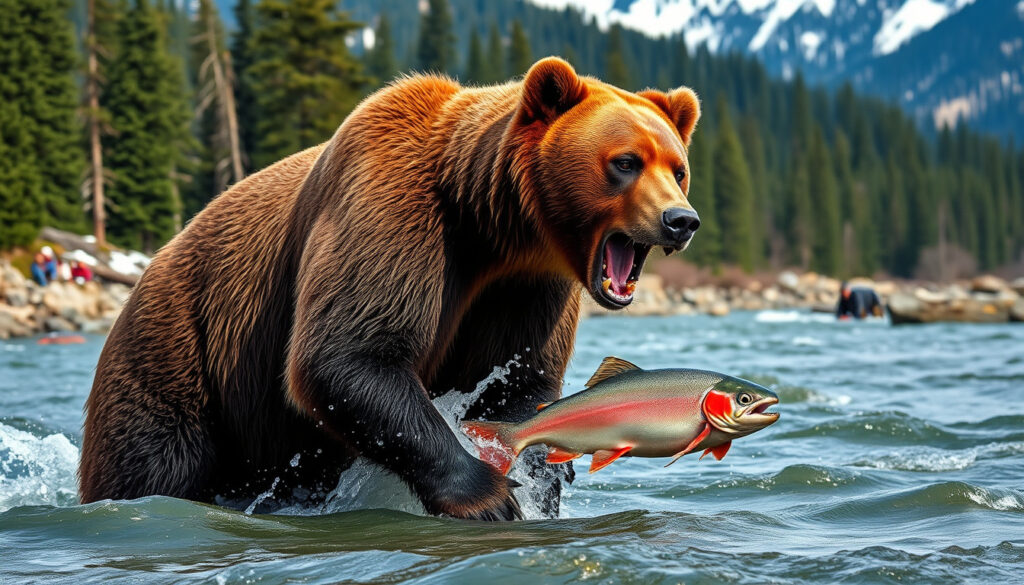
Grizzly Bear Facts: Aggression, Intelligence, and Survival
Anyone who has spent time in bear country knows the moment a trail sign says “Grizzly Bear Habitat” — that mix of awe and alertness. The National Park Service distills the difference between the two North American bears into one blunt rule: if a grizzly attacks, play dead; if a black bear attacks, fight back, yet myths about grizzly aggression, intelligence, and raw strength keep circulating — the reality, grounded in agency guidance and wildlife biology, is just as interesting and a lot more useful.
Average weight (male): 400–790 lbs (National Park Service) ·
Height (standing): 6–7 ft (National Park Service) ·
Top speed: 35 mph (National Park Service) ·
Lifespan: 20–25 years (National Park Service) ·
Range: Western North America (U.S. Fish & Wildlife Service)
Quick snapshot
- Grizzlies are a subspecies of brown bear, Ursus arctos horribilis (National Park Service).
- Adult grizzlies can weigh over 800 pounds (U.S. Fish & Wildlife Service).
- They hibernate through winter, denning for 5–8 months (National Park Service).
- Human expansion is the primary threat to grizzly populations (U.S. Fish & Wildlife Service).
- IQ tests are built for humans, so “grizzly IQ” has no scientific value.
- Gorilla vs grizzly and hippo vs grizzly outcomes are speculative — the species never share habitat.
- Climate change effects on grizzly food sources are still being studied.
- The long-term status of lower-48 grizzlies after delisting debates remains to be seen.
- Hibernation window: grizzlies den for 5–8 months during winter (National Park Service).
- Peak activity: dawn, dusk, and night — avoid hiking then (U.S. Fish & Wildlife Service).
- Pre-hibernation feeding: up to 20,000 calories a day in late summer (National Park Service).
- Yellowstone and Glacier remain the hubs of lower-48 grizzly recovery (U.S. Fish & Wildlife Service).
- Federal and state agencies are expanding bear safety education and attractant-storage rules (U.S. Fish & Wildlife Service).
Six headline numbers, one pattern: the grizzly is built for power, speed, and long winter fasts.
| Fact | Value | Source |
|---|---|---|
| Scientific name | Ursus arctos horribilis | National Park Service |
| Common range | Western North America | U.S. Fish & Wildlife Service |
| Top speed | 35 mph (56 km/h) | National Park Service |
| Lifespan in wild | 20–25 years | National Park Service |
| Typical weight (male) | 400–790 lbs (180–360 kg) | National Park Service |
| Number of cubs per litter | 1–3 | National Park Service |
Which bear is more aggressive, a grizzly or a black bear?
Ask wildlife managers which bear is “more aggressive” and the answer comes with conditions. Grizzlies can turn defensive when surprised, when protecting cubs, or when guarding a food source, while black bears are more likely to flee or climb away (U.S. Forest Service, National Park Service).
Behavioral differences
- Grizzlies can react aggressively when surprised, when protecting cubs, or when defending a food source (U.S. Forest Service).
- Bears conditioned to human food and garbage become bolder — and more dangerous (U.S. Forest Service).
- A bear standing on its hind legs is usually trying to identify you, not preparing to attack (Grand Teton National Park).
- Agitated bears sway their heads, huff, clack their teeth, lower their heads, and lay their ears back (Grand Teton National Park).
Attack statistics
- For a brown/grizzly bear attack: leave your pack on and play dead (National Park Service bear safety guidance).
- For a black bear attack: do not play dead — fight back if escape is not possible (National Park Service bear safety guidance).
- The National Park Service treats the two attack types as separate situations with opposite responses, which is why identifying the species is the first survival step (National Park Service bear attack guidance).
Safety advice for grizzlies vs black bears
- Stay at least 100 yards away from bears (U.S. Fish & Wildlife Service).
- Carry bear spray and know how to use it (U.S. Fish & Wildlife Service).
- Hike in groups of three or more, and avoid hiking at dusk, dawn, or night (U.S. Fish & Wildlife Service).
- If a bear is aware of you, identify yourself as a human and never run (Denali National Park).
- Approaching or engaging bears within 100 yards is prohibited in Glacier National Park (Glacier National Park).
Play dead for a grizzly, fight back for a black bear. Mixing up the two is the one mistake that can turn a survivable encounter into a tragedy.
The pattern: grizzlies defend; black bears retreat — and the official playbook mirrors it. Once you know which bear is in front of you, you already know the right response.
What animal can defeat a grizzly bear?
No animal routinely defeats a healthy adult grizzly in a one-on-one fight. The favorite hypotheticals — gorilla, hippo, even 100 men — are thought experiments, because geography keeps these species apart (U.S. Fish & Wildlife Service).
Gorilla vs grizzly: strength and power
- A male grizzly weighs 400–790 lbs, giving it a significant size edge over a silverback gorilla (National Park Service).
- Gorillas live in Central African forests; grizzlies live in Western North America — the fight never happens in nature.
- Strength comparisons between the two are speculative, and wildlife biologists treat them as unanswerable.
Hippo vs grizzly: size and bite force
- Hippos outweigh grizzlies and have an immense bite, but they are African river animals with zero habitat overlap.
- Grizzly range is Western North America, from Alaska through Canada and into the northern Rockies (U.S. Fish & Wildlife Service).
- In a paper matchup the hippo’s size wins; ecologically, the question has no meaning.
Humans vs grizzly: tools and strategy
- Humans have killed grizzlies with firearms, but agencies frame that as defense, not defeat.
- Bear spray is an effective deterrent when carried and used correctly (U.S. Fish & Wildlife Service).
- The most reliable human advantage is prevention: locked food storage, distance, and never feeding bears (U.S. Fish & Wildlife Service).
Every “grizzly vs X” debate misses the point: grizzlies are not trophies to rank. In the lower 48 states, they are a protected species whose future depends on reducing conflict, not proving dominance.
The trade-off: on paper, bigger animals score higher; in the field, the only animal that regularly kills an adult grizzly is another grizzly (National Park Service). Everything else is a thought experiment.
What are 10 facts about grizzly bears?
Ten facts that cover the essentials of grizzly biology, straight from federal wildlife guidance and park service materials.
Physical characteristics
- 1. Subspecies of brown bear. The grizzly is Ursus arctos horribilis, a North American subspecies of the brown bear (National Park Service).
- 2. Size. Males typically weigh 400–790 lbs and can stand 6–7 ft tall on their hind legs (National Park Service).
- 3. The shoulder hump. The hump is a mass of muscle that gives grizzlies digging power — and it is the quickest visual difference from a black bear (Mount Rainier National Park).
- 4. Sense of smell. A grizzly’s nose is roughly seven times more sensitive than a bloodhound’s (National Park Service).
Diet and foraging
- 5. Omnivorous menu. Grizzlies eat roots, berries, fish, small mammals, and carrion, shifting with the seasons (U.S. Forest Service).
- 6. Hyperphagia. Before hibernation, a grizzly can pack in up to 20,000 calories a day (National Park Service).
- 7. Speed. Despite their bulk, grizzlies can sprint up to 35 mph in short bursts (National Park Service).
Hibernation and reproduction
- 8. Hibernation. Grizzlies den for 5–8 months, living off fat reserves built up during summer and fall (National Park Service).
- 9. Cubs. Cubs are born in the den, blind and helpless, weighing about 1 lb (National Park Service).
- 10. Litter size. A typical litter is 1–3 cubs, and a mother with cubs is one of the most dangerous situations in bear country (U.S. Forest Service).
The pattern: every one of these traits — size, speed, smell, hibernation — maps to a specific safety rule. Respect the biology, and the agency advice starts to feel obvious.
How much IQ does a grizzly bear have?
There is no grizzly IQ score, and there never will be: IQ is a human psychometric concept. What biologists can measure is behavior — memory, learning, and adaptability.
Bear intelligence and memory
- Grizzlies remember food sources and return to them, which is why wildlife managers are strict about not letting bears access human food (U.S. Fish & Wildlife Service).
- A bear conditioned to human food and garbage changes its behavior and becomes more dangerous (U.S. Forest Service).
- Bears investigate the world from two legs: standing up is how they identify you, not how they threaten you (Grand Teton National Park).
Problem-solving in the wild
- Wildlife agencies require bear-resistant storage boxes and locked hard-sided vehicles, precisely because grizzlies solve basic problems to reach food (U.S. Fish & Wildlife Service).
- Bears adapt to human patterns around campsites and trails, which is why rules like “never feed bears” exist (U.S. Fish & Wildlife Service).
Comparative intelligence across animals
- Wildlife observers often compare grizzly problem-solving to a dog’s: strong memory, quick learning, and clear adaptability.
- There is no agreed “smartest animal” ranking in biology; such lists are popular content, not science.
A grizzly does not need a high IQ to be dangerous. It needs a good memory, a strong nose, and a reason to defend food or cubs.
What this means: the smarter the bear, the more important your discipline. A grizzly that learns campsites mean food becomes a management problem — and that usually ends badly for the bear.
What is a grizzly bear’s worst enemy?
Adult grizzlies have no real natural predators except other bears. The species’ worst enemy is human activity — habitat loss, vehicles, and conflict over food (U.S. Fish & Wildlife Service).
Natural predators
- Adult grizzlies sit at the top of the food chain; other bears are their only routine enemy (National Park Service).
- Human activity is the primary threat to grizzly populations (U.S. Fish & Wildlife Service).
Human conflict and habitat loss
- Never feed bears or make food accessible to them; store food, garbage, grills, and other attractants in locked hard-sided vehicles or bear-resistant boxes (U.S. Fish & Wildlife Service).
- Approaching or engaging bears within 100 yards is prohibited in Glacier National Park (Glacier National Park).
- Habitat fragmentation pushes grizzlies into closer contact with roads, towns, and recreation — and close contact rarely ends well for bears.
Conservation efforts
- Yellowstone and Glacier are the core recovery zones for lower-48 grizzlies (U.S. Fish & Wildlife Service).
- Federal agencies push a simple toolkit: bear spray, group hiking, and strict attractant storage (U.S. Fish & Wildlife Service).
- Long-term climate effects on grizzly food sources such as berries and spawning fish are still being studied.
Why this matters: the grizzly’s worst enemy is not a bigger predator; it is a landscape that people are remaking. Every measure that keeps human food away from bears is also a conservation tool.
Two bears, one pattern: the same word hides very different animals — and a different survival response.
| Trait | Grizzly bear | Black bear | Source |
|---|---|---|---|
| Size | Larger; males commonly 400–790 lbs | Smaller | Mount Rainier National Park |
| Shoulder hump | Present | Absent | Mount Rainier National Park |
| Face profile | Concave, dish-shaped | Straight, dog-like muzzle | Glacier National Park |
| Aggression trigger | Surprise, cubs, food sources | More likely to flee or climb | U.S. Forest Service, National Park Service |
| Response to attack | Play dead, keep pack on | Fight back | National Park Service |
The takeaway: if you spot a humped, dish-faced bear in the Northern Rockies, you are facing a grizzly — and the rule is to play dead. If the bear is smaller with a straight muzzle, fight back.
What’s confirmed, what’s unclear
The confirmed list is short and settled. The open questions concern hypotheticals and long-term forecasts, not the basics of grizzly biology.
Confirmed facts
- Grizzlies are a subspecies of brown bear (National Park Service).
- Adult grizzlies can weigh over 800 pounds (U.S. Fish & Wildlife Service).
- They hibernate during winter (National Park Service).
- Human expansion is a primary threat to grizzly populations (U.S. Fish & Wildlife Service).
Open questions
- No standardized test measures animal IQ, so “grizzly IQ” is not a scientific metric.
- Gorilla vs grizzly and hippo vs grizzly outcomes are speculative — the species never share habitat.
- The long-term effects of climate change on grizzly food sources are still being studied.
- The future of lower-48 grizzly protection depends on ongoing delisting and recovery decisions.
- How recovering grizzly populations will interact with expanding recreation across the West remains an active management question.
The pattern: confirmed facts are clear; uncertainties revolve around scenarios that are unanswerable by current science.
What the experts say
Three voices from the agencies that write the rules on bear country.
“If a grizzly attacks, leave your pack on and play dead. If a black bear attacks, do not play dead — fight back.”
Bear safety expert, Yellowstone National Park (National Park Service bear attack guidance)
“Stay at least 100 yards from bears. Carry bear spray, hike in groups, and never let a bear get a reward from your food or garbage.”
U.S. Fish & Wildlife Service spokesperson (U.S. Fish & Wildlife Service bear safety page)
“When a bear stands on its hind legs, it is usually trying to identify you — it is not necessarily aggression.”
Grand Teton National Park bear safety staff (Grand Teton National Park)
For hikers, the grizzly is not a monster to fear but a wild animal to respect at a distance. Federal agencies have handed us the playbook: 100 yards of space, bear spray in hand, food locked away, and a clear-eyed read on which bear is in front of you. For anyone heading into the Northern Rockies or Alaska, the choice is simple — follow the rules that keep bears wild, or become another reason a grizzly gets killed.
home.nps.gov, home.nps.gov, nps.gov, bioone.org, nps.gov, nps.gov, home.nps.gov, nps.gov, fs.usda.gov, cnn.com
Frequently asked questions
Where do grizzly bears live?
Grizzlies live in Western North America, from Alaska through Western Canada and into the northwestern United States, with notable populations around Yellowstone and Glacier national parks (U.S. Fish & Wildlife Service).
What do grizzly bears eat?
They are omnivores: roots, berries, fish, small mammals, and carrion, with seasonal shifts that can push daily intake to 20,000 calories before hibernation (National Park Service).
How fast can a grizzly bear run?
Grizzlies can sprint up to 35 mph (56 km/h) in short bursts — faster than most people can run (National Park Service).
How long do grizzly bears hibernate?
Grizzlies typically den for 5–8 months during winter, living off fat reserves (National Park Service).
Are grizzly bears endangered?
In the lower 48 states, grizzlies are protected under the Endangered Species Act, and federal agencies continue to manage their recovery — with Yellowstone and Glacier as core recovery areas (U.S. Fish & Wildlife Service).
What is the difference between a grizzly bear and a black bear?
The quickest clues are the shoulder hump and face profile: grizzlies have a prominent hump and a concave face, while black bears lack the hump and have a straight, dog-like muzzle (Mount Rainier National Park, Glacier National Park). The attack response is different too: play dead for a grizzly, fight back for a black bear (National Park Service).
Related reading
- Mount Kilimanjaro Climbing Guide — high-altitude trekking and trail prep for wilderness travel.
- Mount Fuji Climbing Guide — planning a safe mountain hike in changing weather.
More related posts
 Houses for Sale Harrogate – Latest 2-3 Bed Prices and Listings
 Fiona Phillips Alzheimer’s: Health, Symptoms, and Family
 Demis Hassabis: DeepMind, Nobel Prize, AlphaFold & AI Predictions
 Olivier Rioux: Height, Stats, and Why the 7’9″ Star Isn’t in the NBA
 Christopher Harborne: Mystery Billionaire Bankrolling Reform UK
 Douglas Murray: Biography, Politics, Books & Personal Life
 How to Increase Dopamine – Science-Backed Natural Methods
 Austin Butler: Health, Relationships & Career News