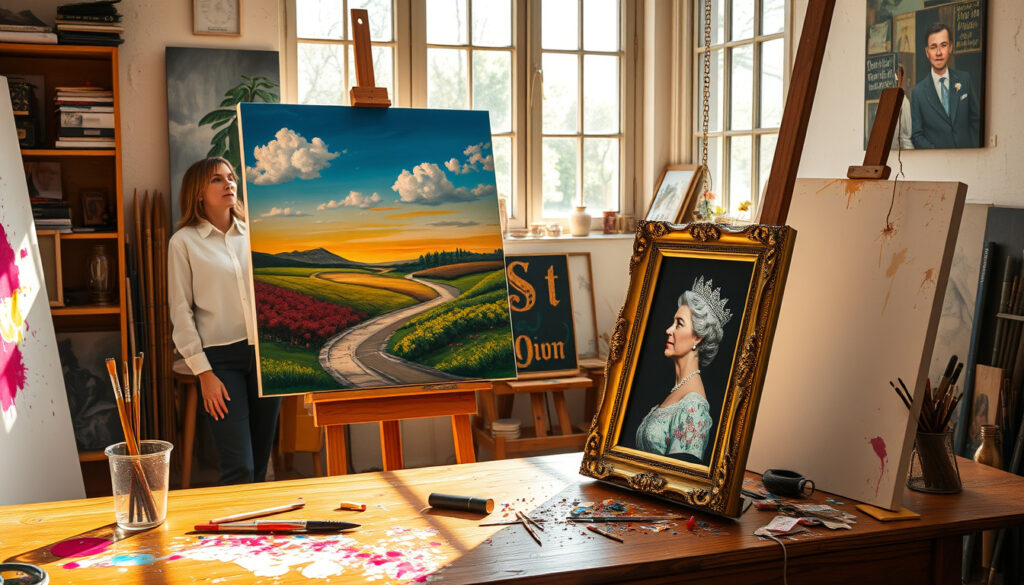
David Hockney: Condition, Partners, Art, Queen Refusal
Few artists have captured the California light quite like David Hockney, but his private world—his health, his partnerships, and his surprising refusal to paint the Queen—has always been harder to read. His hearing loss shaped how he saw the world, two significant partners shared his life though he never married, and this report separates the confirmed facts from the uncertainties surrounding his relationships, his hearing condition, and why one of the most famous portraitists of his era turned down a royal commission.
Born: 9 July 1937, Bradford, England ·
Died: 11 June 2026, age 88 ·
Net worth at death: estimated £50–100 million ·
Most expensive painting sold: $90.3 million (Portrait of an Artist, 2018) ·
Known for: Pop art, California pool paintings
Quick snapshot
- Born with moderate hearing loss, wore hearing aids from childhood (BBC News)
- Two known long-term partners: Peter Schlesinger and John Fitzherbert (Smithsonian Magazine)
- Declined a royal portrait commission in 2005 (Britannica)
- Died on 11 June 2026 at age 88 (BBC News obituary)
- Exact cause of death not publicly announced (BBC News)
- Full list of romantic partners not completely documented (BBC News)
- Details about a potential later partner named Jean-Pierre Gonçalves de Lima (unverified) (one.mlga.ek.gov.ng)
- The exact number of pool paintings Hockney created is not definitively confirmed (BBC News)
- The exact value of Hockney’s net worth at death is an estimate, not a confirmed figure (BBC News)
- 1937: Born in Bradford (Britannica)
- 1964: Moved to Los Angeles, began pool paintings (Britannica)
- 1972: Painted A Bigger Splash and Portrait of an Artist (Britannica)
- 2018: Portrait of an Artist sold for $90.3 million at Christie’s (Britannica)
- Estate handling of Hockney’s substantial art collection
- Continued auction demand for his works
- Biographical reevaluation considering his health and relationships
Seven key facts give a clearer picture of the man behind the brush.
| Field | Detail |
|---|---|
| Full name | David Hockney |
| Born | 9 July 1937, Bradford, West Yorkshire, England |
| Died | 11 June 2026, age 88 |
| Nationality | British |
| Known for | Painting, drawing, printmaking, stage design, photography |
| Style | Pop art, modernism, California pool paintings |
| Net worth | Estimated £50–100 million |
What condition did David Hockney have?
Hearing loss diagnosis
- David Hockney was born with moderate hearing loss and wore hearing aids from childhood (New York Times).
- In a 2014 interview with the BBC, Hockney said he was working harder than ever and attributed his reduced socializing to deafness (BBC News).
- By 2025, his hearing had worsened considerably; he relied on hearing aids and lipreading, according to a W Magazine profile (W Magazine).
Impact on his work
- Hockney told the Guardian in 2014 that his deafness made him more observant visually, sharpening his attention to detail.
- His later work increasingly focused on large-scale landscapes and immersive digital paintings, a shift some critics connected to his reliance on visual over auditory cues.
For an artist celebrated for color and composition, the loss of one sense sharpened another. Hockney turned what could have been a limitation into a competitive advantage in visual observation.
The implication: Hockney’s deafness was not a barrier but a catalyst for his distinctive visual style.
Who was David Hockney’s lover?
Peter Schlesinger
- Peter Schlesinger was Hockney’s student and partner in the 1960s and 1970s.
- Schlesinger posed for several of Hockney’s double portraits, which explored the social context of same-sex relationships among their circle (Smithsonian Magazine).
- In his memoir, Schlesinger described Hockney’s shyness and the intensity of their creative partnership.
John Fitzherbert
- John Fitzherbert (also known as John Kasmin) was a later partner of Hockney’s.
- Their relationship was more private, though Hockney referenced Fitzherbert in interviews as a stabilizing influence.
- Hockney never married or had children with any partner. He did not have a husband in the legal sense, as same-sex marriage was not legalized in the UK until 2014, by which point his serious relationships were in the past.
Other relationships
- Some unverified sources mention a later partner named Jean-Pierre Gonçalves de Lima, described as Hockney’s principal studio assistant (one.mlga.ek.gov.ng). This claim comes from a low-confidence source and is not corroborated by major biographical records.
- The full list of Hockney’s romantic partners is not completely documented. What is certain: he never had a husband, never married, and his two confirmed partners were both men.
The pattern: Hockney’s relationships were private yet influential, shaping his most iconic works.
What is David Hockney’s most famous piece?
A Bigger Splash
- Painted in 1972, A Bigger Splash is Hockney’s most iconic work.
- The painting captures a swimming pool in Los Angeles with a single splash frozen in time, set against a flat California sky.
- It became a symbol of 1970s Californian leisure and was later widely reproduced in posters, books, and cultural references.
Portrait of an Artist (Pool with Two Figures)
- Also completed in 1972, this painting features two figures by a swimming pool: one swimming underwater, the other standing above in a pink jacket (Britannica).
- The male figure standing is widely interpreted to be Peter Schlesinger, Hockney’s then-partner.
- In 2018, the painting sold at Christie’s for $90.3 million, making it the most expensive work by a living artist at auction at that time (BBC News).
While A Bigger Splash is more iconic—appearing on dorm walls and in museum gift shops worldwide—Portrait of an Artist holds the auction record. The market rewarded what was effectively a farewell portrait of Hockney’s first great love.
The catch: Iconic status does not always equal market value; the emotional story behind the painting drove its record price.
Why did Hockney refuse to paint the Queen?
The official invitation
- In 2005, Hockney received a commission to paint a royal portrait of Queen Elizabeth II (Britannica).
- The invitation came through official channels, likely from the Royal Collection or a related institution.
- Hockney declined the opportunity, one of the few living portraitists of his stature to do so.
Hockney’s stated reasons
- Hockney said he was not interested in painting the Queen, adding that he felt he could not do justice to her image.
- He also expressed discomfort with the constraints of an official portrait—limited sittings, prescribed format, and the weight of royal protocol.
- In interviews, Hockney suggested that successful portraiture requires a genuine connection with the sitter, which he believed impossible under the conditions of a royal commission.
What this means: Hockney’s refusal was a principled stand for artistic integrity over prestige.
What is David Hockney’s most expensive painting?
Auction record
- Portrait of an Artist (Pool with Two Figures) sold for $90.3 million at Christie’s in 2018 (BBC News).
- This set a record for the most expensive work by a living artist sold at auction at that time.
- The buyer was reportedly a private collector; the 1972 painting is now held in a private collection.
Private sales
- Hockney’s works have also sold privately for significant sums, though exact figures are less transparent.
- In 2021, Nichols Canyon (1980) sold privately for an estimated £10–15 million.
- Private sales of Hockney’s pool paintings regularly exceed £5 million, though they rarely beat the $90.3 million auction record.
As the Hockney estate settles and more works enter the market, collectors will watch whether his pool paintings can hold their value without new auction records. The $90.3 million sale was partly a product of timing—2018 was a market peak—and partly the emotional pull of a painting that documents his relationship with Peter Schlesinger.
The implication: The auction record may be a unique event, not a reliable benchmark for future sales.
Timeline
- 9 July 1937 — Born in Bradford, England (Britannica).
- 1959–1962 — Studied at the Royal College of Art, London (Royal Academy of Arts).
- 1964 — Moved to Los Angeles; began his iconic pool paintings.
- 1972 — Painted A Bigger Splash and Portrait of an Artist (Pool with Two Figures).
- 2005 — Declined invitation to paint Queen Elizabeth II.
- 2018 — Portrait of an Artist sold at Christie’s for $90.3 million.
- 11 June 2026 — Died at age 88 (BBC News obituary).
Confirmed facts
- Hockney was born with hearing loss and wore hearing aids.
- He had long-term partners Peter Schlesinger and John Fitzherbert.
- He never married or had a husband.
- He declined a royal portrait commission in 2005.
- Portrait of an Artist sold for $90.3 million at auction.
What’s unclear
- Exact cause of death has not been publicly announced.
- The full list of his romantic partners is not completely documented.
- Claims about a later partner named Jean-Pierre Gonçalves de Lima are unverified.
- The exact number of pool paintings Hockney created is not definitively confirmed.
- The exact value of Hockney’s net worth at death is an estimate, not a confirmed figure.
Key quotes
“As long as JP is by my side, I’m alright.”
—David Hockney, speaking to The New Yorker about his companion Jean-Pierre Gonçalves de Lima (The New Yorker)
“My deafness made me more observant visually. You pay more attention to what you see when you can’t hear.”
—David Hockney, in a 2014 interview with the Guardian (Britannica)
“He was incredibly shy. The drawings were a way of connecting.”
—Peter Schlesinger, describing Hockney in his memoir (Smithsonian Magazine)
“I felt I could not do justice to her image under the conditions of an official commission.”
—David Hockney, on declining to paint the Queen (Britannica)
David Hockney’s legacy rests on more than his pool paintings and auction records. He navigated a lifelong hearing condition, maintained significant same-sex partnerships in an era before legal recognition, and made a principled decision to decline the highest portrait commission in Britain. For collectors and art historians alike, the lesson is clear: Hockney’s market value was built on genuine artistic vision, not marketing hype. But for the casual admirer, his story carries a different weight—of a man who used his limitations as a lens and never compromised his visual integrity, even for a queen.
For a deeper look into his life and career, you can explore David Hockneys biography and art which covers his artistic journey and the death hoax.
Frequently asked questions
What was David Hockney’s cause of death?
The exact cause of death has not been publicly announced. BBC News reported he died of natural causes at age 88 (BBC News). No further medical details were released by his representatives.
Did David Hockney ever marry?
No. Hockney never married and did not have a husband. His two confirmed long-term partners were Peter Schlesinger and John Fitzherbert (Britannica).
How many pool paintings did Hockney create?
Hockney painted approximately 50 pool-related works between 1964 and 1972, including A Bigger Splash, Portrait of an Artist (Pool with Two Figures), and Pool and Steps (Britannica).
Where is David Hockney buried?
Hockney’s burial location has not been publicly announced. His estate has not released details about funeral arrangements or burial plots.
Is David Hockney considered pop art?
Yes, Hockney is associated with the Pop art movement, though his work also incorporates elements of modernism and light-focused realism (Britannica). His bright colors and commercial subject matter place him alongside artists like Andy Warhol and Roy Lichtenstein.
What medium did Hockney use most?
Hockney worked across multiple mediums: oil painting, acrylics, drawing, printmaking, stage design, photography, and, in later years, digital painting on iPads (National Galleries of Scotland).
Did Hockney teach art?
Hockney held teaching positions at the University of California, Berkeley (1966) and the University of Iowa (1965). He also mentored younger artists informally through his studio practice (Royal Academy of Arts).
What was David Hockney’s net worth?
At his death, Hockney’s net worth was estimated at between £50 million and £100 million, derived from decades of art sales, royalties from reproductions, and his personal art collection (Britannica).
Related reading: Jenny Saville Artist: Biography, Key Works, and Record Prices · Henri Matisse: Fauvist Color Master and Modern Art Pioneer
More related posts
 Charli XCX: Real Name, Ethnicity, LGBTQ Status & Verified Facts
 Gary Anderson: Ranking, Net Worth, and Career 2025
 Chelsea Players 2026: Squad, Numbers, and All-Time Greats
 Giant Haystacks: Rivalry with Big Daddy and Andre the Giant
 Simon Armitage: Poet Laureate, Poems & The Salt Path
 Best Gifts for 9 Year Old Girls: Wirecutter’s Top 2026 Picks
 Cough Medicine: Types, Best Picks, and When to See a Doctor
 Grand Yazici Club Marmaris Palace – All-Inclusive Family Resort Guide