Mount Kilimanjaro Climbing Guide: Routes, Difficulty, Safety
Every year, tens of thousands of people fly to Tanzania with the same thought: to stand on the roof of Africa, but for every successful summit photo, there’s a trail of questions about age, fitness, and the grim statistics. This guide separates the facts from the hype, covering everything from the easiest route to the oldest climbers, so you can decide if Kilimanjaro is your next adventure or a story best left untold.
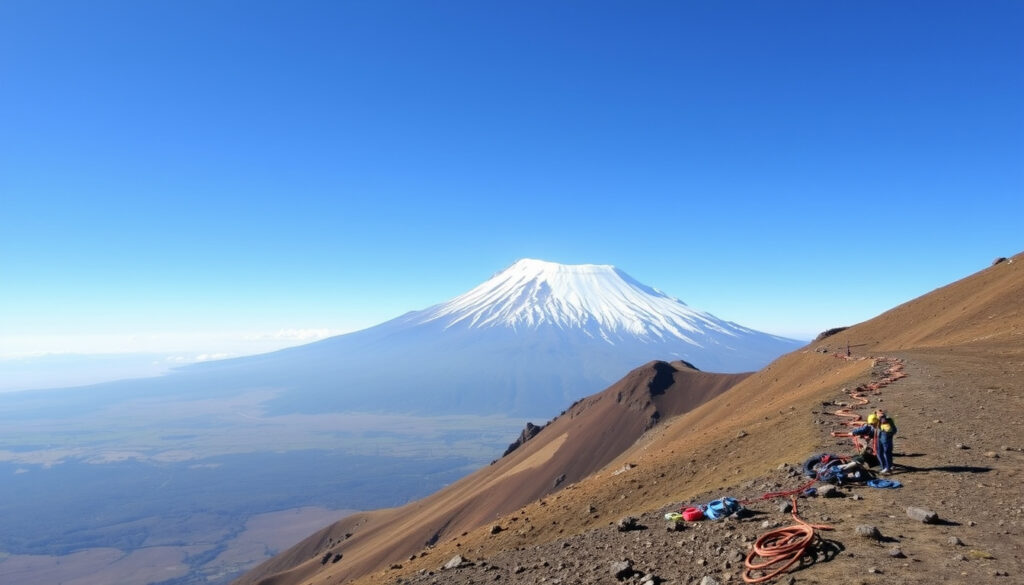
Height: 5,895 m (19,341 ft) ·
Location: Tanzania, East Africa ·
First Ascent: 1889 by Hans Meyer and Ludwig Purtscheller ·
Annual Deaths (estimated): 3–10 climbers per year ·
Summit Success Rate: ~65% on standard routes
Quick Snapshot
- Kilimanjaro is 5,895 m (19,341 ft) high, Africa’s highest mountain (Guinness World Records).
- It is a free-standing mountain, not part of a range (Britannica).
- Exact annual death toll on Kilimanjaro is not officially recorded (Climb Kilimanjaro Safari).
- The “oldest person” record is often contested and varies by source (The Washington Post).
- Guinness World Records confirmed the oldest woman climber as Anne Lorimor in 2019, at age 89 (Guinness World Records).
- In 2026, a report claimed Art Ulene summited at age 90, but the record is unverified (Climb Mount Kilimanjaro).
- If you’re planning a climb, choose longer routes for a higher summit success rate (Kilimanjaro National Park route page).
- Proper acclimatization is key to mitigating altitude sickness (Kilimanjaro National Park route page).
| Attribute | Value |
|---|---|
| Height | 5,895 m (19,341 ft) |
| Location | Tanzania, East Africa |
| First Ascent | 1889 by Hans Meyer and Ludwig Purtscheller |
| Annual Deaths (estimated) | 3–10 |
| Summit Success Rate (standard routes) | ~65% |
| Number of Official Routes | 7 |
Five of those claims are worth a second look when planning your climb. The table below captures the essential contrasts between the main routes, a clear pattern of trade-offs between difficulty, duration, and success.
| Route | Difficulty | Duration | Success Rate | Acclimatization |
|---|---|---|---|---|
| Marangu | Moderate | 5–6 days | ~65% | Limited |
| Machame | Moderate to challenging | 6–7 days | ~75–85% | Excellent |
| Lemosho | Moderate | 7–8 days | ~90–95% | Excellent |
| Rongai | Moderate | 6–7 days | ~75–85% | Good |
| Umbwe | Very hard | 5–6 days | ~60–70% | Poor |
| Northern Circuit | Moderate | 9–10 days | >90% | Outstanding |
The pattern is clear: the trade-off between summit success and time commitment is real. Longer routes like Lemosho and the Northern Circuit offer better acclimatization and higher success rates, but they demand more days and more budget. Shorter routes like Umbwe are tougher and riskier, often leading to lower summit odds.
Climbers who pick a longer route are often trading a few extra days for a dramatically higher chance of summiting. The catch: more time on the mountain means more cost and more exposure to the elements.
Why is Mount Kilimanjaro so famous?
- Highest free-standing mountain in the world
- Highest peak in Africa at 5,895 m (19,341 ft)
- Snow on the equator, near the roof of Africa
- Majestic and relatively accessible for non-climbers
- Cultural and historical significance for Tanzania
The name alone carries weight. Mount Kilimanjaro is not just a mountain; it’s a national symbol and a bucket-list icon. Its fame is built on the stark contrast of a snow-capped peak rising from the equatorial plains, a sight that has drawn explorers, writers, and filmmakers for over a century.
The mountain’s record as the world’s tallest free-standing mountain is a key part of its draw. Unlike peaks in ranges like the Himalayas, which rise from a high plateau, Kilimanjaro shoots up from the savannah, creating a dramatic vertical rise of nearly 5,000 meters. This uniqueness is why it’s a “must-see” for travelers and a point of pride for Tanzanians.
Kilimanjaro’s fame creates its own challenge: 30,000–50,000 climbers attempt it each year, drawing crowds on the most popular routes. The solitude you imagine on a mountain summit might be a conga line on the Marangu route.
What this means: the mountain’s fame is a double-edged sword; it attracts crowds but also guarantees a well-supported infrastructure.
How difficult is Mount Kilimanjaro to climb?
Kilimanjaro is difficult, but not for the reasons most people think. There’s no technical climbing required—no ropes, no harnesses, no rock-climbing moves. The real challenge is altitude. You’re walking for days in thin air, where the only thing you can’t train for is how your body reacts to the altitude. For comparison, other iconic climbs like Mount Fuji offer a different kind of challenge.
A 2026 report in The Washington Post highlighted a 90-year-old climber, but also noted that altitude sickness is the main risk for all. The climb is often described as “a long, hard walk uphill,” which is true, but the word “walk” undersells the mental and physical grind of 5+ days of continuous ascent.
Can a beginner summit Kilimanjaro?
- No technical climbing required (no ropes, harnesses)
- Main challenge is altitude, not terrain
- Success rates vary by route (higher on longer routes)
- Proper physical preparation is recommended
- Age is not a barrier; the oldest climber was 89
Yes, a beginner with the right mindset has a good chance. The biggest mistake is underestimating the mental fortitude required. The mountain doesn’t care if you’ve run a marathon; it cares if you can walk for 6–8 hours a day in a state of altitude-induced misery. Acclimatization is your best friend, and longer routes are your best bet.
Many climbers over 50, like the record holder Art Ulene, have successfully summited. Training should focus on leg strength and cardiovascular endurance to handle the long, relentless days on the mountain.
Do you need oxygen to climb Kilimanjaro?
No, not in the way you think. Kilimanjaro is not a 8,000-meter peak like Everest; it’s a “high altitude” climb, not a “death zone” expedition. Most climbers do not use supplementary oxygen. The air at 5,895 m has about 50% of the oxygen available at sea level, so you will feel short of breath with any exertion.
Your body acclimatizes to altitude by producing more red blood cells, but this takes time. This is why routes with a “climb high, sleep low” strategy—like the Lemosho route—are so effective. Your success depends on giving your body time to adapt, not on being superhuman.
- Choose a longer route (7+ days) to allow gradual ascent.
- Follow a “climb high, sleep low” schedule each day.
- Stay hydrated and eat well, even if appetite fades.
- Identify altitude sickness symptoms early and descend if they worsen.
Where do you sleep when you climb Kilimanjaro?
You’ll sleep in mountain huts or tents, depending on the route. The Marangu route is the only one with permanent huts, while others, like Machame and Lemosho, use campsites. The altitude of your camp matters far more than the quality of the bed. Sleeping at high altitude is hard; you’ll often feel breathless and your heart beats faster.
The implication: your choice of route directly affects your sleep quality and acclimatization pace.
Which is the hardest Kilimanjaro route?
If you’re looking for a chest-thumper, the Umbwe Route is the one. It’s the steepest, shortest, and most direct. The acclimatization is poor because you gain altitude so fast, leading to higher failure rates and more cases of altitude sickness. The trade-off is a shorter climb—5–6 days—but it’s a brutal few days.
The difficulty is not uniform across the mountain. The Marangu Route is often called the “Coca-Cola” route, but its short duration makes it harder than you might think. On the other hand, the Northern Circuit is considered the most comfortable, with a longer itinerary and excellent acclimatization, leading to success rates above 90%.
When comparing to other global treks, it’s a different ball game. For example, the Inca Trail to Machu Picchu is a much lower altitude trek (just over 4,000 m) and shorter, but it’s a very different type of challenge. Kilimanjaro’s altitude is the equalizer; it doesn’t matter if you’re 20 or 60, the air is thin for everyone.
Which is harder, Machu Picchu or Kilimanjaro?
They’re hard for different reasons. Kilimanjaro is a test of altitude endurance; Machu Picchu is a test of cumulative distance at a lower altitude. You don’t “summit” Machu Picchu in the same way; you walk for days through the Andes. Most would argue Kilimanjaro is physically harder due to altitude, even if the daily distances are not longer.
How many climbers died in Kilimanjaro?
Let’s get the grim statistics out of the way. The number most often cited is that between 3 and 10 climbers die on Kilimanjaro each year. But these numbers are not official; there is no central registry at the park level that tracks deaths. It’s a stubbornly hard number to pin down.
Some sources, like Snow Africa Adventure (2026 statistics page), claim a death rate of about 0.03%, given over 30,000 climbers per year. The causes are usually not falls, but altitude-related illnesses like High Altitude Pulmonary Edema (HAPE) or High Altitude Cerebral Edema (HACE), or pre-existing conditions exacerbated by the altitude.
Confirmed Facts
- Kilimanjaro is located in Tanzania, Africa, near the Kenyan border (Guinness World Records).
- The oldest man to summit was Fred Distelhorst (88 years, 180 days) (Guinness World Records).
What’s Unclear
- Exact annual death toll is not centrally recorded (Climb Kilimanjaro Safari).
- The true age of the oldest climber is disputed (some claim 89, others say 90) (The Washington Post).
- Over 30,000 people attempt the climb annually, but exact figures vary (Snow Africa Adventure).
- Deaths are rare, but the exact rate is disputed (Snow Africa Adventure).
One of the more fantastical myths is that Kilimanjaro is “evil.” This is pure fiction, a scare story with no basis in fact. The mountain is a benign giant, and fatalities are incredibly low for the number of visitors it hosts. However, altitude sickness is a real threat, and it can affect anyone, regardless of age or fitness.
Who is the oldest person to climb Mount Kilimanjaro?
Records are tricky things on Kilimanjaro. The Guinness World Records officially crowned Anne Lorimor as the oldest person in 2019, at age 89. For men, Fred Distelhorst summited at 88 years old in 2017.
However, there’s always a challenger. In 2026, reports surfaced that a 90-year-old named Art Ulene had summited, making him the oldest on record. Yet, The Washington Post noted that the record was not yet verified by Guinness. The lesson: for every record, there’s a caveat about verification, and records can be broken by the time you read this.
The trend is upward. Advancements in gear, better route planning, and a focus on safety have made it possible for the very old to conquer the mountain. The question isn’t “can you?” but “are you prepared to train for it?”
Mount Kilimanjaro is located in which continent?
Africa. More specifically, it’s in Tanzania, right on the border with Kenya. This is a point of some national pride, and the surrounding countries are in a friendly rivalry over the mountain’s fame. Travelers seeking other destinations in Africa might consider Cape Verde.
It’s the highest free-standing mountain in the world, meaning it isn’t part of a mountain range. This makes it a distinct feature of the African landscape, a giant dormant volcano that stands alone.
Kilimanjaro height: Where does it measure up?
At 5,895 meters (19,341 ft), the height is a solid fact that most sources agree on. This is high enough to cause altitude sickness, but it’s below the “death zone” (above 8,000 m) where air pressure drops so low that the body begins to shut down. This is why you don’t need oxygen to climb Kilimanjaro, unlike Everest.
To put that in perspective, it’s over 1,000 meters higher than any point in the Alps, and over 6,000 meters higher than the highest point in the UK. But it’s a “stroll” compared to an 8,000-meter peak; the air is thinner, sure, but it’s breathable.
Which route is right for you? A comparison
Choosing a route is not just about difficulty; it’s about your timeline, budget, and what you’re willing to tolerate. Here’s how they stack up:
So, is Kilimanjaro worth the hype?
Yes, but not for the reasons you might think. It’s not a technical challenge, so it won’t make you feel like a mountaineer. Instead, it’s a mental game. It’s about pushing through a headache that won’t go away, dealing with a loss of appetite, and convincing your legs to move another hour up the mountain, all while the view is a sea of clouds.
The summit is the easy part, the descent back to the gate is miserable, but the feeling of standing on the “Roof of Africa” is unmatched. It’s a legitimate achievement, not because it’s the hardest physical thing you’ll ever do, but because it’s a week of discomfort that tests your will.
For the average traveler, the decision is clear: it’s not about if you can do it; it’s about your risk tolerance. For every 100 people who try, about 35 will not reach the summit. (Based on a ~65% average success rate across all routes.)
The takeaway: the reward matches the effort, but only if you go in with eyes open about the odds.
snowafricaadventure.com, therunningweek.com, climbkilimanjaroguide.com, tranquilkilimanjaro.com, guinnessworldrecords.com, en.wikipedia.org, kilipeak.com
Frequently asked questions
How long does it take to climb Kilimanjaro?
The shortest routes (Marangu, Umbwe) can be done in 5–6 days, but the average climb is 6–8 days. Longer routes are strongly recommended for better acclimatization and a higher success rate.
What is the best month to climb Kilimanjaro?
The best months weather-wise are January–March and June–October. These are the dry seasons. The wettest months are April and May, and November, which are best avoided unless you enjoy mud and snow.
Do I need a guide to climb Kilimanjaro?
Yes. It is mandatory. All climbers must be accompanied by a licensed guide, and porters are included for logistics. The park requires it for safety, so there’s no way around this.
What gear do I need for Kilimanjaro?
You need good hiking boots (not running shoes), warm layers (down jacket, thermal base layers), a 4-season sleeping bag (it gets below freezing at night), and a daypack. The full list is long, but you can rent most of it in Moshi, Arusha, or Marangu.
How much does it cost to climb Kilimanjaro?
Prices range wildly from around $2,000 to $6,000, but the park fees alone are substantial. The days of getting it cheap are long gone. Quality matters. A cheaper climb often means a porter shortage and poor gear, which increases your risk of failure or getting hurt.
Can I climb Kilimanjaro without training?
You can, but you shouldn’t. While it’s a walk, the altitude is the equalizer. Training your legs with long hikes, and your lungs with cardio, dramatically improves your chances. People who don’t train often suffer, and some turn back at the summit crater.
What is altitude sickness and how can I prevent it?
It’s your body’s reaction to lower oxygen. Symptoms range from headaches and nausea to severe conditions like HAPE or HACE. The best prevention is a slow ascent, staying hydrated, and knowing when to descend.
More related posts
 Imogen Faith Reid: Biography, Condition, and Career
 Dominic Monaghan: LOTR Career, Net Worth, and Personal Life
 Judi Dench: Health, Family, Career & Personal Life
 Liver King in 2025: Arrest, Steroid Scandal, and Net Worth
 One and One Webmail Login: The IONOS Official Guide
 Christian Pulisic: Bio, Salary, Net Worth & Relationship Rumors
 A/B Testing Guide: Steps, Examples & Best Practices
 Muhammad Ali’s Death and Legacy: Top Questions Answered