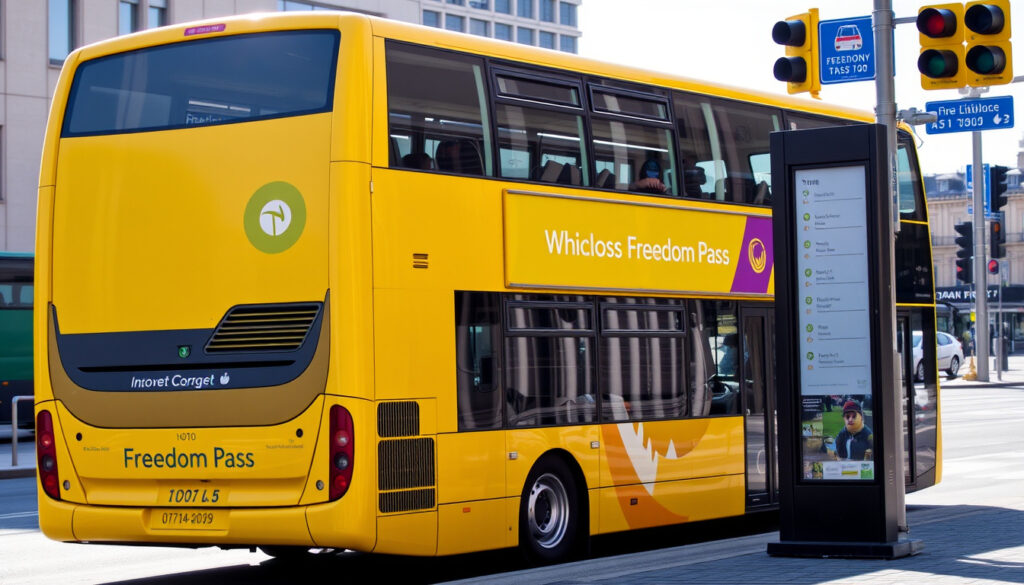
Freedom Bus Pass: Coverage, Times, and Key Rules
If you’re a Londoner approaching your 60s, the letters “Freedom Pass” probably surface at every family dinner and pub quiz. But here’s the thing most people discover the hard way: a 60+ Oyster card and an Older Person’s Freedom Pass are two different pieces of plastic with very different rules, and picking the wrong one can cost you a chunk of change on a Gatwick run. This guide maps out exactly who qualifies for each, what they cover (and pointedly don’t), and how the 60+ card acts as a bridge until the state pension age arrives. We’ll also wade through the fine print that official pages bury, so you don’t get caught mid-journey with a card the driver won’t accept.
Eligibility age: 66 (London residents) · Coverage: Local buses in England + TfL services in London · Bus time restrictions: None on local buses · Tube time restrictions: Weekdays 9:30–23:00; weekends all day · Cost: Free (replacement fee ~£10) · Application channel: Online via freedompass.org
Eligibility & Cost
- London residents aged 66+ qualify for the Freedom Pass (Ealing Council)
- London residents aged 60+ qualify for the 60+ Oyster card (Transport for London)
- Both passes are free; replacement for a lost or damaged pass costs around £10
Bus Travel
- Free on local buses across England with the Freedom Pass (Transport for London)
- No time restrictions on local buses
- Not valid on coaches, express services, or tourist buses
Tube & Rail in London
- Free on TfL services (Tube, DLR, Overground, Elizabeth line) with both passes
- Weekdays 9:30–23:00; weekends anytime
- Freedom Pass adds National Rail within London off-peak (Age UK)
Airport Travel
- Heathrow: free on Tube and Elizabeth line off-peak; free on local buses anytime
- Gatwick: free on local buses only; rail services excluded
- Excludes Heathrow Express, Gatwick Express, Stansted Express
| Feature | 60+ Oyster card | Older Person’s Freedom Pass |
|---|---|---|
| Eligibility age | 60+ (London residents) | State pension age (66 for most, but rising) |
| Coverage | TfL services within London | TfL services + local buses across England |
| Bus times | No time restrictions on local buses | No time restrictions on local buses |
| Tube times | Anytime on weekends; weekdays 9:30–23:00 | Anytime on weekends; weekdays 9:30–23:00 |
| National Rail within London | Not valid | Valid (off-peak, after 9:30 weekdays) |
| Airport rail links | Excluded (Heathrow Express, Gatwick Express, Stansted Express) | Excluded (Heathrow Express, Gatwick Express, Stansted Express) |
| Cost | Free (replacement fee ~£10) | Free (replacement fee ~£10) |
| Renewal | No ongoing charges | No ongoing charges |
| Application | Online via TfL | Online via freedompass.org |
The pattern: the Freedom Pass is strictly a bigger net — it adds National Rail within London and local bus coverage across England — but only becomes available at state pension age. The 60+ card fills the gap for the five or six years in between, but keeps you tied to TfL’s network.
What is the difference between a 60+ card and a Freedom Pass?
At first glance, both cards seem to offer the same golden ticket: free travel for older Londoners. But beneath the surface, they’re built on different legal foundations, with different age thresholds, different coverage zones, and different expiry dates. The 60+ Oyster card is a Transport for London (TfL) product, while the Freedom Pass is a concession managed by London Councils on behalf of all 32 boroughs plus the City of London. Understanding which one you hold — or should hold — makes the difference between a seamless commute and an unexpected penalty fare.
“The 60+ Oyster photocard is for London residents aged 60 or over who are not yet eligible for an Older Person’s Freedom Pass.”
— London Borough of Waltham Forest, Freedom Pass for older people
The upshot: the Freedom Pass is strictly a bigger net — it adds National Rail within London and local bus coverage across England — but only becomes available at state pension age. The 60+ card fills the gap for the five or six years in between, but keeps you tied to TfL’s network.
Who qualifies for the 60+ card?
The 60+ Oyster card is a TfL concession aimed at London residents who have hit 60 but haven’t yet reached state pension age. It’s a bridge benefit: you get free travel on TfL services, but with time restrictions that don’t apply to the Freedom Pass’s bus element. To be clear, this card is not automatic — you need to apply, and TfL verifies your age and London residency before issuing it.
- You must be aged 60 or over
- You must live at a London address that is your sole or principal residence
- You must apply online via TfL’s Oyster site
- Your card is valid until your 66th birthday (or until state pension age, whichever comes first)
- Once you qualify for the Freedom Pass, the 60+ card becomes redundant
The catch: if you move out of London, your 60+ card stops working immediately. It’s not portable, and TfL doesn’t offer a grace period. For anyone splitting time between London and a second home, this is the detail that causes the most frustration.
What this means: The 60+ card acts as a temporary bridge for Londoners aged 60 to 66, but it locks you into TfL-only travel and stops working the day you leave the capital.
What does a Freedom Pass entitle you to?
The Freedom Pass is the broader of the two concessions. It covers free travel on local buses across England, plus free Tube, DLR, London Overground, Elizabeth line, and some National Rail services within London during off-peak hours. The pass also includes tram services and river buses where accepted.
What does a Freedom Pass give you on buses?
On local buses in England, the Freedom Pass gives you unlimited free travel at any time of day. That includes buses in London, Manchester, Birmingham, and any other English city with a local bus network. The key restriction: it only covers local buses, not coaches or express services.
What are the time restrictions on a Freedom Pass?
On local buses, there are no time restrictions — you can ride at 7am, midnight, or 3pm on a Sunday. On the Tube and TfL rail services, the pass is valid from 9:30am to 11pm on weekdays and all day on weekends and bank holidays.
What travel perks are included in London?
In London, the Freedom Pass covers all TfL services: Tube, DLR, London Overground, Elizabeth line, trams, and most local buses. It also covers National Rail services within London during off-peak hours (after 9:30am weekdays, all day weekends).
“Freedom Pass means you can travel free on local buses all over England.”
— Transport for London, Freedom Pass page
What this means for you: The Freedom Pass is the gold standard for older Londoners — it covers local buses nationwide plus all TfL services in London, but you must wait until state pension age to get it.
Can I use my Freedom Pass on buses outside London?
Yes — the Freedom Pass is valid on local buses across England. That’s one of its biggest advantages over the 60+ Oyster card, which only works on TfL services within London. The pass is not valid on buses in Scotland, Wales, or Northern Ireland, and it does not cover coach services like National Express.
Does the Freedom Pass work on National Express?
No. The Freedom Pass is not valid on National Express or other coach services. It only covers local buses in England, not intercity coaches. If you’re booking a coach trip, you’ll need to pay separately.
Does the Freedom Pass work on local buses only?
Yes, it works on most local buses in England, but not on express services, tourist buses, or coaches. The rose symbol on the Freedom Pass indicates free travel on local buses all over England, as confirmed by Transport for London.
What does ‘local bus’ mean for Freedom Pass holders?
A ‘local bus’ is typically a bus that stops frequently and serves local communities, as opposed to express coaches that travel long distances with few stops. The exact definition can vary by operator, but TfL’s guidance is clear: the pass works on local services, not on intercity or tourist services.
Warning: The Freedom Pass does not cover National Express, Megabus, or any other coach service. You must pay separately for these journeys.
Is the 60+ card valid on buses, tubes, and trains?
The 60+ Oyster card’s sweet spot is the local bus network. It gives you free travel on most local buses in London at any time — no weekday morning blackout, unlike the tube. But the moment you step onto a National Rail service, the card’s magic evaporates. It’s also worthless on coaches, express services, and tourist buses. This is where the card’s limitations bite hardest for anyone heading to the airport.
The same goes for the Freedom Pass’s 60+ sibling: both cards exclude the Heathrow Express, Gatwick Express, and Stansted Express. TfL explicitly says the 60+ card is not valid at any time on Heathrow Connect between Hayes & Harlington and Paddington, and the same rule applies to the Freedom Pass. If you’re heading to Gatwick, the Gatwick Express — which runs non-stop from Victoria — is off-limits. You’d need to take a slower, cheaper alternative, or pay full fare.
The trade-off: for everyday London travel, the 60+ card covers your local buses and tube journeys (with the 9:30 weekday cutoff on the tube). But for anything that involves rail, you’ll need to budget separately.
What are the time restrictions on the 60+ card?
Time restrictions are where the 60+ card and Freedom Pass diverge in a way that catches people off guard. On local buses, there are none — you can ride at 7am, midnight, or 3pm on a Sunday. But on the tube, the card is dead from midnight to 9:30am on weekdays. That’s a hard stop: no free travel during the morning rush. On weekends, the tube is free all day.
- Local buses: no time restrictions
- Tube and DLR: weekdays 9:30–23:00; weekends all day
- Overground: weekdays 9:30–23:00; weekends all day
- Trams: no time restrictions
- Emirates Air Line: 30% discount (not free)
The restriction exists because the Freedom Pass — and by extension the 60+ card — is designed as a concession for off-peak leisure travel, not a commuter perk. If you still work mornings, you’re out of luck on the tube. But if your schedule is flexible, the card is generous.
How does the 60+ card compare to the Freedom Pass?
The comparison crystallises into one sentence: the Freedom Pass is a 60+ card plus National Rail within London plus local bus coverage across England. But that “plus” only kicks in at state pension age. For a 60-year-old Londoner, the 60+ card is the only free option available. For a 66-year-old, the Freedom Pass is strictly better.
Let’s be precise about the bus element. The Freedom Pass covers local buses in England — that’s a huge perk for anyone who travels beyond the M25. But it’s not valid on coaches, express services, or tourist buses. National Express and other coach services are excluded entirely. So a Freedom Pass holder can ride a local bus from London to Reading, but not a National Express coach to the same destination. It’s a subtle but important line.
For rail within London, the Freedom Pass is valid on National Rail off-peak — after 9:30 weekdays and all day weekends. That includes most London terminals and suburban routes. But it doesn’t extend to Gatwick Express, Heathrow Express, or Stansted Express. Those remain paid services.
“Providing Londoners over the age of 66 and those with eligible disabilities free public transport across the capital and on local buses across England.”
— Freedom Pass official website
The paradox: the bigger the journey, the less the Freedom Pass helps. It’s a champion of the everyday commute and a paperweight for the airport run.
How to apply for the 60+ card
Applying for the 60+ Oyster card is refreshingly simple: you don’t need an in-person appointment or a stack of paperwork. TfL’s online portal walks you through the steps, and you’ll need proof of your age and London address. The card arrives by post within two weeks, though TfL says it can take up to three weeks during busy periods.
- Visit the TfL 60+ card application page
- Create a TfL account or log in
- Upload proof of age (passport or driving licence)
- Upload proof of London residency (utility bill, council tax statement)
- Submit your application and wait for approval
- Activate your card via your TfL account
If your card gets lost or stolen, a replacement costs around £10 — the same fee TfL charges for a lost Oyster card. There’s no annual fee, no renewal charge, and no hidden costs. The card itself is free, and TfL doesn’t take a cut of your travel savings.
What to watch: if you apply before your 60th birthday, TfL will reject the application. The system checks your date of birth automatically. And if you move out of London, the card stops working on day one — there’s no notice period, no grace window.
Tip: Apply for your 60+ card as soon as you turn 60. The application takes about 15 minutes online, and the card lasts until you qualify for the Freedom Pass at state pension age.
Can I use my Freedom Pass to go to Heathrow or Gatwick?
For London’s six airports, the 60+ card and Freedom Pass have a mixed record. The rule is simple: free travel on local buses, nothing on rail. That means you can ride a local bus to Heathrow, Gatwick, or Stansted, but you can’t use the express trains that connect them to central London.
| Airport | Local bus coverage | Rail services excluded |
|---|---|---|
| Heathrow | Free (e.g., route 111, 285) | Heathrow Express, Elizabeth line, Piccadilly line (tube still free off-peak) |
| Gatwick | Free on local buses (e.g., route 5, 20) | Gatwick Express, Southern, Thameslink |
| Stansted | Free on local buses | Stansted Express (no TfL service) |
| Luton | Free on local buses | Thameslink to London |
| London City | Free on local buses (DLR is paid) | DLR, Elizabeth line |
| Southend | Free on local buses | Greater Anglia to Liverpool Street |
The pattern: Gatwick is the trickiest. The local bus network is patchy, and the most practical way to get there — the Gatwick Express or Thameslink — is excluded. If you’re headed to Heathrow, the Piccadilly line (tube) remains free off-peak with your card, which is a solid workaround.
What TfL services go to Heathrow?
Heathrow is served by the Piccadilly line (Tube) and the Elizabeth line. Both are free with a Freedom Pass or 60+ card during off-peak hours (after 9:30am weekdays, anytime weekends). The Heathrow Express is excluded.
What bus services go to Gatwick?
Gatwick has local bus routes like the 5 and 20 that connect nearby towns, but these are less frequent and take longer than the train. For most travellers, the rail options (Gatwick Express, Southern, Thameslink) are more practical, but they are all excluded from the passes.
What are the airport restrictions?
Both passes exclude the Heathrow Express, Gatwick Express, and Stansted Express. They also exclude Heathrow Connect between Hayes & Harlington and Paddington. TfL confirms this in its official documentation.
What counts as unclear: Some bus routes to airports may be classified as ‘local’ or ‘express’ depending on the operator. Always check with the bus company before boarding to avoid an unexpected fare.
Freedom Pass not working: common issues and how to fix them
Few things are more frustrating than tapping a card and watching the reader flash red. If your Freedom Pass or 60+ card isn’t working, the fix is usually straightforward — but sometimes it requires a call to the council. TfL says 99% of card failures are down to one of three causes: the card has expired, it’s not been activated, or it’s not registered to the right person.
- Card expired: check the expiry date printed on the front; both cards are reissued automatically when they expire
- Card not activated: if you’ve just received it, log in to your TfL account and activate it
- Wrong card for the service: the 60+ card doesn’t work on National Rail — use a Freedom Pass instead
- Card demagnetised: wipe it with a soft cloth; if it still fails, request a replacement
- Reader issue: try a different gate or ask station staff — TfL has a policy of manual override for genuine card failures
The key nuance: a Freedom Pass holder who moves out of London loses eligibility immediately. The UK Parliament confirmed in a written answer that a pass ceases to be valid once the holder’s principal residence moves out of London. This isn’t a TfL glitch — it’s the law. If your card stops working after a house move, that’s why.
What are the renewal and replacement rules?
Both the 60+ card and the Freedom Pass have no ongoing charges — they’re free for life, technically. But “free” comes with strings. The cards expire either on your state pension age (for the 60+ card) or with a new photo (for the Freedom Pass). Renewal isn’t automatic in the way many assume; you need to be re-verified to confirm you still live in London.
- 60+ card: validity ends when you hit state pension age; TfL automatically invites you to apply for a Freedom Pass
- Freedom Pass: validity is five years; you’ll receive a renewal reminder by post
- Replacement fee: around £10 for a lost, stolen, or damaged card (both cards)
- If you move out of London: you must notify the council; your card becomes invalid
The catch: TfL is strict about residency. They cross-check your application against council tax records, and any discrepancy triggers a hold. If you’re a homeowner who rents out a room or a property, be prepared to prove your principal residence is in London.
Related reading: Generation Xyz: Meaning, Age Ranges & Next Generations · Cape Verde Travel Guide: Safety, Visas, Key Facts
en.wikipedia.org, questions-statements.parliament.uk, foi.tfl.gov.uk, tfl.gov.uk, moneyhelper.org.uk, bbc.com, towerhamlets.gov.uk, tfl.gov.uk, walthamforest.gov.uk
Frequently asked questions
What is the difference between a 60+ card and a Freedom Pass?
The 60+ Oyster card is a TfL concession for Londoners aged 60 to state pension age. The Freedom Pass is a broader London Councils scheme for those at state pension age. The Freedom Pass adds National Rail within London and local bus coverage across England. The 60+ card only covers TfL services.
Who qualifies for the 60+ card?
You need to be aged 60 or over and live at a London address that is your sole or principal residence. The card is free and valid until you reach state pension age. It is not automatic — you must apply via TfL.
Are there any renewal fees for the 60+ card?
No ongoing charges. The card is free, and there are no annual fees. Replacement for a lost or damaged card costs around £10.
Is the 60+ card valid on airport trains?
No. The 60+ card is not valid on the Heathrow Express, Gatwick Express, or Stansted Express. It is also not valid on Heathrow Connect between Hayes & Harlington and Paddington. You can use local buses to airports, but rail services are excluded.
Is the Freedom Pass valid on National Express coaches?
No. The Freedom Pass is not valid on National Express or other coach services. It only covers local buses in England, not intercity coaches. If you’re booking a coach trip, you’ll need to pay separately.
What happens if I move out of London?
Both the 60+ card and Freedom Pass become invalid immediately when you move out of London. UK Parliament confirmed that the pass ceases to be valid once your principal residence is no longer in London. There is no grace period.
Does the 60+ card work on all TfL bus services?
It works on most local buses in London at any time. But it is not valid on coaches, express services, or tourist buses such as Big Bus tours. TfL’s own documentation explicitly excludes these services.
More related posts
 Lara Ricote: Biography, Awards, Influences, and More
 What Is a Cute Picture? Definition, Synonyms & Examples
 Gary Anderson: Ranking, Net Worth, and Career 2025
 Janelle Monáe: Pansexual Identity, Relationships & Career
 Canelo Álvarez: Record, Losses, Next Fight & Personal Life (2025)
 Catherine Tate: Career, Relationships, and Net Worth
 Jamie Carragher: Biography, Net Worth, Trophies, and Family
 101 kg in Stone: 15 st 13 lb + NHS Chart