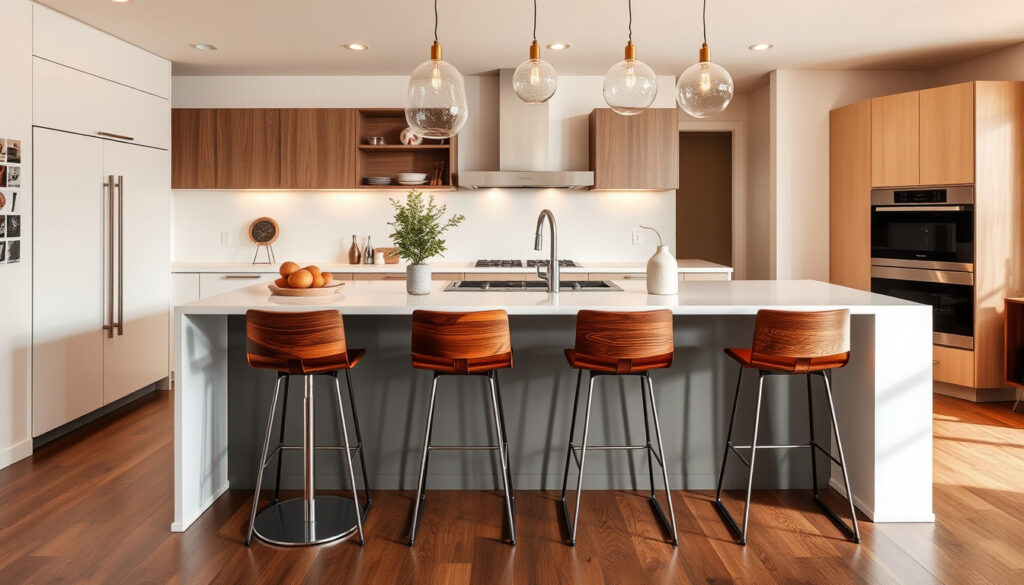
Bar Barstools Buying Guide: Sets, Heights, and Materials
Anyone who has tried to perch a 24-inch counter stool at a 42-inch bar already knows the discomfort of getting the height wrong. This guide sorts the specifications that actually matter—from seat height and set sizing to genuine leather versus PU alternatives—so you can buy with confidence rather than guesswork.
Standard Bar Stool Height: 30 inches (76 cm) ·
Typical Weight Capacity: 250-300 lbs (113-136 kg) ·
Common Seat Width: 18-20 inches (46-51 cm) ·
Popular Set Sizes: Set of 2, 3, or 4 ·
Primary Materials: Wood, metal, leather, faux leather, velvet
Quick snapshot
- Bar-height stools commonly measure 75.5–76.2 cm at the seat (Wayfair UK)
- Counter-height stools typically range 63.5–66 cm (Wayfair UK)
- UK retailers commonly market swivel barstools in sets of two, with some sets of four available (Wayfair UK) (Wayfair UK)
- Genuine leather vs. PU/faux leather is rarely stated clearly in listings — buyers must verify (Aosom UK)
- Displayed prices shift frequently, so the same model can vary by £20+ between promotions (Furniture Village)
- No timeline data available in research notes — this is a product category rather than an unfolding event
- Watch for seasonal price shifts on bar stool sets, particularly clearance pricing (Furniture Village)
- Measure your counter or bar height first — everything else follows from that number
- Check material specifics (PU vs. genuine leather) before comparing prices across retailers
Five specifications, one pattern: the numbers that matter most are seat height, set size, material, weight capacity, and adjustability. These are the dimensions that decide whether a stool works for your space or becomes an expensive mistake.
| Label | Value |
|---|---|
| Standard Seat Height | 30 inches (76 cm) |
| Seat Width | 18-20 inches (46-51 cm) |
| Weight Capacity | 250-300 lbs (113-136 kg) |
| Common Set Sizes | 2, 3, 4 |
| Top Materials | Wood, metal, leather, faux leather, velvet |
| Bar-Height Seat Range | 75.5–76.2 cm (Wayfair UK) |
| Counter-Height Seat Range | 63.5–66 cm (Wayfair UK) |
| Adjustable Height Range Example | 62–82 cm (Aosom UK) |
What are the best bar barstools sets of 2, 3, or 4?
Sets dominate UK kitchen and bar purchases for a simple reason: they guarantee identical height, colour, and style across your seating. Buying individually risks subtle mismatches between batches, especially with upholstered or leather-look finishes.
Advantages of buying a bar stool set
- Matching design and consistent height across all stools
- Set pricing often delivers savings over single purchases
- Sets of two fit most kitchen islands; sets of four suit larger entertaining spaces
UK retailers commonly market swivel barstools in sets of two, with some products also available as sets of four (Wayfair UK). Wayfair lists a four-stool modern leather-upholstered set at £256, equivalent to £64 per stool at the displayed price (Wayfair UK).
How to choose the right set size for your space
Measure your counter or bar run before deciding. A 2-metre counter fits two stools comfortably; a 3-metre run can take three or four. Each stool needs roughly 55–65 cm of width, depending on the seat design and whether users want arm clearance.
The trade-off: a four-stool set fills a room visually, so consider whether your space is primarily for dining or for entertaining. Furniture Village sells an Earth set of four with soft faux-leather upholstery at a displayed special-buy price of £649 and clearance price of £584 (Furniture Village).
The implication: set buyers are not just paying for more stools — they are paying for visual consistency across a whole installation.
Top rated bar stool sets
The most common configuration in UK retail is a set of two swivel stools with faux-leather upholstery, an adjustable gas-lift mechanism, and a chrome or black metal base. Aosom UK displays set-of-two adjustable swivel products at prices including £78.99, £88.99, £95.99, £99.99, and £102.99 (Aosom UK).
What this means: the range of £79–£103 for a pair is crowded, so shoppers who compare specifications rather than just price will routinely find better value in the middle of that band.
What are swivel bar barstools and their benefits?
Swivel stools rotate so you can turn to face a conversation, reach the counter, or step away without dragging the stool across the floor. That rotation is the single most useful feature for kitchen islands, where space is tight and multiple people are often moving around.
How swivel mechanisms work
- 360-degree rotation for easy entry and conversation
- Gas-lift height adjustment integrated into the swivel base (Argos UK)
- Swivel bases in chrome, steel, or black powder-coated metal
Argos lists faux-leather swivel stools with chrome frames and adjustable gas-lift designs (Argos UK). The gas-lift mechanism does double duty: it allows height adjustment and enables the rotation in many models.
Swivel bases add moving parts, and gas-lift mechanisms are the first point of failure on budget stools. A £79 pair with gas lift may last years with light use, but a heavy user sitting and twisting repeatedly will wear the mechanism faster.
Benefits of swivel stools for kitchen islands
Swivel stools eliminate the need to pull the stool out to sit down — you can approach from an angle and rotate into place. For households with children or elderly users, this reduces the awkward shuffle that fixed stools require. Furniture Village describes its Jupiter pair as having deep cushioning, a footrest, and a swivel base (Furniture Village). A footrest matters on swivel models because users often pivot their feet along the floor ring rather than repositioning the whole stool.
Why this matters: the practical difference between swivel and fixed is small on paper but significant in daily use, particularly in open-plan kitchens where the island doubles as a social hub.
Swivel vs. fixed bar stools
Fixed stools are simpler, lighter, and usually cheaper. Swivel stools add convenience but introduce a secondary axis of movement that can feel unstable on hard floors if the base is narrow. Argos displays several Orsina Baina faux-leather adjustable swivel stools at approximately £118.49, with one displayed price of £112.49 (Argos UK).
What are leather bar barstools and how to care for them?
“Leather” is the most misleading word in the bar stool category. Most UK listings at this price point are PU (polyurethane) or faux leather, not genuine hide. That distinction matters for durability, cleaning, and how the stool ages.
Types of leather used in bar stools
- Full-grain leather — top layer of hide, most durable, develops a patina
- Bonded leather — leather fibres bonded with polyurethane, cheaper, less durable
- PU/faux leather — entirely synthetic, easy to wipe clean, can peel with age
Aosom UK lists multiple HOMCOM PU-leather swivel stools with adjustable height, backrests, and footrests (Aosom UK). The phrase “PU-leather” signals a synthetic top layer, not genuine hide — a distinction shoppers must verify in the full product description rather than the title.
The 30-second inspection that separates PU from genuine leather: press a fingertip into the surface. Genuine leather shows a subtle grain that wrinkles slightly; PU stays perfectly smooth and bounces back instantly.
Pros and cons of leather bar stools
Leather and faux-leather bar stools offer an easy-to-clean surface that handles spills far better than fabric. Furniture Village lists an Earth pair with faux-leather upholstery and quilted-effect stitching at £359, with a displayed clearance price of £323 (Furniture Village). The quilted stitching is a design detail unique to faux leather — fabric or genuine leather upholstery rarely features that pattern.
The trade-off: PU leather wipes clean but can crack or peel after a few years, especially in homes with direct sunlight or radiators nearby. Genuine leather lasts longer but demands conditioning and marks more easily.
Leather care tips and cleaning methods
- Wipe spills immediately with a damp, soft cloth — never soak the surface
- Use a dedicated leather cleaner for genuine hides; mild soap and water for PU
- Regular conditioning prevents cracking and fading
- Avoid placing stools near radiators or in direct sunlight
What are luxury kitchen bar stools with backs?
Luxury bar stools earn the label through materials, construction, and comfort, not just price. A padded seat, high back, and premium upholstery transform a stool from a perching spot into a proper seat you can occupy for a two-hour dinner.
Features of luxury bar stools
- Padded seats and high backs for extended seating
- Premium materials like velvet, premium wood, and metallic finishes
- Deep cushioning and reinforced footrests
Furniture Village describes its Crete stool as a faux-leather swivel stool intended for smaller-space seating (Furniture Village). The Jupiiter pair, listed at a displayed special-buy price of £399, shows how deep cushioning and a swivel base push a two-stool set into the luxury bracket (Furniture Village).
Materials: velvet, upholstered, premium wood
Velvet bar stools are rare in UK retail, appearing mainly in boutique ranges. More common are faux-leather and upholstered fabric stools with hardwood or metal frames. Premium wood frames — oak, walnut, or beech — signal durability, while metal frames suggest a modern or industrial aesthetic.
How backs improve comfort and posture
Backs provide lumbar support, which matters when a stool is used for dining or working rather than just a quick drink. A backrest allows you to lean back and relax your spine instead of hovering over the counter. For elderly users or anyone with back issues, a high-back bar stool is close to essential.
What this means: the difference between a £99 stool and a £199 stool is not always visible in product photos — it is in the seat foam density, the frame joinery, and whether the back angle matches your posture.
What is the standard height for bar barstools?
Height is the one specification you cannot adjust after purchase. Get it wrong and the stool is either too tall to tuck under the counter or too short to reach the work surface comfortably.
Bar stool height vs. counter stool height
| Counter height | Stool seat height | Typical use |
|---|---|---|
| 36 inches (91 cm) | 24–26 inches (61–66 cm) | Kitchen counters, breakfast bars |
| 42 inches (107 cm) | 30 inches (76 cm) | Bar-height tables, home bars |
The typical UK marketplace distinction in the sampled listings is approximately 63.5–66 cm for counter-height stools and approximately 75.5–76.2 cm for bar-height stools (Wayfair UK). A Wayfair Leeana swivel set is identified as counter height with a 63.5 cm seat height (Wayfair UK), while a Wayfair Jobani listing is identified as bar height with a 76.2 cm seat height (Wayfair UK). Wayfair also lists a modern faux-leather swivel set with a 75.5 cm seat height as a bar-stool-height product (Wayfair UK).
Some listings say “bar stool” in the title but give counter-height dimensions in the specification. Always check the seat height in centimetres, not the product category name.
How to measure your counter or bar
- Measure from the floor to the top of your counter or bar surface
- Subtract 25–30 cm (10–12 inches) for the space between seat and counter
- The result is your ideal seat height — for a 107 cm bar, that is roughly 76 cm
The pattern: most height mistakes come from assuming “bar stool” means one universal size. In the UK market, the difference between counter and bar height is roughly 10–12 cm of seat height, and ordering the wrong one converts a £100 set into a return.
Adjustable bar stool options
Adjustable stools sidestep the counter-versus-bar problem entirely. Idealo UK lists adjustable HomCom swivel sets with stated height ranges including 62–82 cm (Aosom UK). That 20 cm of travel covers every standard counter and bar height in a typical UK home.
What’s confirmed and what’s still unclear
Confirmed facts
- Standard bar stool seat height is 30 inches (76 cm) for a 42-inch bar (Wayfair UK)
- Counter stools are typically 24–26 inches for 36-inch counters (Wayfair UK)
- Aosom UK states it offers 113 bar stools, mainly from the HOMCOM brand, across different colours, materials, and heights (Aosom UK)
What’s unclear
- Best material for long-term durability depends on usage and environment — no single winner
- Effectiveness of swivel vs. fixed stools varies by layout
- Price volatility: several retailers display different prices for the same model across categories (Furniture Village)
- Sets of 2 are most popular for small spaces (Wayfair UK)
- Leather and faux-leather bar stools are easy to wipe clean
The pattern: what is confirmed in UK retail is height, set size, and basic material properties. What remains uncertain is long-term durability, because that depends on usage patterns that no specification sheet can capture.
Quotes from the market
Simply Barstools states they hold over 30,000 bar stools in stock, offering the largest range in the UK.
Danetti describes bar stools as bringing ‘comfort and conversation to kitchen islands, breakfast bars, and entertaining spaces’.
Wayfair listings show faux-leather swivel sets of two priced from approximately £82.99 to £206.99, with higher-priced options also available.
Wayfair UK (home furnishings marketplace)
Argos lists faux-leather swivel stools with chrome frames and adjustable gas-lift designs.
Argos UK (national retailer)
Summary
The bar stool market rewards buyers who read specifications over marketing. Measure your counter, confirm the seat height in centimetres, verify whether the upholstery is genuine leather or PU, and compare price per stool rather than set price. For UK buyers, the choice is clear: a set of two adjustable swivel stools with verified seat height and material honesty delivers the best balance of value and comfort — or you risk a £100 mistake that no amount of aesthetic appeal can fix.
Frequently asked questions
What is the difference between a bar stool and a counter stool?
Bar stools have a seat height of approximately 76 cm (30 inches) for a 42-inch bar. Counter stools are shorter, with seat heights of 63.5–66 cm (24–26 inches) for 36-inch counters. The difference is roughly 10–12 cm of seat height, so buying the wrong type is an immediate mismatch.
How do I measure for the correct bar stool height?
Measure from the floor to the top of your counter or bar surface, then subtract 25–30 cm (10–12 inches) for comfortable leg clearance. For a 107 cm bar, the ideal seat height is approximately 76 cm. Always check the seat height in centimetres in the product specification.
Can bar barstools be used outdoors?
Most indoor bar stools are not designed for outdoor use. Moisture, UV light, and temperature swings damage PU leather, wood, and standard metal finishes. If you need outdoor stools, look for materials specifically rated for outdoor use, such as aluminium, teak, or all-weather wicker — these are rarer in the standard UK bar stool category.
How to clean faux leather bar stools?
Wipe with a soft, damp cloth and mild soap, then dry with a clean cloth. Avoid abrasive cleaners and soaking the surface. For PU leather, regular gentle wiping is enough — no conditioning needed. Genuine leather requires a dedicated leather cleaner and conditioner to prevent cracking.
Do bar stools with backs take up more space?
Yes, bar stools with backs require more clearance behind the stool for users to sit and stand comfortably. A high-back stool needs roughly 10–15 cm more depth than a backless stool. For tight kitchen islands, backless stools tuck under the counter more easily when not in use.
Are swivel bar stools safe for children?
Swivel bar stools are generally safe for children when used under supervision, but the gas-lift mechanism and swivel base add moving parts. A child sitting and twisting vigorously could tip a lightweight stool. Look for a wide base and a weight capacity above the child’s weight by a comfortable margin.
What is the typical weight limit for a wooden bar stool?
Most standard wooden bar stools have a weight capacity between 250–300 lbs (113–136 kg). The exact figure depends on the joinery, wood type, and construction. Check the product specification sheet rather than assuming a heavy-duty frame from the photo — some wooden stools in UK retail are more decorative than load-bearing.
How to prevent bar stools from scratching floors?
Look for stools with anti-slip floor glides or rubber feet. If the stools you want lack glides, adhesive felt pads or rubber caps fit most legs. Swivel stools with metal bases are the most likely to scratch, so check the base material and add protection before first use rather than after the floor is damaged.
Related reading
More related posts
 Holland Taylor: Relationship, Career, and Life with Sarah Paulson
 Olga Kurylenko: Biography, Net Worth, Height & Movies
 James Hetfield Net Worth, Sobriety, and Life Story
 Paul Hogan: Health, Marriage, Net Worth & Life After Dundee
 Who Is Piers Morgan’s Wife? Celia Walden Bio, Age, Pool Boy
 Can You Freeze Cheese? The Best Tips for All Types
 Chloe Pirrie: Actress in The Crown and The Queen’s Gambit
 Man City vs Tottenham: Stats, History & Betting Odds