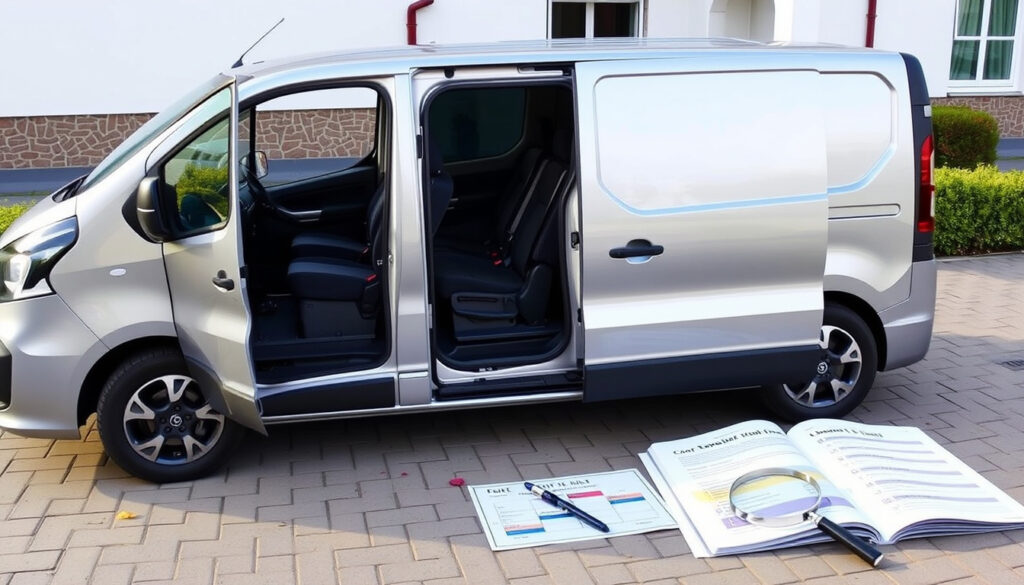
Renault Trafic 9-Seater: Problems, Buying Guide & Comparison
Planning to move nine people without stepping up to a full-size minibus can feel like a numbers game — and the Renault Trafic Passenger keeps appearing in that conversation. Renault UK now lists the nine-seat Advance from £45,385 before metallic paint, which puts it in family-shuttle territory rather than pure fleet territory.
Seating: up to 9 (Renault UK brochure) ·
Torque: up to 380 Nm (Smiths Motor Group) ·
Passenger length: approx 5,080–5,480 mm (Smiths Motor Group) ·
Boot volume: up to 5.7 m³ (Renault UK brochure)
Quick snapshot
- Seating for up to nine people (Renault UK brochure)
- Modular 5-, 6- or 9-seat layouts with up to 5.7 m³ boot volume (Renault UK brochure)
- Reliability rates are buyer-reported rather than factory-documented.
- Which trim is the best value depends on whether you need standard nine seats or can manage with optional extras.
- Ford Transit comparisons change by body variant, so there is no single “bigger” answer.
- Current UK range lists 110, 150 and 170 hp diesels (Renault UK (official site))
- Selected powertrains can be ordered with a nine-speed automatic (Renault UK (official site)) (Renault UK (official site))
- The Trafic nameplate has been around since 1980, with several generations behind it (Wikipedia (background))
- Choose short or long wheelbase; the LWB keeps up to 1,890 litres of boot with all seats in place (Smiths Motor Group)
- Check your UK licence entitlement for a nine-seat van before booking a test drive.
Five figures frame the decision: nine seats, diesel power, a realistic boot, and a price anchor. The rest is choosing which wheelbase fits your driveway and your load.
| Spec | Detail | Source |
|---|---|---|
| Seating | Up to 9 | Renault UK brochure |
| Seat layouts | 5, 6 or 9 | Renault UK brochure |
| Boot volume | Up to 5.7 m³ | Renault UK brochure |
| Load volume (cargo config) | Up to 6,000 litres | Letchworth Renault (dealer) |
| Power outputs | 110, 150 and 170 hp | Renault UK (official site) |
| Torque | Up to 380 Nm | Smiths Motor Group (dealer) |
| Transmission | 6-speed manual or 9-speed automatic | Renault UK (official site) |
| Length | Approx 5,080–5,480 mm | Smiths Motor Group (dealer) |
| Height / Width | Approx 1,973 mm / 1,956 mm | Smiths Motor Group (dealer) |
| Starting price | £45,385 | Renault UK (official site) |
Is the Renault Trafic a good buy?
For UK buyers, the Trafic Passenger makes sense when you genuinely need six, seven or nine seats without moving up to a much larger minibus. The price anchor starts at £45,385 for the Advance SWB nine-seat model, so compare it against a second-hand people carrier before you assume it is cheap. Independent reviews such as carwow’s independent review frame it as a practical, van-based choice rather than a glamorous one.
Overall value for money
- Entry-level Advance SWB nine-seat starts at £45,385 before metallic paint (Renault UK (official site)).
- Long-wheelbase Advance nine-seat starts at £47,035 (Renault UK (official site)).
- Extra trim standardises the nine-seat layout and adds equipment, from £49,165 SWB or £50,815 LWB (Renault UK (official site)).
Cost of ownership
The Trafic is a commercial vehicle underneath, so service intervals and parts prices follow van logic, not car logic.
- Diesel only in the UK range: 110 hp six-speed manual, plus 150 hp and 170 hp versions with nine-speed automatic options (Renault UK (official site)).
- Boot volume up to 5.7 m³ in nine-seat form, so luggage space is tighter than in a panel-van conversion (Renault UK brochure).
- Load volume expands to 6,000 litres if you drop the passenger seats and run it as a cargo van (Letchworth Renault (dealer)).
That flexibility is useful, but it means the same vehicle is trying to be two very different tools.
Resale value
- The factory nine-seat layout standard on Extra avoids the resale questions that come from aftermarket seat conversions (Renault UK brochure).
- Dealer-published dimensions and boot figures give buyers a consistent specification to compare, making a used search easier (Smiths Motor Group (dealer)).
The value case is strongest if you actually need nine seats or the modular layout. Buy a five-seat Advance and add seats later, and you lose both the factory specification and the warranty clarity.
The value proposition centres on the factory nine-seat configuration; without it, the cost case weakens.
What are the common problems with Renault Trafic?
No manufacturer publishes a common-fault league table, so the honest answer is that reported issues cluster in a few areas rather than affecting every van. On older and higher-mileage examples, the inspection checklist matters more than any single statistic.
Engine and transmission issues
- Check the timing chain and oil-change history on diesel engines; this is the first thing a mechanic will ask about.
- Ask for injector and AdBlue/DPF fault codes before committing to a high-mileage example.
- Drive the six-speed manual and, if possible, the nine-speed automatic on a cold start to feel for hesitation or clunks.
Emissions-system fault codes can be expensive on a used diesel Trafic, so never skip an independent pre-purchase inspection.
Electrical faults
- Test every sensor and screen during the test drive: parking aids, lane-keeping warnings, and the infotainment system.
- Check for warning lights on the dash, especially AdBlue and DPF warnings, and ask whether they were reset recently.
Body and interior wear
- Look at sills, wheel arches and door bottoms on older Trafics for rust.
- Open and close the sliding side door several times; passenger van doors get heavy use.
The pattern is not that every Trafic fails; it is that the failures that do appear tend to be electrical, emissions-related, or high-mileage mechanical items. A pre-purchase inspection is worth more than a one-year warranty on a used example.
What is the best Renault Trafic to buy?
The best version depends on your passenger count, how often you carry luggage, and whether you want a factory nine-seat layout or an optional one.
Engine options: dCi 110, 150 and 170
- The current UK range lists 110, 150 and 170 hp diesel outputs (Renault UK (official site)).
- Torque reaches up to 380 Nm (Smiths Motor Group (dealer)).
- A six-speed manual is the entry gearbox, with a nine-speed automatic on selected powertrains (Renault UK (official site)).
Trim levels: Advance vs Extra
- Entry Advance trim makes the nine-seat layout optional (Renault UK brochure).
- Extra trim makes nine seats standard and adds equipment (Renault UK brochure).
- Prices run from £45,385 for Advance SWB to £50,815 for Extra LWB before metallic paint (Renault UK (official site)).
Generation differences
- The latest brochure lists up to ten driver-assistance systems, which points to the updated generation rather than the older Trafic (Renault UK brochure).
- Nine-speed automatic availability is a useful sign that you are looking at a current-spec model (Renault UK (official site)).
- The Trafic nameplate has been in production since 1980, so the used market spans multiple generations (Wikipedia (background)).
For most families, the Advance LWB at £47,035 is the sensible middle: factory nine seats with extra length. If you want standard nine seats and more kit, Extra LWB is the one.
Is the Renault Trafic 9 seater?
Yes — the Trafic Passenger is sold as a nine-seater in both short- and long-wheelbase form, and Renault is explicit about how the seating is configured.
Passenger configurations
- The brochure lists modular 5-, 6- or 9-seat configurations (Renault UK brochure).
- Nine seats are standard on Extra trim and optional on entry Advance trim (Renault UK brochure).
Seat layout details
- Seating for up to nine people, including the driver, is the headline configuration (Renault UK brochure).
- The long-wheelbase version retains up to 1,890 litres of boot space with all seats in place (Smiths Motor Group (dealer)).
Boot space with 9 seats
- Boot volume is up to 5.7 m³ in nine-seat passenger form (Renault UK brochure).
- If you need more luggage room, the LWB is the version to choose (Smiths Motor Group (dealer)).
So yes, it is a true nine-seater. The catch is that boot space, while good for a van-based people carrier, still leaves less room than a panel-van conversion.
Which is bigger, Ford Transit or Renault Trafic?
Ford Transits are longer and payload-focused; the Trafic Passenger is shorter and more car-like. That is why the comparison usually comes down to how many people you actually move and where you park.
Exterior dimensions comparison
- Trafic Passenger length is approximately 5,080–5,480 mm (Smiths Motor Group (dealer)).
- Ford Transit length varies by body, but the Transit Minibus is longer than the Trafic in almost every configuration.
Interior load space
- The Trafic Passenger offers up to 5.7 m³ of boot volume in nine-seat form (Renault UK brochure).
- The Transit Minibus prioritises higher passenger capacity and larger dimensions for fleet use.
Cargo capacity
- The Trafic Passenger can reach up to 6,000 litres of load space when configured for cargo rather than maximum passenger capacity (Letchworth Renault (dealer)).
- The Transit Minibus offers larger payload for dedicated shuttle and fleet duties.
The implication: if you need a van that can also carry six or nine people, the Trafic is the more compact choice. If you need a minibus with serious payload and maximum people-moving capacity, the Transit is the stronger fleet tool.
The real difference is use-case. The Trafic Passenger is a people carrier with a van body; the Transit Minibus is a minibus first and a van second.
| Attribute | Renault Trafic Passenger | Ford Transit Minibus (typical) |
|---|---|---|
| Passenger capacity | Up to 9 (Renault UK brochure) | Higher, varies by body |
| Body length | Approx 5,080–5,480 mm (Smiths Motor Group) | Longer than the Trafic |
| Boot with nine seats | Up to 5.7 m³ (Renault UK brochure) | Seat-layout dependent, generally larger |
| Best fit | Family / small-group shuttle | Fleet and group transport |
These are the specifications Renault dealers and the official brochure actually quote for the current Passenger range. Use them as a checklist when you compare adverts.
| Spec | Detail | Source |
|---|---|---|
| Length | Approx 5,080–5,480 mm | Smiths Motor Group (dealer) |
| Height | Approx 1,973 mm | Smiths Motor Group (dealer) |
| Width excl mirrors | Approx 1,956 mm | Smiths Motor Group (dealer) |
| Boot volume | Up to 5.7 m³ | Renault UK brochure |
| Load volume (cargo config) | Up to 6,000 litres | Letchworth Renault (dealer) |
| Max seating | 9 | Renault UK brochure |
| Power outputs | 110, 150 and 170 hp | Renault UK (official site) |
| Torque | Up to 380 Nm | Smiths Motor Group (dealer) |
| Transmission | 6-speed manual / 9-speed automatic | Renault UK (official site) |
| Fuel | Diesel | Renault UK (official site) |
| Starting price | £45,385 | Renault UK (official site) |
Pros
- Factory nine-seat option on a mainstream van bodyshell
- 5.7 m³ boot with nine seats (Renault UK brochure)
- Up to 6,000 litres in cargo config (Letchworth Renault)
- Nine-speed automatic on selected engines (Renault UK)
Cons
- High list prices for Extra trim
- Commercial-vehicle interior on lower trims
- Diesel-only range in the UK
- Reliability concerns are owner-reported, not factory-shared
The comparison shows that the Trafic Passenger occupies a specific niche: a compact nine-seat people carrier rather than a full-size minibus.
Confirmed facts and what’s still unclear
Confirmed facts
- Nine-seat layout is available from the factory (Renault UK brochure)
- Length is approx 5,080–5,480 mm (Smiths Motor Group)
- Torque reaches up to 380 Nm (Smiths Motor Group)
- Boot volume is up to 5.7 m³ with nine seats (Renault UK brochure)
What’s unclear
- Real-world problem rates for timing chain, injectors and AdBlue
- Which trim is the best used-value buy
- Long-term reliability vs Ford Transit
- How individual examples have been maintained
The confirmed facts provide a reliable specification baseline, but the unclear areas underline the need for a thorough used-vehicle inspection.
What the sources say
The Trafic Passenger can provide up to 6,000 litres of load space when configured for cargo rather than maximum passenger capacity.
— Letchworth Renault (Renault dealer)
Diesel outputs range from 110 hp to 170 hp, with torque reaching up to 380 Nm.
— Smiths Motor Group (Renault dealer)
The nine-seat configuration is standard on Extra trim and optional on entry-level Advance.
— Renault UK brochure (manufacturer publication)
Summary
The Trafic Passenger is not a minibus pretending to be a van; it is a van-based people carrier that happens to seat nine people properly. Families and small shuttle operators should focus on the Advance LWB for value or the Extra LWB for standard nine seats and more equipment.
For UK families actually moving nine people, the choice is clear: buy the Trafic Passenger if you want compact dimensions and a factory nine-seat layout — or move up to a Ford Transit Minibus if payload and maximum capacity matter more. For more buying guides, see our Football Shirts Buying Guide and Rain Jackets: How to Read Waterproof Ratings.
renault.co.uk, pentagon-group.co.uk, pentagon-group.co.uk, hendy.co.uk
Frequently asked questions
Can I drive a Renault Trafic 9-seater on a standard UK driving licence?
A standard category B car licence generally covers vehicles up to 3,500 kg with up to 8 passenger seats. A nine-seat Trafic falls outside that in most cases, so check the current DVLA guidance or ask the dealer before you commit. The seat count is the part buyers underestimate.
What is the best van that can seat 9 people?
The Renault Trafic Passenger is one of the most available factory nine-seat vans in the UK; compare it with the Ford Transit Minibus only if you need a larger body.
How much does a used Renault Trafic cost in the UK?
New prices for the nine-seat Passenger range start at £45,385 and reach £50,815 before metallic paint (Renault UK). Used prices depend on age, mileage and whether the nine-seat layout is factory or aftermarket.
What is the fuel economy of the Renault Trafic diesel?
Renault UK does not publish a single headline figure in the material above; official fuel economy varies by engine and gearbox. Check the current brochure or dealer spec for the exact homologated figure.
Does the Renault Trafic come with Apple CarPlay?
Smartphone connectivity depends on model year and trim. The current brochure highlights the updated infotainment generation, but for CarPlay compatibility on a specific used or new example, confirm with the dealer rather than assuming it is standard.
What is the towing capacity of the Renault Trafic?
The research material did not include a single towing figure for the Trafic Passenger. Check the owner’s manual or dealer data for the exact limit for your chosen engine and body version.
Is the Renault Trafic available in an automatic transmission?
Yes — Renault UK lists a nine-speed automatic for selected Trafic Passenger powertrains. The entry 110 hp manual remains a six-speed gearbox.
More related posts
 Josh Hutcherson: Height, Relationships, Career, and FAQs
 Lawrence Shankland Rangers Transfer: Salary and Bio
 Digestive System: Steps, Organs, Function & Common Questions
 Katherine Devlin: Relationship, Nationality & Blue Lights Role
 Aidan Turner: Age, Height, Children, Poldark Wig & Smoking
 Benson Boone Mystical Magical: The Hit Single Breakdown
 Roller Skates vs Rollerblades: Which to Buy in Ireland (2025)
 Omari Hardwick: Biography, Power Career, and 50 Cent Feud