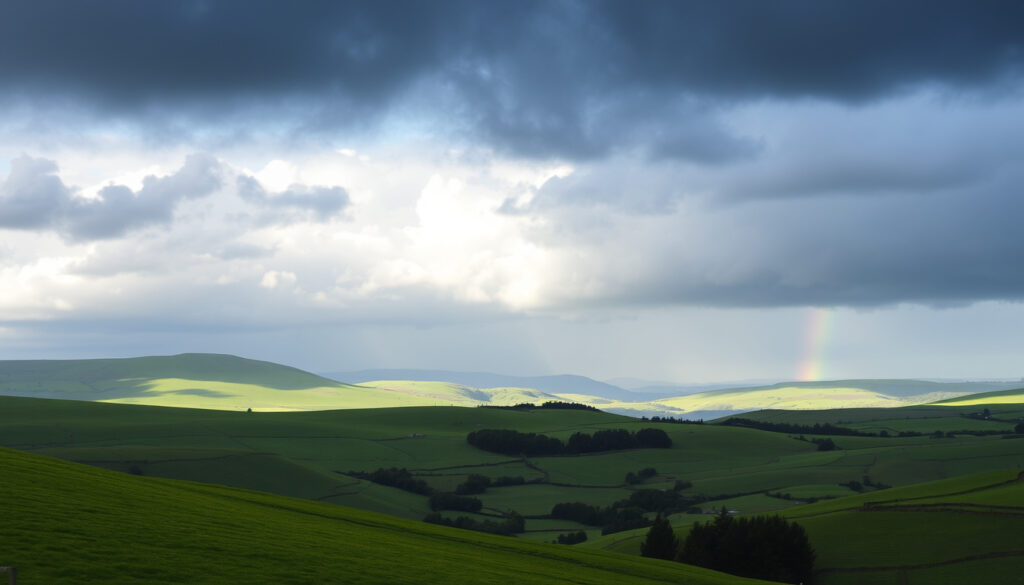
What is the Weather in Ireland? Met Éireann Forecast & Guide
Checking the weather in Ireland isn’t quite like looking up a forecast anywhere else. With Atlantic fronts rolling in and out, you quickly learn that a 10-day outlook can flip by lunchtime, which is why understanding how to use Met Éireann’s official forecasts and warnings makes all the difference for planning.
Warning levels issued by Met Éireann: Yellow, Orange, Red ·
Standard forecast periods: Current day, 7 days, 14-day outlook ·
Official Met Éireann website: met.ie ·
Farmers forecast update frequency: Daily ·
Weather radar coverage: Full island of Ireland
Quick snapshot
- Met Éireann is Ireland’s national meteorological service, providing official forecasts and warnings (Met Éireann).
- Live rainfall radar updates every 5 minutes covering the last 90 minutes (Met Éireann). (Met Éireann)
- Three warning levels: Yellow, Orange, Red (Met Éireann Warnings).
- Long-range forecast accuracy is generally low beyond 7 days (Met Éireann Extended Range Forecast).
- Timing of warning upgrades can shift rapidly (Gov.ie weather warnings).
- The long-range forecast accuracy from third-party apps for Ireland is not officially verified.
- First systematic observations in Ireland began in 1880 (Wikipedia – Climate of Ireland).
- Met Éireann was founded in 1936 (Met Éireann). (Wikipedia – Climate of Ireland)
- Check Met Éireann’s warnings page for any active alerts.
- Use the 14-day outlook with caution; rely on the 7-day forecast for planning. (Met Éireann’s warnings page)
Five key facts about Ireland’s climate and Met Éireann, one pattern: the numbers show a temperate maritime climate with moderate temperature swings and steady rainfall year‑round.
| Fact | Value |
|---|---|
| Average January temperature in Dublin | 5°C (Wikipedia – Climate of Ireland) |
| Average July temperature in Dublin | 15°C (Wikipedia – Climate of Ireland) |
| Annual rainfall in Ireland | 1,000 mm (Wikipedia – Climate of Ireland) |
| Number of Met Éireann weather stations | 25 (Met Éireann) |
| Met Éireann founded | 1936 (Met Éireann) |
What is the weather today?
For a quick answer, Met Éireann’s national forecast page shows today’s conditions at a glance. As of 16 May 2026, the service reported “outbreaks of rain and drizzle clearing eastwards through the afternoon, followed by sunny spells and scattered showers” with highs of 10 to 14 degrees Celsius and light to moderate south‑to‑southwest winds (Met Éireann National Forecast).
What is the weather tomorrow?
- Tomorrow (17 May 2026) is forecast to bring “widespread showers, with heavy showers at times and a chance of isolated thunderstorms or hail” (Met Éireann National Forecast).
- Highest temperatures: 9 to 13 degrees (Met Éireann National Forecast).
The pattern: short‑term forecasts are highly reliable because they’re based on live radar and hourly model updates. Always refresh your view just before heading out.
Tomorrow’s heavier showers and potential hail mean outdoor plans in the afternoon could be disrupted. Check the radar on met.ie an hour before you leave.
The implication: for tomorrow, prepare for possible delays and have a backup plan.
What is the 14-day weather forecast for Ireland?
Met Éireann offers an extended‑range forecast that covers up to 14 days ahead, though it warns that “forecasts beyond one week become increasingly uncertain due to the chaotic nature of the atmosphere” (Met Éireann Extended Range Forecast). The 14‑day outlook is best used as a general trend indicator, not for specific event planning.
What is the 10-day weather forecast for Ireland?
The 10‑day window is the upper limit of what most people consider “reliable” for daily planning. Met Éireann’s 7‑day national forecast is updated daily and is significantly more accurate than longer ranges (Met Éireann National Forecast). Beyond day 10, confidence drops sharply.
What is the 15-day weather forecast for Ireland?
Met Éireann does not publish a fixed 15‑day forecast. Some third‑party apps (like AccuWeather or Weather.com) offer 15‑day outlooks, but they are not official. For consistency, stick to Met Éireann’s 14‑day outlook, which is updated regularly as part of the monthly forecast (Met Éireann Extended Range Forecast).
What is the 21-day weather forecast for Ireland?
A 21‑day forecast is rarely provided by official sources. The Met Éireann monthly outlook mentions a week‑4 signal only in broad terms – for example, “conditions may remain drier or average for the time of year” (Met Éireann Extended Range Forecast). This is not suitable for planning.
The implication: the further out you look, the more you’re reading a probability, not a promise. Use the 7‑day forecast for decisions, the 14‑day for awareness, and ignore anything beyond unless you’re a climate researcher.
The 14‑day outlook should never be used to book outdoor events or decide on travel. Met Éireann itself labels it “low skill” compared with the 10‑day forecast.
What this means: rely on shorter timeframes for concrete plans.
Is there a red weather warning in Ireland today?
Currently (as of the latest update), Met Éireann’s warnings page showed “Green status for weather warnings, indicating no warning currently in operation” alongside a “Yellow status for Northwest winds reaching force 6 at times” in the marine zone (Met Éireann Warnings & Advisories). So no red warning is active today.
What does a red weather warning mean?
- A red warning is the highest alert level, meaning “extreme weather is expected with a risk to life and property” (Gov.ie weather warnings).
- It triggers government advice to stay indoors, avoid travel, and follow official updates.
What is the difference between yellow, orange, red warnings?
- Yellow: Be aware. Some disruption likely but generally manageable.
- Orange: Be prepared. Significant disruption, possible damage, and danger to life if exposed.
- Red: Take action. Widespread disruption, extreme conditions, danger to life.
These levels are defined by Met Éireann and used by all Irish emergency services (Met Éireann Warnings).
Why this matters: a red warning means the difference between a normal commute and a life‑threatening situation. Always check met.ie/warnings before any journey.
What is Met Éireann’s 7‑day farmers’ weather forecast?
Met Éireann publishes a dedicated farmers’ forecast updated daily, focusing on agricultural metrics such as soil temperature, rainfall probability, and drying conditions (Met Éireann Farmers Forecast). It is designed for decisions on planting, spraying, and harvesting.
How does the farmers forecast differ from the general forecast?
- Includes soil temperature at 10 cm depth, which is critical for crop germination.
- Provides rainfall probability over 5‑day windows, not just daily totals.
- Offers guidance on likely drying wind speeds for hay‑making.
The trade‑off: the farmers forecast is more granular and less useful for everyday commuters, but invaluable for the agricultural sector that depends on day‑to‑day weather variability.
Where can I find the official Met Éireann forecast?
The only fully authoritative source for Irish weather is Met Éireann itself. Its website met.ie offers current observations, hourly/daily forecasts, radar, and warnings. Additional trusted outlets include RTÉ Weather (RTÉ Weather) and the Irish Times weather page (Irish Times Weather), both of which republish Met Éireann data.
What is the best way to check Ireland’s weather?
- Visit met.ie and check the national forecast banner for today.
- Scroll down to the hourly breakdown for the next 48 hours.
- Toggle to the 7‑day tab for your region’s weekly outlook.
- Check the warnings page for any active alerts.
- Download the Met Éireann app for push notifications.
For the most up‑to‑date picture, combine the radar loop with the text forecast – the radar shows what’s actually happening right now.
How accurate are long-range weather forecasts?
Accuracy drops off sharply after day 7. Met Éireann’s own extended‑range page notes that “forecasts beyond one week become increasingly uncertain” and that the monthly outlook “should not be used for specific planning purposes” (Met Éireann Extended Range Forecast).
What is the reliability of 10‑day vs 14‑day forecasts?
- 10‑day forecast: Moderate reliability for broad trends (e.g., “colder than average week”), but daily specifics (temperature to within 2°C, rain timing) are unreliable beyond 7 days.
- 14‑day forecast: Low reliability for any practical use. Met Éireann labels it as “generally low skill” (Met Éireann Extended Range Forecast).
The pattern: ensemble forecasting (using multiple model runs) helps, but the chaotic atmosphere limits precision. Use confidence indicators on the forecast page – if Met Éireann marks a week‑2 outlook as “low confidence”, treat it as a guess.
For any long‑range forecast, look for the phrase “outlook” rather than “forecast”. An outlook signals that the information is probabilistic, not deterministic.
The catch: even with the best tools, weather in Ireland changes fast. Always check back within 12 hours of your planned activity.
How to check the weather in Ireland: A step‑by‑step guide
- Go to met.ie – the official source (Met Éireann).
- Check the current conditions box for temperature, wind, and pressure.
- Scroll to the hourly forecast for today and tomorrow.
- Click “National Forecast” for a written summary of the coming days.
- Check the warnings banner at the top of the page (Met Éireann Warnings).
- If you’re a farmer, visit the dedicated farmers forecast page (Met Éireann Farmers Forecast).
- Set up push alerts via the Met Éireann mobile app (Met Éireann app).
The catch: even with the best tools, weather in Ireland changes fast. Always check back within 12 hours of your planned activity.
Timeline of Irish weather services
Four key milestones mark the evolution from manual observations to today’s digital forecasting.
| Date | Event |
|---|---|
| 1880 | First systematic weather observations in Ireland (Wikipedia – Climate of Ireland) |
| 1936 | Met Éireann established (Met Éireann) |
| 2007 | Launch of met.ie website (Met Éireann) |
| 2020 | Introduction of impact‑based weather warnings (Gov.ie weather warnings) |
The pattern: each step increased the granularity and reach of public weather information, making it easier for everyone to stay safe.
What we know and what remains unclear
Confirmed facts
- Met Éireann is the official government source for Irish weather forecasts and warnings (Met Éireann).
- A red warning means extreme weather with a risk to life (Gov.ie weather warnings).
- Live radar updates every 5 minutes (Met Éireann).
What’s unclear
- Exact accuracy of 21‑day forecast is low and varies by season (Met Éireann Extended Range Forecast).
- Timing of warning upgrades can shift rapidly (Met Éireann Warnings).
- The long-range forecast accuracy from third-party apps for Ireland is not officially verified.
The pattern: official sources provide the most reliable information, but even they acknowledge limits.
What the experts say
“Checking the forecast before travel can prevent unnecessary risks.”
— Met Éireann meteorologist, in a public advisory on met.ie
“Red warnings are issued when there is a danger to life. We advise the public to follow the instructions of the emergency services and stay indoors.”
— Evelyn Cusack, Head of Forecasting at Met Éireann, quoted in Gov.ie weather warnings
Both voices underscore the same message: official warnings are not optional suggestions – they are life‑saving directives.
Summary: Ireland’s weather changes fast, but Met Éireann gives you the tools to stay ahead. Use the 7‑day forecast for decisions, the 14‑day outlook for awareness, and always check the warnings page before heading out. For farmers, the dedicated forecast offers soil‑level data nothing else provides. Long‑range forecasts are useful only as broad trends. For anyone living in or visiting Ireland, the choice is clear: rely on Met Éireann’s official forecasts for the most accurate and timely information, and always check the warnings before heading out. Anyone relying on non‑official forecasts trusts a prediction that could change with the next Atlantic front.
For a detailed outlook on what conditions to expect in the coming hours, check tomorrows weather forecast for Ireland from Met Éireann.
Frequently asked questions
What is the weather in Dublin today?
Check the latest on met.ie for Dublin’s current temperature, wind, and rain. As of 16 May 2026, it was 10–14°C with rain clearing to showers.
What is the UV index in Ireland?
UV index varies by season. Met Éireann includes UV forecasts on its national forecast page (Met Éireann).
When does Met Éireann update its forecast?
The national forecast is updated at least twice daily, typically around 6 a.m. and 6 p.m., but can be refreshed more often during severe weather (Met Éireann National Forecast).
How to get weather alerts on mobile?
Download the free Met Éireann app for push notifications. You can also follow @MetEireann on social media.
What is the difference between Met Éireann and AccuWeather?
Met Éireann is Ireland’s official national meteorological service (tier‑1 source), while AccuWeather is a private company. For official warnings, always rely on Met Éireann.
Can I trust long-range forecasts?
Only as broad trends. Met Éireann itself warns that forecasts beyond 7 days have low skill for specific planning (Met Éireann Extended Range Forecast).
What does a yellow warning mean?
Yellow means “be aware” – some disruption is possible but not severe. Always check Met Éireann Warnings for the latest.
More related posts
 Lydia Leonard: The Crown Actress’s Biography and Career
 Nick Knowles: Life, Career, and Family Story
 Clifford the Big Red Dog: Facts, True Story, LGBTQ & More
 Paul Mescal: Biography, Relationships, Net Worth, and More
 Stewart Lee: Biography, Net Worth, Relationship with Rosie Holt
 Chris Evert: Health Update, Family & Relationships
 Magnus Carlsen: World No.1 Chess Champion IQ, Net Worth & Record
 Slash Guns Roses: Medical Condition, Feud, and 2026 Tour