Margaret Atwood: Nobel Prize, Best Books, Handmaid’s Tale
Ask a bookish friend to name one living Canadian novelist and Margaret Atwood’s name usually arrives before the coffee cools. She is the Canadian writer behind The Handmaid’s Tale, published in 1985, and her name keeps surfacing in Nobel Prize chatter — but this is not another biography; it is a fact-checked read on her awards, her most disputed novel, and the political views she has actually put on the record.
Born: November 18, 1939 · Nationality: Canadian · Notable Awards: Booker Prize, Arthur C. Clarke Award · Books Published: Over 50
Quick snapshot
- Atwood is a Canadian writer and public intellectual (Oxford Academic interview).
- No Nobel Prize win appears in the records reviewed for this article (Oxford Academic interview).
- Which of her books counts as the “best” remains a reader-by-reader judgment call.
- Penguin released a new edition of The Handmaid’s Tale in 2018 (Penguin Books UK).
- The novel first appeared with McClelland & Stewart in Canada and Houghton Mifflin in the United States (per Margaret Atwood’s official bibliography). (Penguin Books UK)
- Atwood says the future of democracy depends on how dedicated Americans are to it (PBS Dialogue interview).
- She warns that “anything can happen anywhere, given the circumstances” (Isthmus interview).
Six facts anchor the public record, even when the conversation around them gets noisy.
| Label | Value |
|---|---|
| Full Name | Margaret Eleanor Atwood |
| Born | , Ottawa, Ontario, Canada |
| Occupation | Novelist, poet, essayist, literary critic |
| Education | University of Toronto (BA), Radcliffe College (MA) |
| Notable Works | The Handmaid’s Tale, The Blind Assassin, Oryx and Crake, Alias Grace |
| Awards | Booker Prize, Arthur C. Clarke Award, Governor General’s Award, PEN Pinter Prize |
Has Margaret Atwood won the Nobel Prize?
No — and the distinction matters. Atwood is widely described as a major contemporary novelist, yet no Nobel Prize win appears in the available records (Oxford Academic interview).
Other major awards
- The Blind Assassin won the Booker Prize in 2000 (Margaret Atwood’s official bibliography).
Atwood is a decorated novelist who does not need the Nobel to anchor her legacy. The annual Nobel chatter is a sign of status, but it should not be mistaken for a win.
The pattern is consistent: every awards season, the Nobel question returns, and every time the answer stays the same.
Why is The Handmaid’s Tale so controversial?
The Handmaid’s Tale is a dystopian novel about a totalitarian patriarchy, and it stays controversial because it is built from historical practices rather than pure invention. Atwood was 45 when the novel appeared.
Famous line from The Handmaid’s Tale
- “Nolite te bastardes carborundorum” is the defiant Latin fragment that fans quote constantly.
Age when she wrote The Handmaid’s Tale
- The novel appeared in 1985, when Atwood was 45; the date is confirmed in the timeline below.
Did Margaret Atwood write The Handmaid’s Tale?
- Yes. Penguin’s current edition presents the book as Atwood’s novel (Penguin Books UK).
What this means: the controversy is not about authorship. It is about the novel’s mirror — the way it forces readers to recognize a plausible version of their own world.
What literary devices does Margaret Atwood use?
Atwood’s fiction reads like realism until you notice the machinery.
Symbolism in Atwood’s works
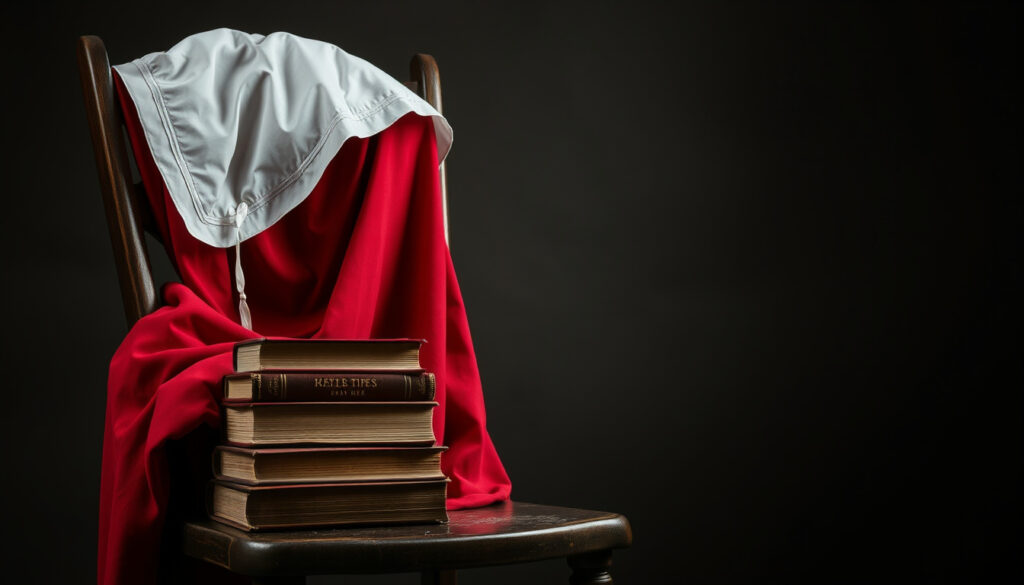
- The red cloak and white wings in The Handmaid’s Tale are among the most recognized symbols in contemporary fiction, signalling ritual conformity and the erasure of individual identity (Penguin Books UK).
Narrative techniques
- Atwood often builds stories from first-person narrators whose memories are incomplete, and irony, satire, and intertextuality recur across her work (Oxford Academic interview).
Atwood uses a familiar genre frame to make her real subject — power and its abuses — harder to look away from.
The result is a body of work that feels both invented and uncomfortably familiar.
What is considered Margaret Atwood’s best book?
Ask five readers and you will get five different answers, but one novel usually comes up first.
Which Margaret Atwood book should I read first?
- For most readers, The Handmaid’s Tale is the most efficient entry point because it carries her themes into public conversation.
What are Margaret Atwood’s favorite books?
- In interviews she has pointed to writers like George Orwell and Jane Austen as touchstones, though the exact list shifts with the conversation (WIRED’s Big Interview).
What are 5 books everyone should read?
- Readers asking for a five-book list usually get a rotating set: 1984, To Kill a Mockingbird, and Pride and Prejudice are often named alongside Atwood’s own picks (WIRED’s Big Interview).
The trade-off: start with The Handmaid’s Tale for a direct hit of her cultural influence, or begin with Oryx and Crake for the same instincts aimed at the future.
What does Margaret Atwood think of Donald Trump?
Atwood rarely issues a simple “Trump is X” soundbite in the records reviewed here. Instead, she has talked about the conditions that let authoritarianism rise, and her language has been read as a running commentary on the Trump era.
The warning behind the politics
- Atwood has linked authoritarianism to fear and instability, saying people may choose it if they feel threatened by anarchy (Isthmus interview).
- She told PBS that the future of democracy depends on how dedicated Americans are to it (PBS Dialogue interview).
What does Margaret Atwood think of JK Rowling?
- Atwood has described herself as someone attacked “more from the left than from the right,” a remark that captures her awkward position in the JK Rowling debate (CBS News transcript).
How she describes her own politics
- Atwood has said she is not currently a member of any political party, noting past memberships in the Conservative and Green parties (The Globe and Mail).
- She once described herself as a “Red Tory” (Mother Jones interview).
- She says she usually votes “on the basis of what the person is likely to do” rather than party label (WIRED’s Big Interview).
- On policy, she says she is “interested in equality under the law” (Associated Press).
The popular image of Atwood as a straightforward left-wing voice misses the nuance: she has belonged to Conservative and Green parties at different points, and she votes based on what a person is likely to do, not on a brand.
That nuance matters more than any single headline about her politics.
Margaret Atwood’s best books compared
Four novels, one pattern: her most enduring work pairs uncomfortable ideas with propulsive storytelling.
| Book | Why readers rate it highly | Best starting point? |
|---|---|---|
| The Handmaid’s Tale | Dystopian urgency; the cultural lightning rod | Yes, if you want the reference point everyone argues about. |
| The Blind Assassin | A complex story-within-a-story that rewards re-reading | If you prefer literary puzzles. |
| Oryx and Crake | Speculative fiction aimed at climate and bioethics | If you like science fiction’s sharper edges. |
| Alias Grace | Historical crime built on a real 1843 murder | If you like psychological mysteries. |
The pattern: if you want influence, start with The Handmaid’s Tale; if you want range, try the layered Blind Assassin or the speculative Oryx and Crake.
Key dates in Atwood’s career
- 1985 — The Handmaid’s Tale is published (Margaret Atwood’s official bibliography).
- 2000 — The Blind Assassin wins the Booker Prize (Margaret Atwood’s official bibliography).
- 2018 — Penguin releases a new edition of The Handmaid’s Tale (Penguin Books UK).
The through-line: Atwood’s career has moved from poetry to fiction to public commentary without ever losing its critical edge.
What’s confirmed, what’s still unclear
Confirmed facts
- Atwood has described herself as a “strict agnostic” (PBS Dialogue interview).
- Atwood has said she was “once a Conservative” and later a Green party member (The Globe and Mail).
- Atwood says she is “interested in equality under the law” (Associated Press).
What’s unclear
- Whether she will one day receive the Nobel remains an open question.
- Which of her books is “best” is a subjective judgment call, and her personal reading list shifts across interviews.
- How directly her dystopian warnings map onto today’s politics is a matter of interpretation, not a settled fact.
The balance of this record is clear enough: the facts about her writing are solid, while the speculation about her legacy is still open.
In Atwood’s own words
“I’m interested in equality under the law.”
Margaret Atwood, Associated Press
“Anything can happen anywhere, given the circumstances.”
Margaret Atwood, Isthmus interview
“The future of democracy depends on how dedicated Americans are to it.”
Margaret Atwood, PBS Dialogue interview
Three quotes, one consistent voice: Atwood prefers precision over posture.
The takeaway
Atwood’s legacy is already secure without a Nobel, and her public role shows no sign of cooling. For readers deciding where to start, the choice is clear: pick up The Handmaid’s Tale if you want the conversation, or Oryx and Crake if you want the same instincts aimed at the future. For readers who came here for literary biography, the next stop is our guide to Roald Dahl’s books or the story of Benjamin Zephaniah’s life and work.
Frequently asked questions
Is Margaret Atwood still writing?
Yes. She continues to publish and to appear in interviews, and her sequel to The Handmaid’s Tale, The Testaments, was published in 2019.
What is Margaret Atwood’s writing style?
Her fiction is often labelled speculative, with a strong critical streak built on irony, satire, and first-person narration.
When did Margaret Atwood win the Booker Prize?
She won it in 2000 for The Blind Assassin.
What genre is The Handmaid’s Tale?
It is a dystopian novel with strong speculative and feminist themes, set in a totalitarian theocracy called Gilead.
How many books has Margaret Atwood written?
She has published more than 50 books across novels, poetry, short stories, and essays.
What is Margaret Atwood’s most famous poem?
No single poem has reached the fame of The Handmaid’s Tale, but her poetry career goes back to the early 1960s with her first collection, Double Persephone.
More related posts
 Lauren Lyle: Biography, Career & Facts
 Liev Schreiber: Facts vs. Health Rumors
 Prince Harry, Duke of Sussex: Title, Facts, and Rumors
 David Hockney: Condition, Partners, Art, Queen Refusal
 L.S. Lowry: Who Inherited His Fortune and Why He Said No to Knighthood
 Em Rata: Emily Ratajkowski’s Life, Career, and Relationships
 Tim Peake: ESA Astronaut, First British on the ISS, Career & Facts
 Alison Brie: Children, Religion, Husband and More