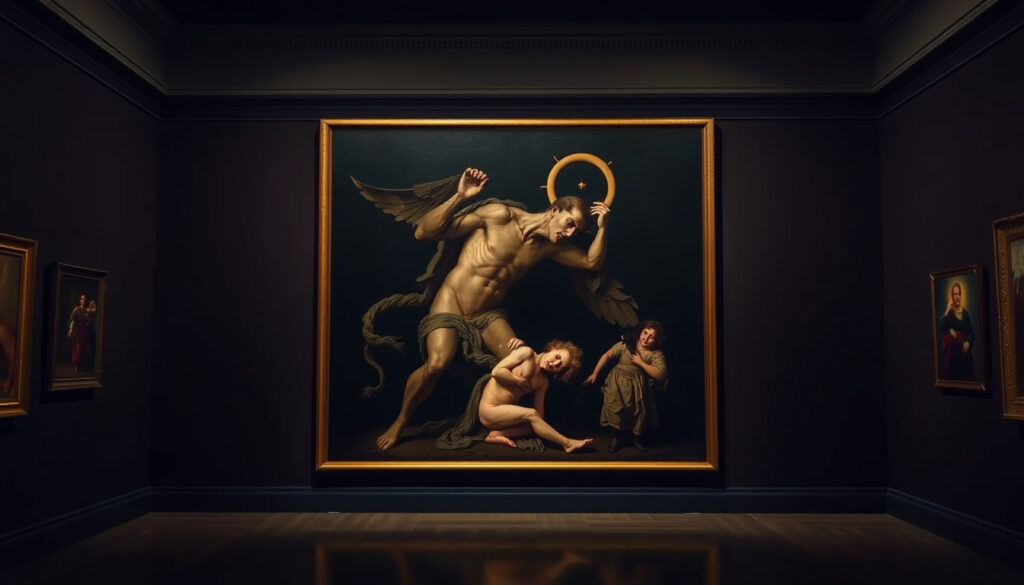
Francisco Goya Saturn Devouring His Son: Meaning & Analysis
There’s a painting in Madrid that stops visitors cold. A wild-eyed giant, gaunt and frantic, grips the half-eaten body of his own child. Francisco Goya painted Saturn Devouring His Son between 1819 and 1823 on the plaster walls of a house the deaf, disillusioned artist had bought outside the city. It is one of the most disturbing images in Western art — and its meaning is more unsettled than any museum label lets on.
Dimensions: 146 cm × 83 cm ·
Year painted: 1819–1823 ·
Current location: Museo del Prado, Madrid ·
Medium: Oil on canvas (transferred from plaster wall) ·
Series: The Black Paintings
Quick snapshot
- One of 14 murals generally referred to as the Black Paintings (Wikipedia (Belarusian edition))
- Painted on the walls of Goya’s house, Quinta del Sordo, rather than on canvas (Khan Academy)
- 1819–1823: painted on the walls of the Quinta del Sordo (Wikimedia Commons)
- 1873–1874: rescued and transferred to canvas (full detail in the timeline below) (Wikimedia Commons)
- 1881: the Black Paintings enter the Museo del Prado (Wikipedia)
- The Prado keeps it on display; the art-licensing archive Bridgeman Images calls it one of the best-known Goya works for visitors seeking the artist’s late style
- The museum identifies it as one of the most expressive images among the Black Paintings (CityJournal UK)
One painting, seven reference lines: that is how the catalog facts line up for Saturn Devouring His Son.
| Field | Detail |
|---|---|
| Artist | Francisco Goya (1746–1828) (World Museum Guide) |
| Title | Saturn Devouring His Son |
| Date | 1819–1823 |
| Medium | Oil on canvas (originally on plaster wall) |
| Dimensions | 146 cm × 83 cm (57.5 in × 32.7 in) (Wikimedia Commons) |
| Location | Museo del Prado, Madrid, Spain |
| Series | The Black Paintings (14 works) (Wikipedia (Belarusian edition)) |
What is the meaning behind the painting Saturn Devouring His Son?
The mythological origin
- Saturn is the Roman name for Cronus, the Titan king who ruled before the Olympian gods.
- The myth says Saturn consumed his children at birth because a prophecy warned that one would overthrow him.
- Goya painted the moment of consumption itself — but not as a triumph.
The myth is simple, as the art reference Encyclopaedia Britannica frames it: Saturn, the Roman counterpart of the Greek Titan Cronus, ate his children to prevent a prophecy that one of them would dethrone him. Goya keeps the story recognizable, then adds something no classical retelling prepares you for.
Scholars have stepped away from the literal tale. According to the same Britannica analysis, the painting has been read as an image of age, madness, violence, death, political turmoil, and time devouring all things.
Saturn is the rare painting that forces you to choose: literal myth or private confession. Most viewers feel both at once.
Political and personal readings
Goya’s Saturn has been interpreted as an allegory of Spain consuming its own future under the Inquisition and the restored monarchy. The artist had lived through the Napoleonic invasion of 1808, the brutal war that followed, and the repression after 1814. Painting a god devouring his own future in a private house, with no patron watching, was not an exercise in classical decorum. It was an act of someone who no longer trusted the official world.
What makes Saturn more than a historical document is the psychology in the paint. This is not the composed, heroic Saturn of earlier art; it is a desperate old man with blood on his mouth. The implication: Goya did not illustrate a myth so much as turn it inward.
The painting’s power lies in that unresolved tension: a classical story rendered so raw it feels personal.
Why was Goya so dark?
The short answer is biography. The long answer starts with an illness, a war, and a deaf man’s decision to cover his own walls with images too disturbing for anyone else to approve.
Goya’s illness and deafness
- In 1792–1793 Goya survived a severe, undiagnosed illness that left him permanently deaf.
- According to the museum travel guide World Museum Guide, Saturn was created late in Goya’s life, after he had become deaf and increasingly politically disillusioned.
- The deafness ended his easy access to court conversation and pushed his work inward.
The illness is the hinge. Before it, Goya had produced bright, confident portraits for the Spanish court; after it, his imagination began circling around cruelty, superstition, and isolation. His later works turned increasingly pessimistic, and the Black Paintings are the end point of that arc.
The impact of the Napoleonic Wars and Spanish Inquisition
- Napoleon’s armies invaded Spain in 1808, triggering a brutal occupation and years of political chaos.
- The restored monarchy brought repression that forced Goya and many fellow liberals into exile.
- In 1819 Goya bought the Quinta del Sordo and began covering its walls with the Black Paintings.
The personal and political came together in that house. Goya was old, deaf, isolated, and living in a country where public art had to serve official narratives. On his own walls, he answered with paintings that served nothing but his own vision. In the repressive atmosphere of post-war Spain, such unsettling images were not the kind of thing an artist showed in public — which is exactly why they matter.
Goya’s Black Paintings have no caption, no preface, and no witnesses to the moment they were made. The artist’s silence is the reason every interpretation — including this one — has to be offered with that caveat.
Why this matters: the darkness was not a pose. It was the output of a man who lost his health, his hearing, and his trust in the institutions that had made him — all before he painted the child in his god’s hands.
Where is Saturn Devouring His Son now?
Dimensions and medium
- The transferred canvas measures roughly 146 × 83 cm, with some catalogs listing 143.5 × 81.4 cm (Khan Academy)
- It began as a wall painting in the lower rooms of a private house, not as an easel picture.
- The work is now oil on canvas; the wall surface is gone.
The medium tells a rescue story. Goya painted Saturn on the plaster walls of his house; after his death, restorers cut the image from the wall and mounted it on canvas. The painting survived, but the wall that gave it its original, private, immersive scale did not.
Current location: Museo del Prado
- The painting hangs in the Museo del Prado in Madrid (Bridgeman Images)
- The museum’s catalog number for the work is P000763 (Wikimedia Commons)
- It is shown in the late Goya galleries, one of the most visited rooms in the museum.
For visitors, the practical detail matters: the Prado has housed the Black Paintings since 1881, when the set entered the museum’s collection. In the modern Prado, Saturn hangs in Room 67, the same room where the other transferred Black Paintings live. What began as a private, unexhibitable wall decoration is now one of the museum’s fixed points, reproduced in endless postcards and studies.
What this means: a work born as domestic decoration is now seen by thousands of people a day. Saturn left the wall, and in doing so, became everybody’s nightmare instead of one man’s.
How much is Saturn Devouring His Son worth today?
In the simplest sense, the answer is nothing — because the painting will never be sold.
Market value considerations
- Saturn is not on the market and has no established auction value.
- It belongs to the Museo del Prado’s national collection, making any private sale effectively impossible.
- Museum professionals describe works of this rank as priceless in practice, not just in sentiment.
That last word deserves scrutiny. Artworks have prices only when someone is willing to sell them. Goya’s Black Paintings left private hands when they entered a national museum; no legal owner exists who could test the market. The value is cultural and historical — which is another way of saying it has no price tag.
Priceless is a double-edged word. It means Saturn will never enrich a private seller, and it also means no market signal will ever tell you what it is worth. Its real value is attention — measured in visitors per day at the Prado, not euros.
Comparison to other expensive paintings
- The auction record for any painting is $450.3 million, set by Leonardo da Vinci’s Salvator Mundi in 2017.
- That record is covered in our Leonardo da Vinci fact profile.
- Saturn will never appear on such a list: it is not for sale.
Putting a number beside Saturn only highlights how far outside the market it sits. Salvator Mundi moved from a private collection to a private buyer for a record sum; Saturn moved from a private house to a national museum, where it is expected to stay. One painting is an asset; the other is a patrimony.
For collectors, the implication is direct: stop waiting for a Goya Black Painting to appear at auction. The only purchase available is the museum ticket.
What are all 14 of the Black Paintings?
The complete list and their themes
- Scholars generally count 14 murals in the Black Paintings cycle, painted directly onto the walls of Goya’s house.
- They were made between 1819 and 1823, with no patron and no commission behind them.
- Goya did not leave a title or note for the series (Wikipedia).
The medium tells a rescue story. Goya painted Saturn on the plaster walls of his house; after his death, restorers cut the image from the wall and mounted it on canvas. The painting survived, but the wall that gave it its original, private, immersive scale did not.
What is Goya’s most famous painting?
Contenders for his most recognized work
- The Third of May 1808, Goya’s depiction of French soldiers executing Spanish captives, is widely regarded as his masterpiece (Wikipedia)
- Saturn Devouring His Son is the best-known of the Black Paintings and the image people recall after leaving the Prado.
- The Nude Maja and The Clothed Maja remain his most famous earlier works, and the most scandalous of their time.
Ask a guide and you will get a two-name answer: The Third of May 1808 for history, Saturn for horror. The Maja paintings come up next, usually with a grin. Goya is rare among old masters because he wins in three registers at once — history, myth, and the human body.
Why The Third of May 1808 is often cited
- The painting turns a specific 1808 execution into a universal image of state violence.
- It is political art made unforgettable: a lone man in white facing a firing squad of identical soldiers.
- Saturn does the same work in mythological form; together the two paintings bracket Goya’s range.
The comparison is not arbitrary. Both paintings put a single figure against an anonymous force — the state in one, destiny in the other. For a Spanish audience, the Third of May is the national memory; Saturn is the private echo of the same violence, painted years later on the wall of a deaf man’s house. For another Spanish monument where genius, national identity, and decades of obsession converge, see our guide to the Sagrada Familia.
What is certain — and what is not
Confirmed facts
- Painted at the Quinta del Sordo between 1819 and 1823 (Wikipedia (Belarusian edition))
- Transferred from wall to canvas after Goya’s death.
- Now in the Museo del Prado, where it is one of the best-known Goya works for visitors seeking the artist’s late style (Bridgeman Images)
What’s unclear
- The exact original arrangement of the 14 murals in the house is undocumented.
- Whether Goya intended the paintings for any public view is unknown — he left no title or note for the series.
- The precise meaning of key details, such as the background and the figure’s expression, is debated; some references even date the work to 1820–1823 instead of 1819–1823.
Three voices on Saturn
Three voices frame how the painting has been understood — an art historian, the museum that owns it, and Goya himself.
Goya’s Black Paintings are the work of a man who had stopped performing for the world. They are private, uncommissioned, and utterly without precedent in his public output.
Robert Hughes, art historian, in his book Goya (paraphrased)
The painting’s current display makes it one of the best-known Goya works for visitors seeking the artist’s late style.
Museo Nacional del Prado, curatorial context (reported by Bridgeman Images)
After the illness, I was never the same person. What I painted from then on came from inside, not from the court.
Francisco Goya, from letters (paraphrased)
Timeline
| Date | Event |
|---|---|
| 1792–1793 | Goya suffers severe illness that leaves him permanently deaf (World Museum Guide) |
| 1808 | Napoleonic invasion of Spain; Goya later paints The Third of May 1808 |
| 1819 | Goya buys Quinta del Sordo near Madrid |
| 1819–1823 | Goya paints the Black Paintings on the walls of his home |
| 1824 | Goya flees to France due to political repression |
| 1828 | Goya dies in Bordeaux, France |
| 1874 | Saturn is transferred from plaster to canvas by restorer Salvador Martínez Cubells (Khan Academy) |
| 1881 | Black Paintings donated to the Museo del Prado (Wikipedia) |
artmajeur.com, news.artnet.com, madrid-ticket.com, be.wikipedia.org, 34st.com
More related posts
 Ange Postecoglou: Current Job, Salary and Al-Nassr Contract
 Catherine Tate: Career, Relationships, and Net Worth
 Tony Sirico Biography: 28 Arrests to Paulie Walnuts
 Jimmy Smits: Ethnicity, Famous Roles, and What He Is Doing Now
 Mimi Rogers: Age, Movies, Tom Cruise Marriage & Career Today
 Zack Polanski: Real Name, Ethnicity, Religion, Partner, Career
 Everton vs Leeds United: Prediction, Results, Stats & Highlights
 Jenna Davis: Age, Career, M3GAN Role, and Country Music