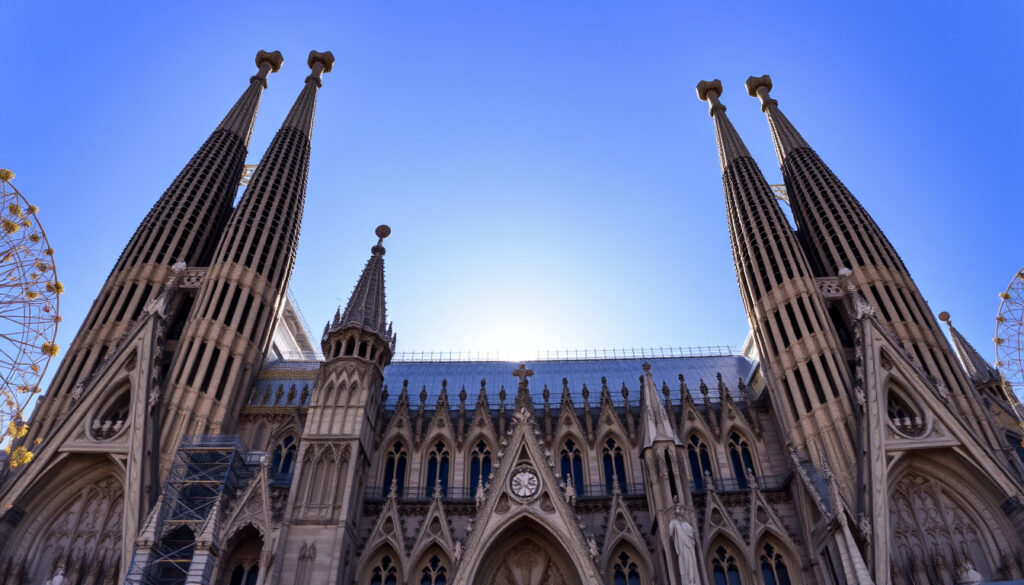
Sagrada Familia: 2026 Completion, History, and Visit Tips
There’s something quietly humbling about a building that outlasts every person who started it. The Sagrada Familia in Barcelona has been rising stone by stone for 144 years, surviving war, funding gaps, and the death of its visionary architect.
Construction started: 1882 ·
Expected completion: 2026 ·
Final height: 172.5 m (566 ft) ·
Annual visitors (pre-COVID): ~4.5 million ·
Number of towers: 18
Quick snapshot
- Construction started 1882 under architect Francisco de Paula del Villar (Sagrada Familia official home)
- Gaudí took over in 1883 and transformed the design (Vatican News)
- Completion targeted for 2026, the centenary of Gaudí’s death (Sagrada Familia prices)
- Tower of Jesus Christ reached final height in 2025 (Sagrada Familia FAQs)
- Whether all decorative ornamentation will be finished by 2026
- If the basilica will ever be consecrated as a cathedral (it remains a minor basilica)
- Number of future weddings allowed (extremely rare)
- October 2025: Tower of Jesus Christ structurally completed (Sagrada Familia official app)
- February 2026: Upper arm of the cross installed (Sagrada Familia ticket page)
- June 2026: Pope Leo XIV blessed the tower (Sagrada Familia official history)
- Interior work to continue through 2027–2028
- Final towers (Mary, evangelists) nearing completion
- Official ticket system now requires pre-booking
| Attribute | Value |
|---|---|
| Full name | Basílica de la Sagrada Família |
| Architect(s) | Francisco de Paula del Villar (1882–1883), Antoni Gaudí (1883–1926), ongoing successors |
| Construction start | 1882 |
| Expected completion | 2026 |
| Height (final) | 172.5 meters (566 ft) |
| Number of towers | 18 (12 apostles, 4 evangelists, Virgin Mary, Jesus) |
The table above confirms the scale: 172.5 meters and 18 towers mark a basilica that will soon claim the world’s tallest church tower.
Will Sagrada Familia ever be finished?
The short answer is yes — and the finish line is now clearly marked. The Sagrada Familia’s official website confirms that full completion of all towers and structural elements is expected in 2026, exactly 100 years after Antoni Gaudí’s death. The tallest tower, the Tower of Jesus Christ, reached its full external height in 2025, and the upper arm of the cross was installed in February 2026.
When is the Sagrada Familia expected to be completed?
- Full completion target: 2026
- External works of the central tower completed February 2026
- Interior finishing work will stretch into 2027–2028
What factors have delayed its completion?
The project has faced funding gaps from the start — it relies entirely on private donations and ticket sales. The Spanish Civil War in 1936 brought a devastating blow: anarchists broke into Gaudí’s workshop and burned his models and notes, erasing decades of detailed planning. More recently, the COVID-19 pandemic forced a halt in construction and a steep drop in visitor revenue.
How much progress has been made on the towers?
All 18 towers are planned, and the central Tower of Jesus Christ now stands at 172.5 meters, making it the tallest church tower in the world. The towers of the four evangelists and the Virgin Mary are still under construction, with scaffolding visible from most angles.
Why did it take 144 years to build the Sagrada Familia?
Few construction projects in history have stretched across four, five, or even six generations. The Sagrada Familia’s timeline is a saga of interrupted ambitions and institutional patience. What started as a modest neo-Gothic church under architect Francisco de Paula del Villar in 1882 became something far more audacious when Antoni Gaudí took over a year later. Gaudí completely reimagined the design, adding complex symbolism, parabolic arches, and the iconic tree-like columns that make the interior feel like a stone forest.
What caused the initial construction slowdown?
- Gaudí’s obsessive refinement: he often redesigned elements on the fly, slowing progress.
- Funding source: entirely from private donations — no government money — which often dried up.
- After Gaudí’s death in 1926, construction lacked his central direction and detailed plans.
How did the Spanish Civil War affect the project?
In 1936, anarchists stormed the basilica’s workshop and destroyed Gaudí’s plaster models, drawings, and notes. The loss was catastrophic. It took decades for subsequent architects to reconstruct the original vision using photographs and fragments. The war effectively stopped construction for years.
What role did private donations play?
From the beginning, the project has been funded exclusively through private donations and, more recently, ticket sales. No state or church institution foots the bill. This financial model means that when tourism dips — as happened during the pandemic — the budget shrinks and work slows. Currently, a standard entry ticket costs €26, with tower access pushing the price to €36.
The reliance on ticket revenue creates a paradox: the more visitors pay to see an unfinished building, the faster it can be finished. Every entry fee is essentially a construction donation.
Is Gaudí buried in the Sagrada Familia?
Yes — Antoni Gaudí lies in the crypt of the basilica he designed. He died in 1926 after being struck by a tram, and his funeral drew thousands of mourners through the streets of Barcelona. His tomb is marked with a simple slab in the crypt, which is open to visitors but requires a special ticket to access.
Where exactly is Gaudí’s tomb located?
It sits in the crypt below the main altar, a quiet space that contrasts with the soaring nave above. The crypt was the first part of the basilica completed and has been in use since the late 19th century.
What did Antoni Gaudí suffer from?
Gaudí suffered from arthritis and adhered to a strict vegetarian diet, which left him frail in his later years. He was also notoriously ascetic, often neglecting food and sleep while absorbed in his work.
How did Gaudí die?
On June 7, 1926, after his daily walk to the church of Sant Felip Neri, Gaudí was hit by a tram near the Plaça de la Universitat. He was taken to a charity hospital — unrecognized at first because of his shabby clothes — and died two days later. He was buried in the crypt, surrounded by the unfinished monument that defines his legacy.
Can you just walk into Sagrada Familia?
No. Tickets must be booked in advance through the official website or app. The official FAQ states that tickets are nominative, personal, and non-transferable, and walk-in entry is not permitted. Availability is based on occupancy at the time of purchase, and tickets are released roughly two months before the visit date.
How many hours do I need in Sagrada Familia?
Most visitors spend between 1.5 and 2 hours inside, which includes time in the basilica, the museum, and one tower climb (if you have a tower ticket). The official app offers a self-guided audio tour that helps pace the experience.
Has anyone got married in Sagrada Familia?
Weddings are virtually unheard of. The basilica is an active church, but ceremonies are reserved for high-profile figures or special permissions — the kind of event that makes international news. For ordinary visitors, it’s not an option.
Do they light up the Sagrada Familia at night?
Occasionally. The façade is illuminated for special events — for example, on World Cholangiocarcinoma Day, the basilica was lit in green. The official history page records the first illumination of the Tower of Jesus Christ after its blessing in June 2026. There’s no regular nightly light show, but check the official events calendar.
Your ticket time slot is strict. If you arrive late, you may be denied entry. The official app lets you manage tickets and enter using a QR code — no printing required.
What does “sagrada” mean in English?
“Sagrada” translates from Spanish and Catalan as “sacred” or “holy.” The full name Sagrada Família means “Holy Family” — referring to Jesus, Mary, and Joseph. The basilica is dedicated to the Holy Family, and its three grand façades represent the Nativity, the Passion, and the Glory of Christ.
What is the dark figure in Sagrada Família?
On the Nativity façade, a dark, menacing figure crouches above the portal. It’s often called the “devil” or a gargoyle, but Gaudí intended it as a symbolic representation of evil — a visual reminder of the struggle between good and evil. The figure is deliberately carved in a way that looks demonic up close, yet from a distance blends into the organic forms of the façade.
Why is there fruit on Sagrada Familia?
Fruit sculptures — pineapples, grapes, apples, and cherries — adorn the Nativity façade. They symbolize abundance and the Tree of Life, a recurring motif in Gaudí’s work. The fruit is made from stone and ceramic, painted in vivid colors that catch the morning sun.
What did George Orwell say about Sagrada Familia?
In his 1938 book Homage to Catalonia, George Orwell described the basilica as “one of the most hideous buildings in the world.” The remark captures the polarized public opinion of Gaudí’s work in the 20th century. Today, Orwell’s comment is often quoted as a historical curiosity — a reminder that even masterpieces can polarize.
Sagrada Familia Specifications
Six key measurements capture the scale of the basilica:
| Specification | Value |
|---|---|
| Overall height | 172.5 m (566 ft) |
| Longest nave length | 90 m (295 ft) |
| Widest nave | 60 m (197 ft) |
| Number of towers | 18 |
| Tallest tower | Tower of Jesus Christ (172.5 m) |
| Seating capacity | Approx. 8,000 |
Timeline: Key milestones
- 1882 – Cornerstone laid; construction begins under Francisco de Paula del Villar
- 1883 – Gaudí takes over and transforms the design
- 1926 – Gaudí dies; buried in the crypt
- 1936 – Spanish Civil War: anarchists destroy Gaudí’s models and notes
- 2005 – Nativity façade inscribed as UNESCO World Heritage
- 2010 – Pope Benedict XVI consecrates the basilica as a minor basilica
- 2025 – Tower of Jesus Christ reaches final height; world’s tallest church tower
- 2026 (target) – Full completion of all towers
What’s confirmed — and what’s still uncertain
Confirmed facts
- Gaudí is buried in the crypt.
- Construction started in 1882.
- Completion is targeted for 2026.
- The Tower of Jesus Christ is the tallest church tower in the world.
- Tickets must be booked in advance.
What’s unclear
- Exact final cost and whether all ornamentation will be finished by 2026.
- Whether the basilica will ever be consecrated as a cathedral (it is a basilica).
- Number of future weddings permitted.
Voices on the Sagrada Familia
“One of the most hideous buildings in the world.”
— George Orwell, Homage to Catalonia (1938)
“My client is not in a hurry.”
— Antoni Gaudí, referring to God, on the slow pace of construction (attributed)
Summary
The Sagrada Familia’s 144-year journey to completion is a rare example of how patience, private funding, and technological adaptation can outlast war and death. With the central tower already dominating Barcelona’s skyline and a 2026 deadline in place, the basilica is moving from construction site to cultural icon. For anyone planning to visit, the rule is simple: buy tickets ahead, allow two hours, and expect to see a building that is both finished and unfinishable — a monument to the idea that some things are worth waiting for.
Related reading: Puerto Rico: Travel Guide, Facts, Tax Rules, and Pros & Cons · Mount Kilimanjaro Climbing Guide: Routes, Difficulty, Safety
Additional sourcessagradafamilia.org, sagradafamilia.org, sagradafamilia.org, sagradafamilia.org, sagradafamilia.org, blog.sagradafamilia.org, sagradafamilia.org, sagradafamilia.org
Frequently asked questions
Is Sagrada Familia a cathedral?
No — it is a minor basilica, not a cathedral. A cathedral is the seat of a bishop; Barcelona’s cathedral is the Cathedral of the Holy Cross and Saint Eulalia.
Can you take photos inside Sagrada Familia?
Yes, photography is allowed, but flash, tripods, and selfie sticks are prohibited. Commercial shoots require special permission.
How much do Sagrada Familia tickets cost?
A standard basilica ticket is €26. With a guided tour, it’s €30. Tower access adds €6–€10. Reduced rates are available for seniors, students, and under-30s.
What is the best time to visit Sagrada Familia to avoid crowds?
Weekday mornings (before 10 a.m.) are quietest. The later afternoon after 4 p.m. also tends to be less busy. Book the first morning time slot.
Is the Sagrada Familia UNESCO listed?
Only the Nativity façade is a UNESCO World Heritage site (inscribed in 2005 as part of Antoni Gaudí’s works). The rest of the basilica is not yet listed.
Can you climb the towers of Sagrada Familia?
Yes, tower access is available with a special ticket (€36). There are elevators and narrow spiral staircases; the experience is not recommended for those with claustrophobia.
What is the dress code for visiting Sagrada Familia?
Visitors must cover shoulders and knees. Hats must be removed inside. The basilica reserves the right to deny entry to anyone not appropriately dressed.
More related posts
 Sean Astin: Biography, Biological Father, Nepo Baby & SAG-AFTRA
 Johnny Galecki: Biography, Health Rumors, Career Hiatus, and More
 Fred Astaire: Wives, Children, Wealth, and His Lasting Legacy
 Jimmy Carter: Life, Presidency, Legacy, and Cause of Death
 Jacqueline Wilson: Famous Books, Biography & Current Status
 Parminder Nagra Movies and TV Shows – Complete Filmography List
 Peter Crouch: Height, Wife, Net Worth, Career & Now