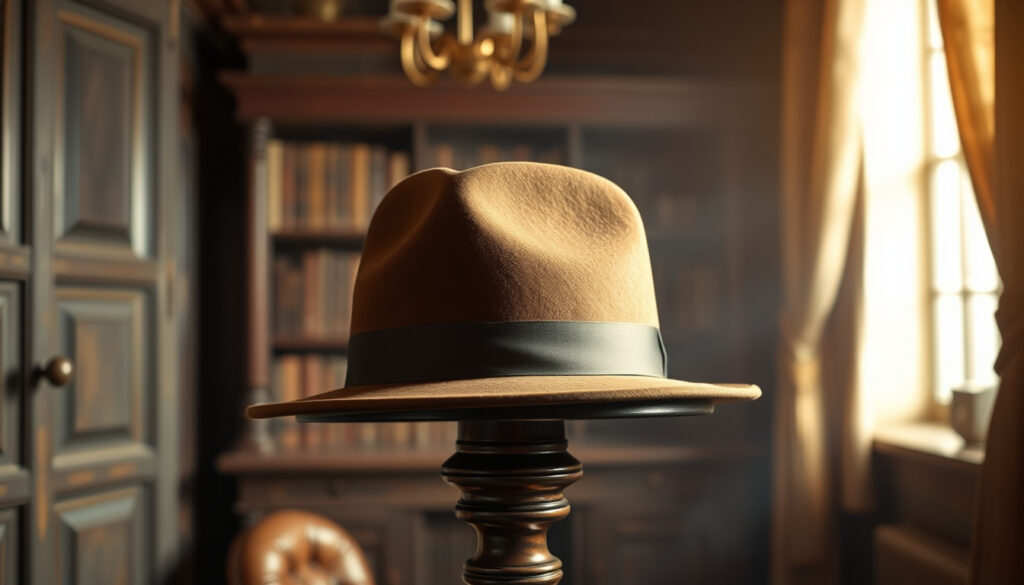
Fedora Hat: Complete History, Symbolism, Styling Guide 2026
Few accessories carry as much baggage as the fedora: one glance at its pinched crown and you’re either seeing a 1940s detective or remembering the internet’s least flattering style meme. The hat’s story starts in 1882, when actress Sarah Bernhardt wore it on stage in the play Fédora, according to fashion reference Encyclopedia.com (fashion and clothing reference). Between that debut and today’s revival sit Hollywood detectives, mid-century crooners, and one of the internet’s favorite style punchlines.
Year of Origin: 1882 ·
Original Wearer: Sarah Bernhardt (in the play Fédora) ·
Standard Brim Width: 2.5 inches (6.4 cm) ·
Peak Popularity Era: 1940s–1950s ·
Common Materials: Wool felt, straw, fur felt
Quick snapshot
- Debuted in the 1882 play Fédora (Encyclopedia.com (fashion and clothing reference))
- Soft felt construction with an indented, creased crown (Encyclopedia.com (fashion and clothing reference)) (Encyclopedia.com (fashion and clothing reference))
- Prince Edward’s adoption in the 1920s made it fashionable menswear (The Metropolitan Museum of Art (costume collection))
- Golden age in the 1930s–1950s (VICE (culture publication))
- The exact moment the fedora was deemed widely uncool (no reliable source yet)
- Whether the 2020s revival becomes a lasting trend or a niche moment (no reliable source yet)
- The precise origin of the “fedora guy” stereotype, tied to 2000s online culture (VICE (culture publication))
- : stage debut in Fédora (Window Through Time (fashion-history blog))
- 1920s: men adopt it; Prince Edward leads the way (The Metropolitan Museum of Art (costume collection)) (Window Through Time (fashion-history blog))
- 1960s: formal headwear culture collapses (The Metropolitan Museum of Art (costume collection)) (Window Through Time (fashion-history blog))
- 2000s: ironic reputation hardens online (VICE (culture publication)) (Window Through Time (fashion-history blog))
- Quiet-luxury and modern-western trends drive a targeted revival (Farfetch (global fashion platform))
- Designers release refined, updated versions (Farfetch (global fashion platform)) (Farfetch (global fashion platform))
- Styling now separates the hat from its meme past (Farfetch (global fashion platform)) (Farfetch (global fashion platform))
Six attributes, one pattern: the fedora is engineered for shaping — soft felt, a dented crown, and a brim that answers to the hand.
| Attribute | Detail | Source |
|---|---|---|
| Year of Origin | 1882 | Window Through Time (fashion-history blog) |
| Name Source | Princess Fédora (play character) | Window Through Time (fashion-history blog) |
| Common Material | Wool felt, straw, fur felt | Farfetch (global fashion platform) |
| Traditional Brim Width | 2.5 inches (6.4 cm) | Merve Bayindir (hat-style blog) |
| Crown Style | Center dent with side pinches | Merve Bayindir (hat-style blog) |
| Peak Popularity Era | 1940s–1950s | VICE (culture publication) |
The name is the first clue to the fedora’s strange history: it began as a piece of theater, not a piece of menswear.
Why Is a Hat Called a Fedora?
Who wore the original fedora hat?
- The hat debuted in Fédora, a play by French dramatist Victorien Sardou, and the title character gave the hat its name (Encyclopedia.com (fashion and clothing reference)).
- Fashion-history blog Window Through Time (fashion-history blog) dates the Paris opening to .
- Sarah Bernhardt, the era’s most celebrated actress, played Princess Fédora Romilovna — and her stage costume became a street-level sensation.
The play itself was a melodrama about a Russian princess, which explains why “fedora” sounds like a Russian name even though the hat was born in Paris. Women in France, Germany and England copied Bernhardt’s soft felt look before men caught on, according to Encyclopedia.com (fashion and clothing reference). The fedora’s first audience, in other words, was not the city street or the movie screen but the theater — and the first people to wear it in public were women who wanted a piece of that theatrical confidence.
The gendered start matters. The fedora entered the world as a woman’s hat — a fact that gets lost in all the detective-noir imagery that came later.
Is Fedora Russian or Italian?
- The word comes from the play’s title character, Princess Fédora, not from a country or a designer.
- Borsalino is a brand, not a synonym: the Italian maker’s international visibility popularized a distinct Italian interpretation of the fedora (Bon Clic Bon Genre (fashion-history site)).
So the Russian/Italian confusion is understandable. The name sounds Russian, the most famous maker is Italian, and the actual origin lands in a Paris theater in 1882, on the head of a woman pretending to be a princess.
What Does a Fedora Hat Symbolize?
What does a fedora symbolize in film noir?
- In its golden age, the fedora meant mainstream masculinity — a standard part of the urban uniform, worn by bankers and gangsters alike (VICE (culture publication)).
- Film noir turned it into shorthand for mystery and detection: the tilted brim, the shadowed eyes, the silhouette that says “private eye” (VICE (culture publication)).
- Frank Sinatra’s narrow-brimmed fedora kept the style attached to cool through the 1950s (The Metropolitan Museum of Art (costume collection)).
Early fashion accounts also tie the hat to women’s rights and liberation symbolism: the fedora was practical, androgynous and visible at a moment when women were claiming public space (Farfetch (global fashion platform)). Hold that connection loosely — the archival record is thinner than the legend, and the story rests mostly on fashion journalism rather than suffrage-era documents.
Filmmakers knew exactly what they were doing. Put a fedora on a character and the audience instantly reads the genre: the brim low over the eyes for danger, the hat set back for confidence, the removal of the hat as a gesture of respect. That visual vocabulary is so strong that the hat survived as a cinematic symbol long after it disappeared from daily wardrobes. Then the meaning flipped. By the 2000s the fedora had become an ironic internet symbol, shorthand for a certain kind of socially awkward “nice guy” rather than a noir hero (VICE (culture publication)).
The same hat that read as feminist in 1900, masculine authority in 1950, and a punchline in 2005 never actually changed. The culture around it did.
What this means: the fedora is a mirror. Filmmakers, marketers and wearers project onto it whatever their era needs — elegance, danger, irony, or reinvention.
What Hat Is Mistaken for a Fedora?
What is the difference between a fedora and a trilby?
- The brim is the quickest giveaway: a fedora’s brim runs about 2.5 inches, while a trilby’s is roughly 1.5 inches and angles up sharply at the back (Bon Clic Bon Genre (fashion-history site)).
- The crown differs too: the fedora carries a pronounced center dent with side pinches (Merve Bayindir (hat-style blog)), while the trilby’s crown is narrower and shallower.
- A fedora’s brim is wide enough to snap up or down, which changes the whole character of the hat; a trilby’s stays fixed in its sharp angle.
Most “fedoras” that look slightly off on people are actually trilbies. The confusion is so common that the trilby’s sharper, smaller proportions get blamed for the fedora’s bad reputation — a case of mistaken identity that has followed both hats for decades.
What is a Panama hat?
- The Panama hat is woven from toquilla straw and carries a distinct crown and brim style — a summer classic, not a fedora variant (Bon Clic Bon Genre (fashion-history site)).
A quick rule: if it’s soft felt with a dent and a snapable brim, it’s a fedora. If it’s woven straw with a different silhouette, it’s a Panama. If it’s a small, sharp-brimmed felt hat, it’s a trilby trying to borrow the fedora’s name.
The pattern: fedora confusion is mostly a proportion problem. Get the brim and crown right, and the hat announces itself correctly.
Why Do Fedoras Have a Bad Reputation?
When did fedoras become uncool?
- After World War II, men’s fashion turned informal, and hats shifted from daily requirement to optional accessory (The Metropolitan Museum of Art (costume collection)).
- By the 1960s, everyday hat-wearing had collapsed, leaving the fedora looking like a costume from an earlier era (VICE (culture publication)).
- By the 2000s, the fedora had become an ironic internet symbol — the “fedora guy” meme did the rest (VICE (culture publication)).
The fall was cultural, not stylistic. Once men stopped wearing hats daily, the fedora lost its utility and became a prop. The meme that followed — stereotyping the fedora-wearer as a self-styled intellectual with poor social timing — was unfair and often cruel, but it ended the hat’s mainstream run.
Why don’t men wear fedoras anymore?
- Formal headwear culture ended; there was no single moment, just a slow shift away from suits, hats and gloves (The Metropolitan Museum of Art (costume collection)).
- The irony spiral of the 2000s added a social cost to wearing one (VICE (culture publication)).
- Cheap costume versions that flooded shops made real fedoras harder to distinguish from props.
A bad reputation, in other words, is the result of lost context plus meme-ification. A fedora in 1950 was neutral. A fedora in 2010 made a claim — and not the claim the wearer intended.
The trade-off: the fedora’s baggage is also its filter. Wear it knowingly and it signals taste; wear it aimlessly and it signals the meme.
Who Should Wear a Fedora?
What kind of man wears a fedora?
- Confidence and a considered personal style matter more than age, face shape, or head size.
- The fedora looks best on someone who treats it as an accent, not as the whole personality.
The honest answer: anyone can wear one, but not everyone should wear one on a given day. The hat rewards people who already know how they want to look. It punishes people who put it on hoping the hat will do the work.
How should women wear a fedora?
- Women wore fedoras before men did — the original wearer was a woman in a Paris play.
- Women’s fedoras historically came in brighter colors with upturned brims, partly to keep the brim out of the face (VICE (culture publication)).
Modern styling is simple: pair a felt fedora with a blazer, dress or tailored denim, keep the rest of the outfit clean, and let the hat be the statement. If cold-weather layers are part of the plan, our women’s cardigans 2026 trends and styling guide covers the other half of a smart-casual wardrobe.
When should a man not wear a hat?
- Indoors, at the table, in theaters, and in formal or religious settings — the old etiquette still reads as respect.
- Skip the fedora with a full executive suit unless the entire look is intentionally vintage.
The rule of thumb: a hat is an outside garment. When in doubt, take it off at the door — and never sit in a restaurant, theater or someone’s home wearing it.
A fedora rewards confidence and punishes hesitation. Treated as tailoring, it’s a classic; treated as a costume, it becomes a punchline.
Are Fedora Hats in Style in 2026?
Is the fedora making a comeback?
- Quiet-luxury and modern-western trends have driven a targeted revival (Farfetch (global fashion platform)).
- Designers are releasing refined, updated versions that distance the hat from its meme years (Farfetch (global fashion platform)).
- Influencers and stylists now pair fedoras with contemporary casual looks instead of period costumes (Farfetch (global fashion platform)).
The revival is more discerning than the 2000s boom. The new fedora is softer, more tailored, and worn by people who dress deliberately. Fashion platforms now frame it as a statement of informed personal style — a deliberate accent rather than a costume (Farfetch (global fashion platform)).
The 2026 version tends to have a snugger crown, a moderate brim, and a color that works with the rest of the wardrobe. Think caramel suede, charcoal felt, or natural straw — not glossy black novelty. Where the 2000s revival was loud, the 2020s version is quiet: softer colors, cleaner crowns, less brim. The modern wearer treats the fedora the way they treat a good watch or a well-cut coat — as an anchoring piece rather than a punchline.
What is the new style of fedora?
- A refined crown with a less exaggerated pinch reads modern; deep costumey shapes read retro.
- Felt for winter, straw for summer, and a fit that passes the mirror test before you leave the house.
The catch: the comeback is real but conditional. It lives on the people who wear it well, which makes 2026 a good year to try the fedora — with a mirror, not a meme, in mind.
The revival depends on styling, not the hat alone. With a modern-western wardrobe the fedora looks intentional; with cargo shorts, it recreates the meme.
Why this matters for buyers: a well-chosen fedora in 2026 reads as taste; a careless one reads as irony. There is no neutral setting on this hat.
Fedora vs Trilby: Side-by-Side Comparison
Compare the two side by side, and one pattern shows immediately: the trilby is a trimmed-down fedora — shorter brim, shallower crown, less structure. Most hat guides put the fedora’s brim at about 2.5 inches and the trilby’s at roughly 1.5 inches, according to fashion-history site Bon Clic Bon Genre (fashion-history site).
| Point of comparison | Fedora | Trilby |
|---|---|---|
| Brim width | About 2.5 inches (6.4 cm), can be snapped up or down | About 1.5 inches (3.8 cm), angled sharply at the back |
| Crown | Center dent with side pinches, structured soft felt | Narrower and shallower, often unpinched |
| Silhouette | Heavier, more formal presence | Lighter, sleeker, more casual |
| Cultural mood | 1940s detective, noir, classic Hollywood | 1960s jazz, mod, Ivy League casual |
| Common mistake | The word people use when they mean any brimmed hat | Often sold as a “fedora” — actually its smaller cousin |
The pattern: the trilby is the fedora’s lighter, faster cousin. Buy the wrong one, and the hat that could have looked timeless just looks off — which is exactly how most “bad fedora” photos happen.
Fedora Hat at a Glance: Key Specifications
Twelve practical specs, one takeaway: the fedora’s identity lives in the details — the dent, the pinch, the soft brim that shapes to your hand.
| Specification | Detail |
|---|---|
| Year of origin | 1882 |
| Origin production | Fédora by Victorien Sardou, Paris |
| Original wearer | Sarah Bernhardt (title role) |
| Common materials | Wool felt, straw, fur felt |
| Crown style | Center dent |
| Crease | Lengthwise center crease |
| Pinch | Side pinches at the crown |
| Brim width | 2.5 inches (6.4 cm) |
| Brim style | Soft, can be snapped up or down |
| Peak popularity | 1940s–1950s |
| Women’s variants | Brighter colors, upturned brims (VICE (culture publication)) |
| Associated maker | Borsalino — a brand, not a hat type (Bon Clic Bon Genre (fashion-history site)) |
What this means: once you can name the parts — dent, pinch, snap, felt — you can spot a fedora, style it, and avoid buying a trilby with fedora ambitions.
Pros and Cons of Wearing a Fedora
Upsides
- Adds an instant, defined silhouette to a plain outfit.
- Carries a century of cultural meaning, from early women’s fashion to film noir (VICE (culture publication)).
- Works across seasons with wool felt, fur felt and straw versions (Farfetch (global fashion platform)).
- Makes sense on both men and women when proportioned correctly.
- The crease, pinch and brim can be shaped to your face.
Downsides
- Still carries “fedora guy” meme baggage in many settings (VICE (culture publication)).
- The wrong outfit turns it into a costume instantly.
- Brims catch doorways, wind and rain.
- Cheap felt versions look worse than no hat at all.
- It reads formal in casual settings and casual in formal ones.
The trade-off is simple: the fedora amplifies whatever look it joins. Done well, it’s the most interesting thing in the room; done carelessly, it’s the most mocked.
How to Wear a Fedora: A Step-by-Step Guide
- Match the material to the season: wool or fur felt for autumn and winter, straw for spring and summer.
- Match the brim to your frame: modest brims for lighter proportions, wider brims for broader shoulders.
- Set the crease and pinch to your face shape; a deeper pinch can narrow a rounder face.
- Keep the outfit smart-casual — a blazer, a roll-neck, tailored denim, an overcoat. Avoid full suits unless you’re aiming for a period look.
- Wear the hat level, with the front edge slightly down. Perched on the back of the head, it reads as costume.
- Take it off indoors: homes, restaurants, theaters and formal settings all call for a bare head.
- Store it crown-down on a stand or in a hat box, never resting on the brim, and brush felt hats with a soft hat brush.
Think of the fedora as the final layer, not the main event. If the outfit works when you take the hat off, it will work with it on.
Fit is the silent killer. A fedora that sits too high looks like a costume; one that sits too low hides the eyes and reads as menace. The crown should sit just above the brows, and the brim should frame the face without overwhelming it. If you can’t settle the angle in thirty seconds, the hat is wrong.
The Fedora’s Timeline: 1882 to Today
Seven moments, one arc: a stage costume becomes a masculine uniform, then a stereotype, then a test of personal style.
| Period | What happened | Source |
|---|---|---|
| Fédora debuts in Paris; Sarah Bernhardt wears the hat as Princess Fédora. | Window Through Time (fashion-history blog) | |
| 1920s | Men adopt the fedora as a softer alternative to the bowler; Prince Edward’s patronage helps. | The Metropolitan Museum of Art (costume collection) |
| 1940s–1950s | Golden age: film-noir detectives, Sinatra’s narrow brim, mainstream masculinity. | VICE (culture publication) |
| 1960s | Formal headwear culture collapses; the fedora ages overnight. | The Metropolitan Museum of Art (costume collection) |
| 1980s | Indiana Jones links the fedora to adventure archetypes. | Merve Bayindir (hat-style blog) |
| 2000–2020 | Ironic “fedora guy” reputation hardens online. | VICE (culture publication) |
| 2020s–present | Quiet-luxury and modern-western trends drive a guarded revival. | Farfetch (global fashion platform) |
Why this matters: every era rewrote the fedora to fit its own anxieties, and the 2020s are no exception. The hat’s current meaning is being written by the people who wear it well.
Related reading: Indiana Jones movies in order · Women’s cardigans 2026 trends and styling guide
What’s Confirmed and What’s Still Unclear
The confirmed list is short and solid; the unclear list is where the fedora’s mythology lives.
Confirmed facts
- The fedora debuted in the 1882 play Fédora (Encyclopedia.com (fashion and clothing reference)).
- It is defined by a soft felt body, an indented crown, and a shapable brim (Encyclopedia.com (fashion and clothing reference)).
- The trilby has a significantly shorter brim — about 1.5 inches vs the fedora’s 2.5 inches (Bon Clic Bon Genre (fashion-history site)).
- Popularity peaked in the mid-20th century (VICE (culture publication)).
- The hat developed a negative internet reputation in the 2000s (VICE (culture publication)).
- Indiana Jones wears a fedora (Merve Bayindir (hat-style blog)).
What remains unclear
- The exact moment the fedora was deemed widely uncool.
- Whether the 2020s revival will become permanent or remain a niche trend.
- The precise origin of the “fedora guy” stereotype, though it is tied to 2000s online culture (VICE (culture publication)).
- The strength of the early feminist-symbolism story, which rests on fashion journalism more than suffrage archives.
- The exact timeline of the fedora’s jump from women’s fashion to men’s staple, which is only roughly documented.
- Which brand produced the definitive early fedora; Borsalino dominates the record, but it was one of several makers (Bon Clic Bon Genre (fashion-history site)).
- Whether the next dominant meaning of the fedora will be elegance or irony.
The split verdict: the fedora’s facts are solid, while its cultural meaning keeps moving. That tension is exactly why the hat remains so easy to argue about.
What the Record Says
“A fedora is generally characterized by a soft felt construction, an indented or creased crown, and a brim.”
— Encyclopedia.com (fashion and clothing reference)
“The fedora became strongly associated in popular culture with old Hollywood, detectives, gangsters, and noir imagery.”
— VICE (culture publication)
“The hat became associated with women’s rights and liberation symbolism in accounts of its early adoption.”
— Farfetch (global fashion platform)
“Growing informality after World War II reduced hat ownership, while narrower-brimmed fedoras remained relevant with 1950s tailoring.”
— The Metropolitan Museum of Art (costume collection)
The common thread: every era projected its own values onto the fedora — and the hat accepted all of them.
Final Verdict: Is the Fedora Worth It in 2026?
The fedora is back — not as the default hat of mid-century America, but as a deliberate accent for people who like their clothes to say something. Its revival is tied to a broader shift toward intentional dressing: quiet-luxury and modern-western styles that reward confidence. The hat’s history cuts both ways. It can make a plain outfit look considered, or it can make a careful outfit look careless, and the difference lives in proportion, fabric and attitude. For the modern buyer, the choice is clear: treat the fedora as a deliberate, confident accent — or leave it on the rack, because the hat forgives nothing in between.
The pattern: the fedora asks for a decision before you leave the house. Treat it as tailoring and it flatters; treat it as a costume and it confirms every meme it ever inspired.
Frequently Asked Questions
Can women wear fedora hats?
Yes — women wore the fedora before men did, starting with Sarah Bernhardt in the 1882 play Fédora. Women’s fedoras historically came in brighter colors and sometimes upturned brims (VICE (culture publication)), and modern styling works with dresses, blazers, denim and tailoring.
What materials are fedora hats made from?
Wool felt, fur felt and straw are the classic choices. Felt suits cooler months; straw suits spring and summer (Farfetch (global fashion platform)).
How should a fedora hat fit?
A fedora should sit level on your head, roughly a finger’s width above the ears, with the sweatband snug but not tight. If it leaves a red mark or moves when you nod, the size is wrong.
Which face shapes best suit a fedora hat?
Rounder faces tend to suit a taller crown and wider brim; longer faces suit a shallower crown. The pinch and crease shape the effect, so adjust them to your face rather than accepting a factory default.
How do I clean and store a fedora hat?
Brush felt hats with a soft hat brush after wear, and store them crown-down on a flat surface or on a hat stand in a cool, dry place. Never rest a hat on its brim, and avoid crushing the pinch.
What is the difference between a fedora and a Panama hat?
A fedora is soft felt with a dented crown and snapable brim. A Panama hat is woven from toquilla straw and has a distinct crown and brim style, making it a summer classic rather than a fedora variant (Bon Clic Bon Genre (fashion-history site)).
Are fedoras appropriate for formal events?
Only with a deliberately styled look. At weddings and galas, a fedora reads as either vintage flair or a faux pas, depending on the dress code. The safe rule is to take it off indoors and let the rest of the outfit carry the formality.
More related posts
 Cush Jumbo: Ethnicity, Age, Net Worth, Children & Leaving Vera
 Todd Boehly: Net Worth, Teams Owned, and Political Affiliation
 Gary Anderson: Ranking, Net Worth, and Career 2025
 Grizzly Bear Facts: Aggression, Intelligence, and Survival
 Abraham Lincoln: Facts, Assassination, and Lasting Legacy
 200 Pounds in KG – Exact NIST Conversion and Tables
 Jenny Saville Artist: Biography, Key Works, and Record Prices