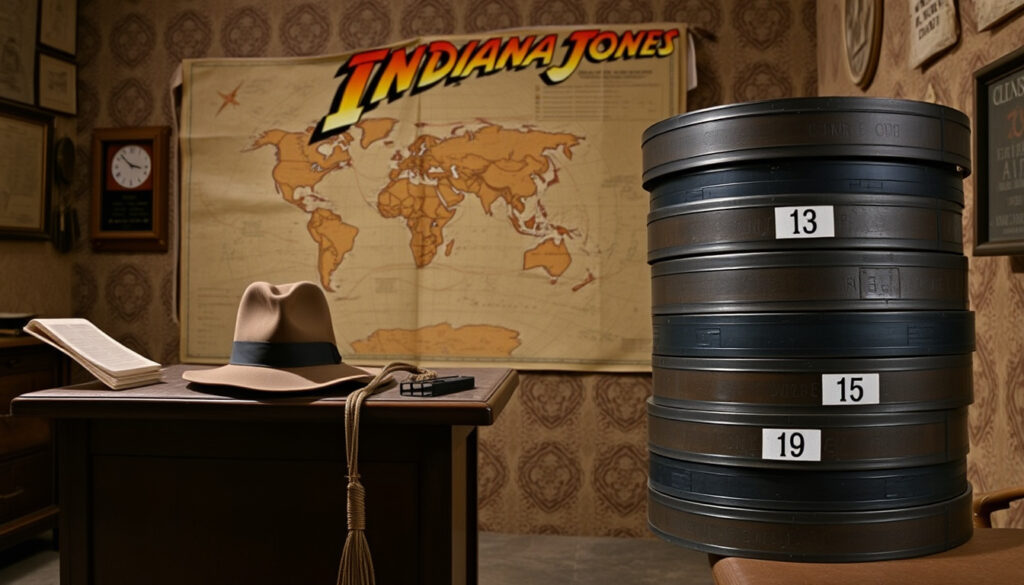
Indiana Jones Movies in Order: Ranking, Controversy, Flops
Few movie characters still generate arguments the way Indiana Jones does. Fans have spent four decades debating which film to watch first, whether Temple of Doom holds up, and why the last adventure lost money. With five theatrical films released between 1981 and 2023, the franchise offers a rare paper trail: release dates, box-office ledgers, casting history, and critical reception can answer most of its loudest fights.
Theatrical films: 5 (1981–2023) · First film: Raiders of the Lost Ark · Latest film: Indiana Jones and the Dial of Destiny · Franchise box office: Approximately $2.4 billion worldwide · Directors: Steven Spielberg (first four); James Mangold (fifth)
Quick snapshot
- Five films have been released since 1981 (Box Office Mojo (box-office tracker))
- Harrison Ford plays Indiana Jones in all five films (Britannica (encyclopedia))
- Dial of Destiny underperformed the franchise’s earlier box-office runs (The Numbers (film-finance database))
- Whether a $300 million budget turns Dial of Destiny into a true flop depends on how losses are counted (The Numbers (film-finance database))
- Whether Temple of Doom’s stereotypes make the film “racist” is a critical interpretation, not a settled rating (Rotten Tomatoes (critics’ database))
- The story chronology splits from release order early: Temple of Doom is a 1935 prequel, one year before Raiders (1936) (Wikipedia (encyclopedic database))
- The Last Crusade opens even earlier, with a 1912 prologue (Wikipedia (encyclopedic database))
- Dial of Destiny’s 56% second-weekend drop turned its release into a story about losses (IndieWire (trade publication))
- The open question for Disney is whether the franchise continues as a theatrical series (IndieWire (trade publication)) (IndieWire (trade publication))
Seven facts frame every Indiana Jones debate: one franchise, five films, two directors, and one actor who stayed for all of them.
| Label | Value |
|---|---|
| Franchise type | Adventure action film series (Britannica (encyclopedia)) |
| Films | 5 (Box Office Mojo (box-office tracker)) |
| First film | Raiders of the Lost Ark (1981) (IMDb (film database)) |
| Latest film | Indiana Jones and the Dial of Destiny (2023) (The Numbers (film-finance database)) |
| Director of first four | Steven Spielberg (Britannica (encyclopedia)) |
| Director of fifth | James Mangold (IMDb (film database)) |
| Lead actor | Harrison Ford (IMDb (film database)) |
What is the correct order for the Indiana Jones movies?
The answer depends on which kind of order you want: the order the movies were released, or the order the story actually happens.
Release order by year
- Raiders of the Lost Ark — June 12, 1981 (release dates per Box Office Mojo (box-office tracker) and The Numbers (film-finance database))
- Indiana Jones and the Temple of Doom — May 23, 1984
- Indiana Jones and the Last Crusade — May 24, 1989
- Indiana Jones and the Kingdom of the Crystal Skull — May 22, 2008
- Indiana Jones and the Dial of Destiny — June 30, 2023
Chronological timeline of the films
- Story order per Wikipedia (encyclopedic database): — The Last Crusade’s prologue shows a teenage Indy.
- — Temple of Doom takes place in India.
- — Raiders of the Lost Ark.
- — The main story of The Last Crusade.
- — The Dial of Destiny prologue.
- — Kingdom of the Crystal Skull.
- — The later sections of Dial of Destiny.
Which order new viewers should watch
For a first watch, release order is the safer route. The prequel placement of Temple of Doom only distracts if you do not yet know where the character ends up.
Release order also tracks the filmmaking evolution, from the 1981 original to the heavier visual effects and digital de-aging of the 2023 sequel.
What this means: the Indiana Jones series is two orders at once, and the gap between them explains why the “where to start” question never dies.
The gap between release and chronological order explains the franchise’s unique appeal.
How racist is Indiana Jones Temple of Doom?
The fair version of the question is not “Is Temple of Doom racist?” but “Why do viewers keep asking?” The answer sits at the intersection of 1980s studio filmmaking and 1930s adventure tropes.
The film’s colonial-era imagery
- The story sends Indiana Jones to India in 1935, into a world of lost temples, sacred stones, and palace intrigue.
- The villains are a reimagined Thuggee cult, a group that had been used in British colonial fiction for decades.
- Spielberg later described the tone as too dark, too subterranean, and much too horrific.
Criticism of Indian and Asian character portrayals
The criticism is not a modern invention. Reviewers in 1984 noted the film’s reliance on racialized villains and exaggerated characterizations, and the discussion has only sharpened since. Rotten Tomatoes (critics’ database) preserves this critical history in its reviews and audience discussions.
Modern conversations about Temple of Doom usually separate the film’s craft from its content. The action choreography and production design are still admired; the representation is not.
How modern audiences discuss the film
- It is often called the franchise’s most uncomfortable watch.
- It is also a case study in how 1980s blockbusters inherited and repeated colonial-era adventure formulas.
- Defenders point to the period genre, while critics argue the genre itself is the problem.
Why this matters: Temple of Doom is not a film with a single verdict. It is a test case for how audiences separate what was exciting in 1984 from what reads differently in a streaming library.
The catch: the film’s commitment to period adventure tropes forces modern viewers to reckon with the genre itself.
Which actor famously turned down the role of Indiana Jones?
The casting story is one of the rare Hollywood “what ifs” with a paper trail.
Tom Selleck and Magnum, P.I.
- Tom Selleck was offered the role of Indiana Jones before Harrison Ford was cast.
- CBS would not release him from his Magnum, P.I. contract.
- The conflict is documented in Wikipedia (encyclopedic database).
Harrison Ford’s casting
Ford was not the first choice, but he became the definition of the role. The casting change turned Indiana Jones into a distinctly American screen hero — sarcastic, fallible, and never superhuman.
What changed after Raiders
- Raiders of the Lost Ark made Ford a franchise anchor beyond Star Wars.
- The role gave Spielberg and George Lucas a second shared icon, alongside their space saga.
- Later sequels leaned into Ford’s age, culminating in the 2023 film about an aging Indy.
The pattern: a scheduling conflict, not a creative choice, almost changed the face of the franchise. The Selleck story survives because it shows how much of Hollywood history depends on who was free on the right Tuesday.
Why did Dial of Destiny flop?
Whether it flopped depends on the number you use. The production budget was enormous, the worldwide gross was modest by franchise standards, and the second-weekend collapse shaped the coverage.
Production budget and opening weekend
- The Numbers (film-finance database) lists a reported production budget of $300 million for Dial of Destiny.
- IndieWire (trade publication) reported a 56% drop in the second domestic weekend.
Worldwide box office result
- The Numbers (film-finance database) reports a worldwide gross of roughly $384 million.
- After its second weekend, IndieWire (trade publication) calculated about $121.2 million domestically and $248 million worldwide.
- That trajectory put the film below Kingdom of the Crystal Skull’s roughly $790.7 million and even below the 1989 installment’s $474.2 million.
Reception and franchise fatigue
- Critical response for Dial of Destiny was warmer than the previous sequel’s, but not enough to override the financial math.
- The 2023 release carried the weight of a franchise that had not produced a film in 15 years.
- The de-aging effects and the melancholy tone divided fans who expected a lighter adventure.
The takeaway: Dial of Destiny is a commercial underperformer by the only scale that matters for a blockbuster — the one that starts with a $300 million budget before marketing costs.
The implication: the franchise’s future depends on recalibrating expectations.
What’s considered the worst Indiana Jones movie?
Fan rankings produce different orders, but the bottom of most lists is a two-film race.
Critical consensus
- Kingdom of the Crystal Skull is most often placed last in critical roundups and fan polls (Rotten Tomatoes (critics’ database)).
- Temple of Doom is the other frequent last-place pick, for tone and representation rather than effects.
- Dial of Destiny has mixed reviews but does not dominate “worst” lists the way its predecessor did.
Fan rankings
- Fans who prioritize action tend to put Temple of Doom higher for its ambitious set pieces.
- Fans who prioritize coherence and character tend to rank Crystal Skull last.
Why Temple of Doom and Crystal Skull are debated
Temple of Doom is darker and uncomfortable. Crystal Skull is lighter and, for many viewers, forgettable. Different lists punish different sins.
The verdict: there is no “official” worst Indiana Jones movie, but the franchise’s two lowest-ranking entries show why the debate persists.
The pattern: each generation finds its own reason to question the series’ low points.
What is the biggest flop in movie history of all time?
To answer where Dial of Destiny fits, you first have to define a flop. Five films, one pattern: the franchise’s box office climbed through four releases, then fell sharply with the fifth.
How to measure a box-office flop
- Box-office trackers such as The Numbers (film-finance database) publish the budgets and grosses that let analysts estimate losses.
- A flop is usually measured by estimated loss: production budget plus marketing and distribution costs, minus theatrical revenue and ancillary income.
- Films like John Carter, Mars Needs Moms, and Cutthroat Island are routinely cited in biggest-flop discussions (Wikipedia (encyclopedic database)).
Frequently named record-setting bombs
- John Carter is one of the most commonly named Disney bombs of the 2010s.
- Mars Needs Moms is another Disney release that lost tens of millions in theatrical release.
- Cutthroat Island is the classic example of a film whose failure was catastrophic relative to its budget.
Where Dial of Destiny fits
The numbers tell the story of a franchise that peaked in 2008 and then declined.
| Film | Worldwide gross | Reported production budget | Box-office context |
|---|---|---|---|
| Raiders of the Lost Ark | ~$389.9M | — | Hit that launched the franchise |
| Temple of Doom | ~$333.1M | — | Darker prequel still turned a healthy profit |
| The Last Crusade | ~$474.2M | — | Rebound after the second film’s mixed reception |
| Kingdom of the Crystal Skull | ~$790.7M | — | Peak commercial performance for the series |
| Dial of Destiny | ~$384M | $300M | Underperformer relative to franchise expectations |
Gross figures and budget per Wikipedia (encyclopedic database) and The Numbers (film-finance database). Dial of Destiny is better described as an underperformer than as the largest flop in movie history.
What this means: the “biggest flop” label belongs to films whose losses were catastrophic relative to much smaller markets. Dial of Destiny lost money, but it did not redefine the word.
The catch: scale matters more than absolute numbers in the flop conversation.
Confirmed facts vs. what’s unclear
Confirmed facts
- There are five Indiana Jones films, released between 1981 and 2023 (Box Office Mojo (box-office tracker))
- Tom Selleck dropped out of Raiders because of his Magnum, P.I. commitment (Wikipedia (encyclopedic database))
- Harrison Ford played Indiana Jones in all five films (Britannica (encyclopedia))
- Dial of Destiny underperformed relative to the franchise’s earlier box office (The Numbers (film-finance database))
What’s unclear
- Whether Dial of Destiny’s reported losses are enough to call it an outright flop depends on how losses are counted (The Numbers (film-finance database))
- Whether Temple of Doom’s racial stereotypes make it “racist” depends on critical interpretation (Rotten Tomatoes (critics’ database))
- Which film is the definitive worst Indiana Jones movie remains a matter of debate.
Voices from the franchise
“It was too dark, too subterranean, and much too horrific.”
Steven Spielberg, reflecting on Temple of Doom in later interviews
“This has to be about a hero at the end of his road.”
James Mangold, on directing Dial of Destiny
For Disney, the Indiana Jones conversation has shifted from celebration to cost-benefit. A reported $300 million production budget demanded a worldwide audience that Dial of Destiny did not find, even though the franchise still holds roughly $2.4 billion in cumulative theatrical gross. The pattern does not erase four decades of film history — it just sets the terms for the next chapter. For Disney, the calculation is clear: another theatrical adventure must be built to a realistic box-office ceiling, or the franchise’s future belongs to streaming and nostalgia, not opening weekends.
Frequently asked questions
Who is Indiana Jones?
Indiana Jones is an archaeologist and adventurer played by Harrison Ford in five films. The character was created by George Lucas and Steven Spielberg and first appeared in Raiders of the Lost Ark in 1981.
Who created Indiana Jones?
George Lucas conceived the story, and Steven Spielberg directed the first four films. James Mangold directed Dial of Destiny.
How many Indiana Jones movies are there?
Five theatrical films between 1981 and 2023.
What is Indiana Jones’s real name?
Henry Walton Jones Jr. He gets the name Indiana from a childhood dog.
Why was Kingdom of the Crystal Skull controversial?
Fans and critics objected to the CGI-heavy action and a storyline involving aliens and a refrigerator escape, among other choices.
Will there be an Indiana Jones 6?
No sixth film has been announced. Disney and Lucasfilm have not confirmed a continuation after Dial of Destiny.
More related posts
 Paris Jackson: Biography, Conditions, Identity, and Key Facts
 Marlon Wayans: Net Worth, Career & Family Facts
 Cassie Ventura: $20M Diddy Settlement, Relationship, Kids
 Iris Law: Biography, Age, Height, Parents, Net Worth & More
 Iona Stephen: Age, Nationality, Career as Sky Sports Presenter
 Brian McFadden: Westlife Exit, Career, Relationships & Net Worth
 George IV: Mad King, Regency, Children, and Cause of Death
 Henri Matisse: Fauvist Color Master and Modern Art Pioneer