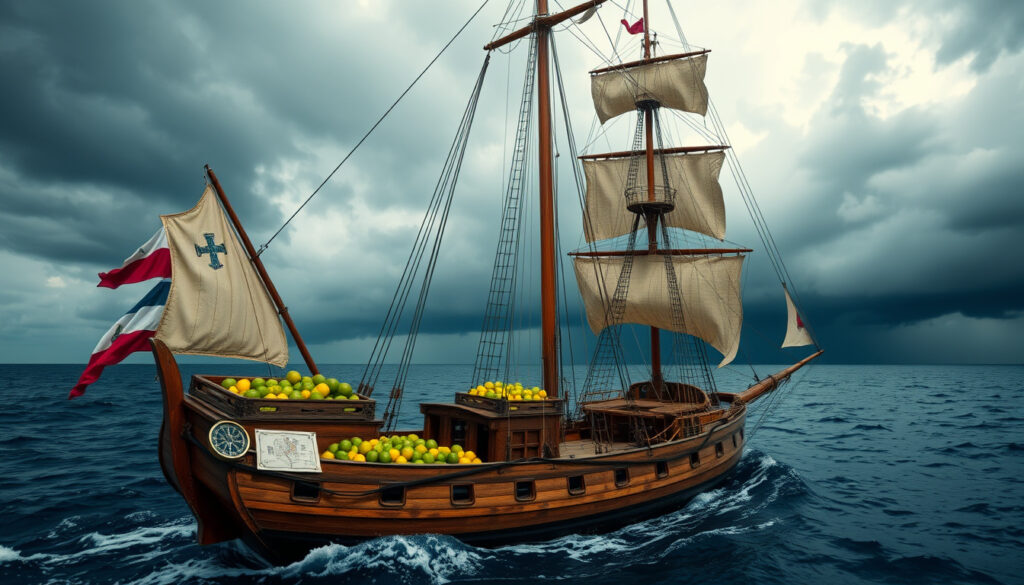
Captain Cook: Voyages, Scurvy Prevention, and Controversies
Few figures from the Age of Exploration still spark as much debate as Captain James Cook. A brilliant navigator who prevented scurvy and mapped vast stretches of the Pacific, he is also remembered for violence against Indigenous peoples and the colonial upheaval that followed his voyages.
Born: 7 November 1728, Marton, Yorkshire, England · Died: 14 February 1779, Kealakekua Bay, Hawaii · Rank: Captain, British Royal Navy · Voyages: Three major Pacific expeditions (1768–1779) · Key Medical Achievement: Prevented scurvy on long voyages via diet and hygiene
Quick snapshot
- Cook was killed in Hawaii on 14 February 1779 (Royal Museums Greenwich).
- He led three major Pacific voyages (Britannica).
- He prevented scurvy on his ships (Britannica).
- Exactly what happened during the first violent encounter with Aboriginal people at Botany Bay is debated (The New Yorker).
- Whether Cook’s death was a ritual sacrifice or a random fight is still discussed by historians (ABC News Australia).
- No living descendants are documented (Britannica).
- 1728 – Born in Marton, Yorkshire (Britannica).
- 1768‑1771 – First voyage: Endeavour to Tahiti, New Zealand, Australia (Royal Museums Greenwich).
- 14 Feb 1779 – Killed in Kealakekua Bay (Royal Museums Greenwich).
- Debate over Cook’s legacy continues, with Indigenous communities pushing for a more critical framing (The New Yorker).
- Scholars re‑examine his role in the British colonization of Australia and Hawaii (The New Yorker).
Six key facts about Cook’s life — from birth to his final voyage:
| Label | Value |
|---|---|
| Birth | 7 November 1728, Marton, Yorkshire, England |
| Death | 14 February 1779, Kealakekua Bay, Hawaii |
| Spouse | Elizabeth Batts (m. 1762) |
| Children | 6, all died without descendants of their own |
| Notable Ships | HMS Endeavour, HMS Resolution, HMS Discovery |
| Scurvy Prevention Success | Only one death from scurvy across three major voyages |
What was Captain Cook most famous for?
Captain James Cook is most famous as the British Royal Navy officer who led three groundbreaking voyages to the Pacific Ocean between 1768 and 1779 (Britannica). He was also an exceptional cartographer, having charted Newfoundland in the 1760s before his Pacific expeditions (Royal Museums Greenwich).
Mapping the Pacific and Newfoundland
- Cook’s early work mapping Newfoundland established his reputation as a skilled surveyor.
- His Pacific charts were so accurate they remained in use for decades (National Library of Australia).
Three major voyages (1768–1779)
- First voyage (1768–1771): HMS Endeavour to Tahiti, New Zealand, and the east coast of Australia (Royal Museums Greenwich).
- Second voyage (1772–1775): HMS Resolution to the Antarctic Circle and Pacific Islands, disproving the existence of a large southern continent (Columbia River Maritime Museum).
- Third voyage (1776–1779): Search for the Northwest Passage, contact with Hawaii, and Cook’s death (Britannica).
First European contact with Hawaii and eastern Australia
- Cook became the first European to reach the Hawaiian Islands (1778) and the east coast of Australia (1770) (Royal Museums Greenwich).
The implications of his expeditions still echo in modern debates over colonial history.
Did Captain Cook discover Australia?
No. Australia had been inhabited by Aboriginal peoples for at least 65,000 years when Cook arrived (National Library of Australia). What Cook did was chart the east coast in 1770, claiming it for Britain and naming it New South Wales.
Aboriginal habitation for 65,000+ years prior
- Archaeological evidence shows continuous Indigenous occupation of Australia for tens of millennia before any European arrival.
Cook’s 1770 voyage along the east coast
- The Endeavour sailed up the coast, making landfall at Botany Bay in April 1770 (Royal Museums Greenwich).
Role in British colonization
- Cook’s favourable reports encouraged the British government to establish a penal colony at Botany Bay, which led to widespread dispossession of Aboriginal lands.
The catch: even today, the term “discovery” is used in some school curricula, highlighting the ongoing struggle over historical narrative.
How do Hawaiians feel about Captain Cook?
Initially, Cook was welcomed by Native Hawaiians, who were celebrating the Makahiki festival — a period of peace and fertility. Some historians believe he was mistaken for the god Lono (ABC News Australia). Modern Hawaiian attitudes are far more critical.
Initial welcome and the Makahiki festival
- Cook arrived at Kealakekua Bay in January 1779, during Makahiki, and was treated with great ceremony (Britannica).
Violent conflict leading to his death
- When Cook returned after a storm damaged his ship, relations soured. A dispute over a stolen cutter escalated, and on 14 February 1779, Cook was killed in a fight on the beach (Royal Museums Greenwich).
Contemporary Native Hawaiian perspectives
- Today, many Native Hawaiians view Cook’s arrival as the beginning of foreign intrusion and colonization, not a friendly visit. The anniversary of his death is not celebrated (The New Yorker).
Hawaiians welcomed Cook as a chief during a sacred festival, yet that same encounter ended in his death and, for Hawaiians, foreshadowed the overthrow of their kingdom.
This paradox underscores why Cook remains a deeply contested figure in Hawaii.
What disease did Captain Cook prevent?
Cook is widely credited with preventing scurvy on his long voyages, a disease caused by vitamin C deficiency that had decimated naval crews for centuries.
Scurvy: causes and symptoms
- Scurvy causes fatigue, gum disease, and eventually death from lack of vitamin C.
Cook’s innovations: sauerkraut, citrus, fresh provisions
- Cook enforced a diet that included sauerkraut, citrus juice, and fresh greens whenever possible (Britannica).
- He also insisted on cleanliness and ventilation below decks (Royal Museums Greenwich).
Impact on naval health
- Across three major voyages, only one crew member died from scurvy — a stunning achievement for the time (Columbia River Maritime Museum).
The pattern: his medical success is often cited to balance his colonial violence, yet the two are separate aspects of his legacy.
What was Cook’s cause of death?
Captain James Cook died on 14 February 1779 at Kealakekua Bay, Hawaii, during his third voyage.
Context of the conflict at Kealakekua Bay
- After a storm, Cook returned to the bay to repair his ship. Tensions rose when a cutter was stolen. Cook attempted to take a Hawaiian chief hostage to recover the boat (Royal Museums Greenwich).
The fatal encounter on 14 February 1779
- A skirmish broke out on the beach. According to Royal Museums Greenwich, Cook shot one man dead before being overwhelmed and killed by Native Hawaiians (Royal Museums Greenwich).
Burial and aftermath
- His body was later returned to the British for a formal sea burial. The controversy over whether his death was a ritual sacrifice or a random fight continues among historians (ABC News Australia).
The story of Cook’s death is often simplified as “he was killed by natives,” but the full account shows a complex chain of actions on both sides — and remains a flashpoint in Hawaiian‑Western relations.
This event continues to fuel scholarly debate and cultural sensitivity in Hawaii.
Was Cook a good leader?
Assessments of Cook’s leadership vary widely. He maintained discipline and prioritized crew health through diet and hygiene, but also had violent confrontations with Indigenous peoples. Modern historians note both his navigational genius and his role in colonial violence.
Strict discipline vs. paternal care for crew
- Cook enforced a regime that reduced scurvy and kept his crews healthier than most contemporaries.
- He was known for his temper and could be harsh, but also showed concern for his men’s welfare.
Diplomatic skills with Pacific Islanders
- He often established peaceful trade, but relations could quickly turn violent over misunderstandings or theft.
Criticisms from historical and modern perspectives
- Some early critics questioned his treatment of Indigenous people; modern critiques emphasize his role in enabling colonization.
The implication is that leadership judgments must account for the full context of his actions.
What did Captain Cook do to the Aborigines?
During his 1770 voyage along the east coast of Australia, Cook encountered Aboriginal people. Initial interactions were sometimes peaceful, but violence also occurred.
Initial contact: trade and peaceful encounters
- At Botany Bay, Cook’s party traded with local Aboriginal groups. However, cultural misunderstandings led to clashes (National Library of Australia).
Violent incidents and misunderstanding
- In one recorded instance, Cook’s marines fired on a group of Aboriginal men after they refused to trade and threw spears. Cook’s journal downplays these incidents (The New Yorker).
Long-term impact of colonization
- Cook’s reports encouraged British settlement. The arrival of the First Fleet in 1788 led to the dispossession, violence, and disease that devastated Aboriginal communities.
What this means: the true cost of Cook’s journey is measured in the dispossession of Aboriginal nations.
Timeline: Captain Cook’s life in key dates
- 1728 – Born in Marton, Yorkshire (Britannica).
- 1755 – Joins the Royal Navy (Royal Museums Greenwich).
- 1768‑1771 – First voyage: HMS Endeavour (Royal Museums Greenwich).
- 1772‑1775 – Second voyage: HMS Resolution (Royal Museums Greenwich).
- 1776‑1779 – Third voyage: HMS Resolution & Discovery (Britannica).
- 14 Feb 1779 – Killed at Kealakekua Bay (Royal Museums Greenwich).
These dates provide a skeleton for understanding the rapid and impactful career of Captain Cook.
Are there any living descendants of Captain James Cook?
No. His six children all died without descendants of their own (Britannica).
Certainties and debates
Confirmed facts
- Cook was killed in Hawaii on 14 February 1779 (Royal Museums Greenwich).
- He led three major Pacific voyages (Britannica).
- He prevented scurvy on his ships (Britannica).
- He charted the east coast of Australia for Britain (Royal Museums Greenwich).
What’s unclear
- Exact details of the first violent encounter with Aboriginal people at Botany Bay are debated.
- Whether Cook’s death was a ritual sacrifice or a random fight is still discussed (ABC News Australia).
- The exact number of living descendants is uncertain; none are documented.
- Whether Cook was actually mistaken for the god Lono remains disputed among historians (ABC News Australia).
This breakdown helps separate established history from ongoing scholarly debate.
In their own words
“Cook’s voyages were among the most famous maritime exploration voyages in history.”
“The Hawaiian public memory of Cook has changed from celebration toward critical reassessment.”
— ABC News Australia
“Cook’s legacy is tied to violence and colonial harm, not just exploration.”
— The New Yorker
The three quotes illustrate the spectrum of modern opinion on Cook.
For Australia and Hawaii, the Captain Cook story is not a relic of the 18th century — it is a living debate about national identity, colonial violence, and whose history gets told. The implication is clear: to understand Cook, you must listen to the voices he silenced.
reddit.com, en.wikipedia.org, facebook.com, reddit.com, observerireland.org
For readers interested in a more detailed account of James Cooks life and voyages, this biography provides extensive coverage of his three major Pacific expeditions.
Frequently asked questions
What made Captain Cook famous?
He led three Pacific voyages and was the first European to reach Hawaii and the east coast of Australia (Britannica).
Was Australia discovered by Captain Cook?
No. Aboriginal peoples inhabited Australia for tens of thousands of years before Cook (National Library of Australia).
How do Native Hawaiians view Captain Cook?
Many view his arrival as the start of foreign intrusion and colonization (ABC News Australia).
What disease did Cook prevent on his ships?
He prevented scurvy through a diet of sauerkraut, citrus, and fresh greens (Britannica).
How did Captain Cook die?
He was killed by Native Hawaiians on 14 February 1779 after a conflict escalated (Royal Museums Greenwich).
Was Cook considered a good leader?
He maintained discipline and crew health, but also had violent confrontations. Modern assessments note his navigational genius and his role in colonial violence.
What impact did Cook have on Aboriginal people?
His reports encouraged British settlement, leading to dispossession and conflict. He had some peaceful but also violent encounters (The New Yorker).
Does Captain Cook have any living descendants?
No. His six children all died without descendants of their own (Britannica).
Related reading
- King George III: Madness, Illness & Historical Facts – Cook served under King George III during his voyages.
- Edward the Confessor: Life, Death, and Legacy – A historical biography similar in depth and style.
More related posts
 Maisie Smith: Age, Relationship with Max George, Career
 Christy Turlington: Supermodel Turned Health Advocate
 What a Sad Little Life Jane – Come Dine Rant Origin and Legacy
 Calvin Bassey: age, religion, parents, salary
 Czechia or Czech Republic? Travel Guide & Tips
 Carrie Fisher’s Cause of Death, Relationships & Legacy
 The Rubens at the Palace: Luxury Hotel Guide & Reviews
 What Does Matcha Taste Like? Guide to Flavors & Notes