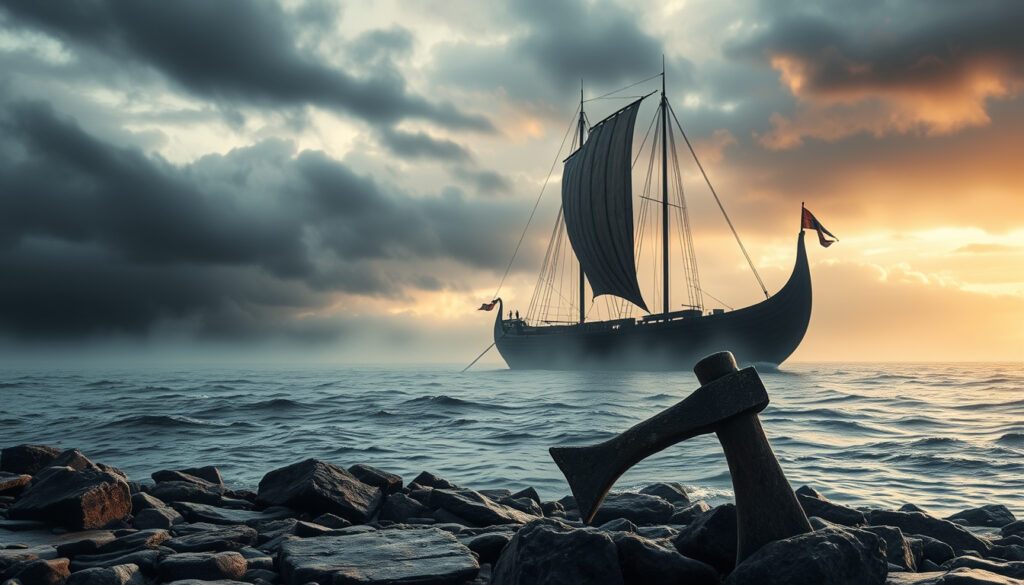
Ragnar Lothbrok: Historical Fact vs. Popular Myth
Most people know him as the legendary Viking who raided Paris, defied kings, and faced a pit of snakes, but the line between historical fact and centuries-old storytelling has blurred so completely that even experts cannot agree on the basics. This guide separates the confirmed details from the fabricated drama, tracing where the historical record ends and where the myth begins.
Confirmed Facts
- World History Encyclopedia – Ragnars saga loðbrókar
- Encyclopaedia Britannica – Pit of snakes
- HistoryExtra – Björn Ironside, Ivar the Boneless
- Wikipedia – Vikings (2013–2020)
Historical figure: Semi-legendary · Main source: Ragnars saga loðbrókar · Time period: 9th century · TV series: Vikings (2013–2020)
Who Was Ragnar Lothbrok?
Ragnar Lothbrok is the quintessential Viking hero, but his existence is far from certain. The name itself translates to “Ragnar Hairy-Breeches,” a nickname reportedly tied to the woolen garments he wore into battle. British and French sources mention a Viking leader named Ragnar who raided Paris in the 9th century, so it is entirely possible a real person sparked one of history’s greatest legends, yet the story that survives is undeniably semi-legendary, mixing historical events with mythological feats.
The character has overshadowed any potential real figure. Modern popular retellings often present Ragnar as a single, unified ruler of the Vikings, but the historical Ragnar was a figure of legend, not a documented king with a stable kingdom. His story is famously recorded in the Ragnars saga loðbrókar, an Icelandic saga that chronicles his adventurous life, his raids, and his dramatic death in a snake pit. This saga, written down around the 13th century, is one of the major medieval sources for Ragnar traditions.
Why Is His History So Unclear?
The confusion boils down to a mix of oral tradition, poetic exaggeration, and a glaring lack of contemporary records. He is not mentioned in any source from the 9th century; instead, the earliest surviving records were written centuries later, long after his death. The process of recording history based on memory means that over time, mythological elements—like his descent from the god Odin—became woven into the fabric of reality, making it practically impossible to untangle the facts.
Moreover, the name “Ragnar” was not rare, which complicates the matter even further. There could have been several different Viking chieftains with this name between the 9th and 11th centuries, and their deeds were likely merged into one single legendary figure. This is why modern historians refer to him as “semi-legendary.” They acknowledge that while the traditions surrounding him are fascinating, there is simply no way to confirm his existence from the historical record alone. The real challenge is that the absence of a dedicated section on the controversy of his existence in mainstream discussions often misleads people into believing he is a verified historical king.
“Ragnar Lothbrok’s existence is described as uncertain in modern reference works.” – Encyclopaedia Britannica
What Is the Source of the Legend?
The most comprehensive account comes from the Ragnars saga loðbrókar, a medieval Icelandic saga. The saga tells of a heroic warrior who avenges his grandfather, marries the legendary shield-maiden Lagertha, and later weds the princess Aslaug. Ragnar’s personality in the sagas is characterized by his ambition, his intelligence, and his somewhat tragic fate. While the saga was written approximately 400 years after the events it purports to describe, it remains a cornerstone of Norse literature.
“The best-known narrative source for Ragnar is the 13th-century Icelandic Saga of Ragnar Lothbrok.” – World History Encyclopedia
A candidate historical basis for Ragnar is the Viking leader Reginheri, who attacked Paris in 845 AD. Reginheri is believed by many historians to have been a historical figure, but he is not confirmed to be the same person as the Ragnar of the sagas. The legend mentions that Ragnar was eventually captured by King Aella of Northumbria and died in a pit of snakes, a tale immortalized in the saga and its subsequent translations. This story is powerful and memorable, but it is critical to note that this event is not in the medieval sagas as a confirmed historical fact, but rather as a dramatic and symbolic end to a legendary life.
Key Insights
- Encyclopaedia Britannica – Semi-legendary
- HistoryExtra – Possibly Reginheri
- HistoryExtra – Raid on Paris (845 AD)
Key Insights: Historical Accuracy vs. Fiction
Comparing the Ragnar of history to the Ragnar of the TV series requires a clear-eyed view of what is documented versus what is invented. The significant differences are not just in the scenes of action but in the very core of the character’s motivations and relationships.
- Historical Ragnar: A legendary figure, possibly based on the historical Viking leader Reginheri, whose raids on Paris were recorded in Frankish chronicles.
- Vikings TV Ragnar: A semi-fictional character played by Travis Fimmel, whose story is based on the legend, but heavily dramatized. The TV show is not a documentary and takes creative liberties with the timeline, relationships, and even the laws of physics.
- The TV series’ portrayal: The show presents Ragnar as a tenant farmer who becomes a great hero. This is a significant departure, as the historical and legendary Ragnar is typically associated with royal blood from the start.
- Sources of the character: The creator of Vikings, Michael Hirst, has stated that the show is loosely based on the legend, but uses it as a springboard for new storytelling. This is an important distinction for viewers seeking historical accuracy.
One of the most prominent differences lies in the condition of Ragnar’s sons. In the show, Ivar the Boneless is given a very specific, physically disabling condition. Historically, the name “Boneless” is a mystery, but a popular modern interpretation suggests it was a form of the condition osteogenesis imperfecta, or brittle bone disease. Interestingly, this condition is not historically documented for the real Ragnar, nor is it mentioned in the medieval sources as a characteristic of his son.
The historical narrative is even more complex. No historical source mentions Ragnar having a specific disease, and no contemporary evidence confirms her existence, meaning a lot of what we know about the character is the result of literary invention. For example, the burning of Ragnar to death in a pit of snakes, while iconic, is not verified. His death in a snake pit is not verified.
Could it be that the Ragnar we know is a composite of several different men? The ambiguity surrounding him makes him an appealing subject for storytelling, but it also emphasizes the difficulty in treating him as a true biographical subject. For the modern viewer, then, the television show’s appeal is its drama, not its factual accuracy.
Timeline of Ragnar Lothbrok
Below is a look at the events that shaped the legend, from the earliest possible historical anchor in the 9th century to the modern television era that made him a household name.
- 845 AD: Ragnar (or a leader named Ragnar) raids Paris. (HistoryExtra)
- 9th century: The historical period in which the Viking raids, including those on Paris, took place. (World History Encyclopedia)
- 12th-13th century: Icelandic sagas are written down, codifying the legend. (World History Encyclopedia)
- 2013: The History Channel’s Vikings premieres. (TMDb)
- 2020: The TV series concludes, cementing the legacy for a new generation. (Wikipedia)
Is There a “Real” Ragnar in the Sagas?
The sagas describe Ragnar’s sons, including Björn Ironside, Ivar the Boneless, and other sons, as central figures in their own rights, but they also connect them directly to their father’s legacy. The sons play a key role in the “heirs of Ragnar” stories, which are as much about avenging their father as they are about their own conquests. The historical authenticity of these stories is also debated.
A critical look at the primary sources, such as the Ragnars saga loðbrókar, reveals a story designed to entertain, not document. The sagas were written in a Christian context, centuries after the Viking Age, by authors who were looking back at their pagan past with a mixture of pride and detachment. This lens of storytelling means that the sagas are a blend of historical memory, myth, and pure invention, carefully designed to create a compelling page-turner.
Therefore, the “real” Ragnar is not a person you can find in the historical record. He is a story, a legend, and a character that embodies the values of his era. His story, which has survived for over a millennium, is the greatest testament to his power as a cultural symbol, even if the historical man remains forever out of reach.
The Tale of the Snake Pit & His Progeny
The most famous and dramatic aspect of Ragnar’s story is his death. The narrative of his execution at the hands of King Ælla in a pit of poisonous snakes is possibly the most iconic of all his tales. According to the epic poem the Kráka-þáttr (a short story about Ragnar), the dying king is said to have joyfully announced that his sons would avenge him, sparking the revenge narrative that dominates the saga’s final chapters. This event is not in the medieval sagas as a primary source, but is itself a medieval saga that was integrated into the larger legend. The snake pit is a potent symbol of danger, fate, and the hero’s final challenge, but historians note that it is a recurring motif in Norse mythology, often used to symbolize death and rebirth.
His sons, including Björn Ironside and Ivar the Boneless, are figures in their own legends. Their historical existence is also a topic of debate, but they are often considered more firmly rooted in historical reality than their father. They were Vikings who, according to the sagas, led the Great Heathen Army to invade England in 865 AD, an event that does have historical evidence. The sons’ saga is one of bloodshed, strategy, and a thirst for vengeance, which further cements their legendary status, but the source material makes their story just as intertwined with myth as their father’s.
There is, however, a notable absence: the saga does not mention Ragnar’s wife, Lagertha, dying in the snake pit with him. Instead, the saga focuses on his marriage to Aslaug and his complicated relationship with his sons from different marriages. The sons, in turn, are given characteristics that range from the historical (Björn becoming king of Sweden) to the fantastical (Ivar’s alleged invincibility in battle).
The legend of Ragnar Lothbrok and his sons serves as a foundational myth, but it is also a masterclass in storytelling. It is a story of a man (or men) who meet their fates with courage and defiance, setting the stage for epic stories of revenge and conquest. The historical evidence for the events is so thin that one could argue the story’s primary purpose is symbolic, not historical.
Could these sons be a part of a single story, or are they themselves reflections of historical Vikings who lived later and whose stories were grandfathered into the Ragnar family tree? The trade-off is that in making Ragnar a legendary hero, you lose the historical facts about the real people whose lives might have inspired the legend. It is a reminder that history is often a story we tell ourselves, not necessarily a list of things that happened.
What the TV Show Got Right (and Got Wrong)
The History Channel’s Vikings captured the public’s imagination, but show creator Michael Hirst has always maintained that it is drama, not docudrama. The series, which premiered in 2013, took significant creative liberties to make the story work for modern audiences. For instance, the historical Ragnar was a man of dubious origins, but the show presents him as a farmer who becomes a hero, which served to create a strong narrative arc.
One of the most significant changes is the portrayal of Ragnar’s relationship with his sons and the reasons behind his death. In the show, Ragnar is often indecisive and tortured, whereas in the sagas, he is more of a traditional hero. The show’s timeline is also compressed and rearranged. The raid on Paris in the show, for example, happens only a few years after his first adventures, while in history, it might have been a decade or more apart. Moreover, the character Ragnar Lothbrok in Vikings is a fictional character based on the legendary Ragnar Lodbrok.
Actor Travis Fimmel decided to leave the show after season 4, which dramatically changed the show’s trajectory. The condition is not historically documented for the real Ragnar, but the show used Ivar’s disability to explore themes of vulnerability and strength, which is a very modern narrative addition. The show also portrayed the historical setting with a high degree of visual detail, but the events and characters are firmly in the realm of fiction.
The key takeaway is that the show is an adaptation, not a historical record. While it has sparked a lot of interest in Viking history, it is a mistake to use it as a reference for historical facts. The show’s creators have blended real events with creative storytelling to produce a compelling entertainment product, not an educational one. To be a wise viewer is to appreciate the show for what it is: a great story loosely inspired by the legendary Ragnar Lothbrok.
Why Was Ragnar Removed from Vikings?
In the television series, Ragnar dies at the end of season 4, killed by King Ælla’s men. Actor Travis Fimmel chose to leave the show after that season, which shifted focus onto Ragnar’s sons. This narrative arc follows the legend’s structure, where the sons avenge their father’s death.
How Many Wives Did Ragnar Have?
In the sagas, Ragnar had at least two wives: Thora Borgarhjort and Aslaug. Some accounts mention Lagertha as a first wife, but historical sources are unclear. The television series depicts him married to Lagertha and later to Aslaug.
When did Ragnar sleep with Aslaug?
According to the sagas, Ragnar met Aslaug after his marriage to Thora ended. The exact timing is not specified in historical records, but the tale says they married after Ragnar proved his worth by a series of feats. In the TV show, the relationship is heavily dramatized and occurs after Ragnar’s journey to Scandinavia.
Ragnar Lothbrok’s Sons: Legacy Beyond the Legend
The legacy of Ragnar is undeniably tied to the accomplishments of his sons. Their adventures in the sagas and historical records are often just as epic as those of their father. From Björn Ironside, who supposedly founded the House of Munsö and is a progenitor of Swedish kings, to Ivar the Boneless, who led the Great Heathen Army, the sons expanded the world of Ragnar far beyond a single raid or feud.
While the historical evidence for these sons is also thin, their stories function as a bridge between the legendary age and the Viking Age that can be historically verified. For example, the Great Heathen Army that invaded England in 865 AD is a historical fact, and the leaders were said to be the sons of Ragnar. This mixture of historical fact and legendary horror stories makes them both frustrating and fascinating to historians.
The takeaway is that Ragnar Lothbrok’s story is so powerful because it is a complete package. It is a story about ambition, exploration, personal conflict, and the unbreakable bond between a father and his sons. It is not a simple story of good vs. evil, but a complex tale of flawed individuals trying to survive in a brutal world. In the end, Ragnar’s legacy is secure, not because he was a real king, but because his story is a great one worth telling.
Key Facts
- Encyclopaedia Britannica – Semi-legendary
- HistoryExtra – Possibly Reginheri
- HistoryExtra – Raid on Paris (845 AD)
- World History Encyclopedia – Ragnars saga loðbrókar
- Encyclopaedia Britannica – Pit of snakes
- Wikipedia – Vikings (2013–2020)
The Legend Lives On
In the end, whether Ragnar Lothbrok was a single historical person, a composite of several Viking leaders, or entirely a work of fiction, he has become a symbol of the Viking spirit. The sagas about him emphasize bravery, the thirst for adventure, and the importance of legacy. The events of his life, whether real or imagined, have captured the imagination of countless generations, and the character remains a monumental figure in popular culture.
The question isn’t really about “reconstructing” Ragnar’s appearance or actions with accuracy. The question is about what his story tells us about the culture that created him. He is a myth, a story, a legend, and a mirror into the Viking world. While the real historical man may never be revealed, his legend will continue to endure as one of the most compelling stories ever told.
Are There Other TV Shows or Movies About Ragnar?
Yes, the story of Ragnar Lothbrok has been adapted for the screen more than once. Other projects have portrayed Ragnar, but Fimmel’s is the most famous. Notably, the 1958 movie The Vikings and the 2013 film Hammer of the Gods have also drawn from the legend. The story of Ragnar and his sons is one of the most adapted stories from Norse mythology, so it’s likely we’ll see more versions of his story in the future.
Each adaptation takes a different approach. Hammer of the Gods takes a more realistic and grim approach to the legend, while the 1958 film is a more traditional Hollywood epic. The character of Ragnar (or his sons) has also appeared in other television shows and media, showing that the legend continues to be a rich source of material. The story of Ragnar is a classic, and its themes of revenge, adventure, and the struggle for power are timeless.
Are There Any Reconstructions of Ragnar’s Appearance?
No, there are no historical likenesses of Ragnar Lothbrok. He is only described in the sagas, which are not known for their descriptive accuracy when it comes to physical appearance. The TV show’s actor appearance is not historical. The show’s creators made a deliberate choice to portray Viking society with a certain aesthetic, and the actors fit that vision, but the real Ragnar could have looked very different. Any image we have of Ragnar today is a work of art, not a historical record.
Modern technology and genetic testing can offer some clues about how people from that time and place looked, but the evidence is not specific to any individual. This leaves the field open for artistic creativity, which is why we see Ragnar portrayed with various hairstyles, tattoos, and builds across different media. The historical absence of a likeness means that Ragnar can be whatever the storyteller needs him to be, which is part of why he is such a compelling character.
en.wikipedia.org, en.wikipedia.org, historic-uk.com, mittelalter.digital, historycollection.com, thecollector.com, express.co.uk
Frequently Asked Questions
Is Ragnar Lothbrok a real historical figure?
Ragnar Lothbrok’s existence is described as uncertain in modern reference works. He is a semi-legendary figure, and while there may have been historical Viking leaders who inspired parts of his story, there is no contemporary evidence that a single person named Ragnar Lothbrok existed.
Who was the real Ragnar Lothbrok based on?
A candidate historical basis for Ragnar is the Viking leader Reginheri, who attacked Paris in 845 AD. However, this is not confirmed, and many historians believe the saga character is a composite of several different Viking leaders.
What is the most famous story about Ragnar?
The most famous story is his death, where he is thrown into a pit of snakes. The tradition claims that he jested that his sons would avenge him, setting off a chain of events that led to the Viking invasion of England.
Does the history of Ragnar match the TV show Vikings?
No. The TV show Vikings is a highly fictionalized account. It is based on the legend, but it takes significant creative liberties with the timeline, characters, and events. The show is not a documentary.
Who are Ragnar’s sons?
According to the sagas, Ragnar had several sons, including Björn Ironside, Ivar the Boneless, Sigurd Snake-in-the-Eye, and Ubbe. These sons are major figures in their own right, and their exploits are often just as famous as their father’s.
Did Ragnar really have a disease like in the show?
No. The condition that affects Ivar the Boneless in the TV show is not historically documented for the real Ragnar. The show’s portrayal is a dramatization for entertainment purposes.
Related reading: Santa Claus: The Real Story, Origins, and History Explained · Arthur Guinness: Real Life, 21 Children & Netflix Accuracy
More related posts
 Joanne McNally: Age, TV Shows, Nose Cartilage, ADHD
 Steph McGovern: Biography, Career, Accent
 How to Make Overnight Oats: Perfect Recipe, Ratios & Tips
 How Much Is Kindle Unlimited – UK £9.49 US $11.99 Rates
 Canelo Álvarez: Record, Losses, Next Fight & Personal Life (2025)
 Max Dowman: 15-Year-Old Arsenal Wonderkid’s Records & Salary
 Rachel Green: Biography, Popularity, and Cultural Impact
 Cineworld Didsbury: Showtimes, Policies, and Latest News