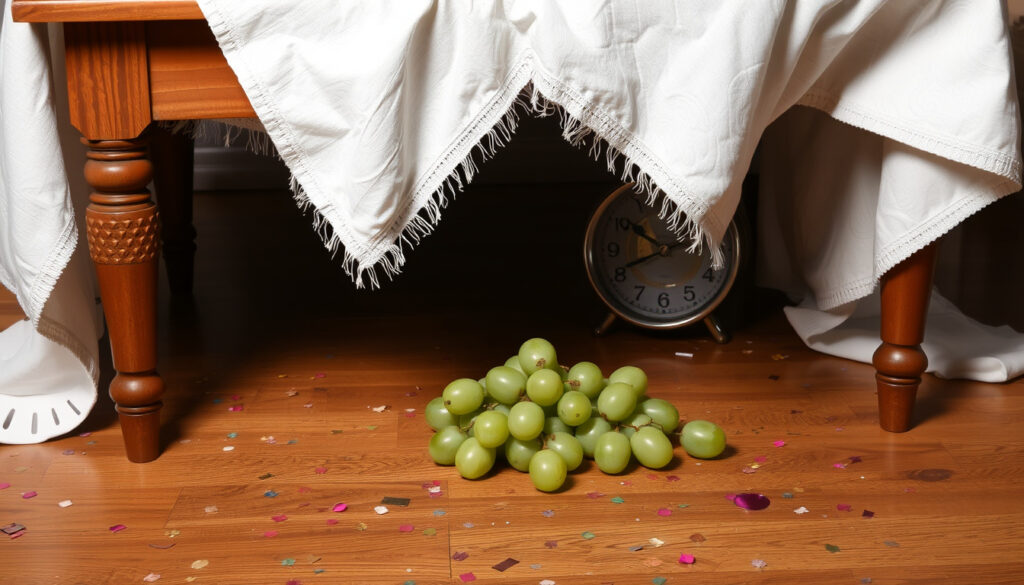
12 Grapes Under the Table: Rules and Meaning Explained
Few New Year’s rituals sound as strange as eating a dozen grapes while crouched under a table. Yet for many in Spain and Latin America, that odd position is the secret to attracting love in the year ahead.
Year tradition first recorded: 1909 ·
Country of origin: Spain ·
Total seconds to eat all grapes: 12 ·
Grapes per second recommended: 1 ·
Number of clock chimes at midnight: 12 ·
Typical grape color used: Green (seedless)
Quick snapshot
- Spanish New Year’s Eve custom dating to the early 1900s (Wikipedia historical record)
- Eat one grape per clock chime at midnight (Wikipedia timing guidance)
- Each grape represents a month of good luck (Wikipedia folklore interpretation)
- A romantic variation for love and relationship wishes (Petra Madalena lifestyle commentary)
- Common among single people seeking a partner (Petra Madalena folk-belief analysis)
- Touching the table leg is said to focus the wish (Petra Madalena romantic ritual description)
- Start exactly at the first chime (or slightly before) (Wikipedia timing instruction)
- Finish all 12 grapes before the last chime (Wikipedia speed requirement)
- Use seedless, bite-sized grapes for speed (Wikipedia preparation tips)
- First recorded mention in Alicante, Spain in 1909 (Wikipedia historical record)
- Gained national popularity by the 1920s–1930s (Wikipedia popularity expansion)
- Under-the-table variant emerges in late 20th century (Petra Madalena folk innovation timeline)
The pattern: the tradition is simple on the surface but layered with regional twists and romantic interpretations that most guides overlook.
| Attribute | Value |
|---|---|
| Age of tradition | Over 115 years (first documented 1909) |
| Origin | Alicante, Spain |
| Global reach | Practiced in Spain, Latin America, and Hispanic communities worldwide |
| Grape requirement | 12 grapes, usually green and seedless |
| Time window | 12 seconds (one per chime) |
| Common wishes | Health, love, prosperity, and travel |
Why eat 12 grapes under the table?
The short answer: the under-the-table position is a romantic offshoot of the standard Spanish New Year’s grape ritual. While the main tradition — called las doce uvas de la suerte — is about general good luck for the year ahead, the under-the-table version focuses specifically on love and relationship wishes (Petra Madalena lifestyle and folklore commentary).
The meaning of the under-the-table position
- Eating under a table is reportedly believed by some to channel romantic energy and attract a partner.
- Touching the table leg while eating is said to help focus the wish on love.
- The position adds an element of humility and intention to the ritual.
Romantic and relationship wishes associated with the location
- Some participants reportedly eat the grapes under the table while silently naming the person they wish to attract.
- Others touch a table leg with one hand and eat with the other to “ground” the wish.
- The romantic interpretation commonly says that eating 12 grapes under a table can predict or attract love within the coming year (Petra Madalena blog, folk-belief analysis).
Historical origin of the ‘under the table’ variation
- The standard 12-grape tradition dates back to at least 1895 and was popularized in 1909 by Alicante vine growers who had a surplus harvest (Wikipedia historical record).
- The under-the-table romantic twist is a much later adaptation — likely emerging in the late 20th century.
- No single town or person is credited with inventing the under-the-table variant, and its spread appears to be organic through word of mouth.
Singles who try the under-the-table version gain a focused love intention but lose the broader, year-long luck that the standard 12-grape tradition promises. You can’t sit under furniture and expect career prosperity from the same ritual.
The under-the-table version is folk innovation, not ancient tradition. That doesn’t make it less meaningful to those who practice it, but it helps to know you’re participating in a living, evolving custom rather than a fixed ancient rite.
Do you eat grapes at 11:59 or 12:00?
The most common point of confusion about this tradition is the exact start time. Get this wrong and you risk finishing too early or too late — both of which reportedly carry bad luck.
The exact timing of the first grape
- The standard tradition calls for eating one grape with each bell strike, starting at the first chime of midnight.
- Practically speaking, you need to pop the first grape in your mouth just before the first chime so you have time to chew and swallow before the second chime.
- Many experienced participants start at 11:59:50 to give themselves a head start (Wikipedia timing guidance).
Synchronizing with the clock chimes
- A standard clock chime sequence takes about 12 seconds from first strike to last.
- You must finish grape number 12 before the twelfth chime fades.
- If you finish early, you wait. If you finish late, you miss the window.
For first-timers, the margin for error is about one chewed grape per second. Peeling or seeding grapes beforehand is the single biggest success factor — the clock won’t wait for you to deseed.
Tips for starting at the right moment
- Pre-peel and deseed all 12 grapes and place them in a small bowl.
- Position yourself near the clock or television that will broadcast the chimes.
- Start your first grape at approximately 11:59:57 so you swallow just after the first chime begins.
- Keep a glass of water nearby to wash down any stubborn grape skins.
The timing is strict but manageable with preparation. Most failures happen because people start too late or try to chew unpeeled grapes in a panic.
Is it 12 grapes in 12 seconds or 12 minutes?
There’s no ambiguity in the classic version: 12 grapes in 12 seconds, one per chime. But modern variations have stretched that window, creating confusion.
The standard speed: one grape per second
- The traditional requirement is exactly 12 seconds, matching the 12 chimes of the clock at midnight (Wikipedia speed requirement).
- Each chime acts as a countdown: grape one at chime one, grape two at chime two, and so on.
- This leaves no time for hesitation, coughing, or laughter.
Consequences of taking longer than the chime sequence
- Traditional belief holds that failing to finish within the 12 chimes brings bad luck for the coming year.
- Each unfinished grape is said to represent a month of misfortune.
- Some modern practitioners allow up to a minute as a relaxed variation, but purists stick to the 12-second rule.
Variations in different countries
- In parts of Latin America, the ritual is sometimes adapted to local clock traditions.
- Some families count slowly to 12 after midnight instead of syncing with broadcast chimes.
- The under-the-table romantic version typically follows the same 12-second timing, adding the floor position as an extra element.
The 12-second constraint is what gives the tradition its thrill. It’s a small performance challenge — and the shared tension in Spanish households at midnight is part of what keeps the custom alive.
What happens if you don’t finish the 12 grapes at midnight?
Superstition paints a bleak picture: incomplete grape consumption means bad luck for the months corresponding to the grapes you missed. But the reality is more forgiving than most articles suggest.
Common superstitions about incomplete grape consumption
- Each grape not swallowed by the last chime corresponds to a month of potential misfortune.
- If you only manage 10 grapes, months 11 and 12 are reportedly unlucky.
- Some believe the bad luck is permanent for that year; others think you can try again next year.
Is the bad luck permanent or fixable?
- There’s no standardized “fix” documented in folklore, but some practitioners recommend a quick second attempt with new grapes after the chimes end.
- Others suggest making a sincere wish immediately after failure to mitigate the bad luck.
- The lack of a formal remedy reflects the tradition’s folk origins — it evolved organically, not through a central authority.
Practical advice to avoid failure
- Use seedless grapes — preferably green, as they’re softer and easier to chew quickly.
- Peel the grapes in advance if you have time; skins slow you down.
- Cut larger grapes in half so they’re bite-sized.
- Practice with a stopwatch before New Year’s Eve — one grape per second is deceptively fast.
The grapeseed is the most common saboteur. A single seed lodged in a grape can add two to three seconds of chewing time — enough to miss two or three chimes. Seedless grapes aren’t a suggestion; they’re a success requirement.
Preparation reduces spontaneity but dramatically increases success rates. Decide whether you value the raw, unscripted experience or the satisfaction of completing the ritual.
Where do you eat the 12 grapes at midnight?
Location matters more than most guides acknowledge. The standard position and the romantic under-the-table variant serve different intentions.
Standard location: in front of the television or clock
- Most Spanish families gather in the living room where the clock or TV broadcast is visible.
- The tradition calls for being near the sound of the chimes so you can sync your eating.
- Many families stand together, each holding a small bowl of 12 grapes, waiting for midnight.
Under-the-table location and its significance
- Eating under the table is a specific variant done for love wishes, not general luck.
- The position is reportedly believed by some to draw romantic energy toward the person.
- Touching a table leg is said to anchor the wish and make it more powerful.
- Participants often perform this alone or with trusted friends, not in large family groups.
Other creative locations used around the world
- Some people eat grapes on their doorstep, symbolically inviting luck into the home.
- Others face a mirror while eating, reportedly for self-reflection wishes.
- Outdoor balconies are popular in warmer climates, where the sound of church bells carries clearly.
Location shapes intention. Living room = general luck. Under the table = romantic wish. Threshold = home-centered prosperity. Choose your spot based on what you want from the coming year.
Timeline of the tradition
- 1909 — First recorded mention of eating 12 grapes at midnight in Alicante, Spain. Vine growers promote the custom to sell surplus grapes after an excellent harvest (Wikipedia historical origin).
- 1920s–1930s — Tradition spreads across Spain and gains national popularity as a New Year’s Eve fixture.
- Late 20th century — Adaptation of eating under the table for love wishes emerges in some regions as a folk innovation.
- 2000s–present — Global dissemination through social media and travel; variations appear worldwide, including the romantic under-the-table twist.
What we know and what remains uncertain
Confirmed facts
- The tradition began in Spain in the early 20th century.
- Each grape is eaten with each bell chime at midnight.
- The under-the-table variant is associated with romantic wishes.
- Alicante grape growers popularized the custom in December 1909 to sell surplus harvest.
- The practice is tied to welcoming the New Year and is still active today.
What’s unclear
- The exact origin of the under-the-table twist is not precisely documented.
- Whether eating under the table started in a specific town or as a viral trend.
- The effectiveness of the tradition in bringing actual luck is anecdotal and unmeasured.
- Whether the romantic interpretation predates the late 20th century is unknown.
Expert and cultural perspectives
“Each grape brings one month of good luck.”
Dr. Daniel Compora, professor of folklore, quoted in Vogue (via Wikipedia reference)
“The custom is said to date back at least to 1895, but was greatly popularized in 1909 when Alicante vine growers promoted it after an excellent harvest.”
Atlas Obscura, travel and folklore publication (via Wikipedia historical record)
“The tradition is widely recognized as Spanish in origin and is now followed in parts of Latin America.”
Wikipedia ‘Twelve Grapes’ entry
For the single person in Madrid or Mexico City staring at a bowl of 12 green grapes at 11:58 PM, the choice is straightforward: stay at the table for general luck, or slip underneath it and bet on love. The ritual works not because grapes have supernatural power, but because the act of focused intention — performed with real effort and a deadline — forces you to decide what you actually want for the next 12 months.
Related reading: Hasta la Vista Baby: Meaning, Origin & Terminator Quote
Frequently asked questions
What wishes do people make while eating 12 grapes under the table?
The most common wishes focus on love and relationships. Some people silently name the person they hope to attract, while others make a general wish for romantic companionship in the coming year. Touching the table leg is said to help focus the intention.
Do I need green or red grapes for the 12 grapes tradition?
Green seedless grapes are the most common choice because they’re softer, easier to chew quickly, and don’t require deseeding during the 12-second window. Red grapes work but are often firmer and take longer to chew. The tradition doesn’t specify color — speed and ease are the priorities.
Is it necessary to eat the grapes under the table for the wish to work?
No. The under-the-table position is a romantic variant, not a requirement of the main tradition. The standard 12-grape ritual is eaten at a table or wherever the clock is visible. Eating under the table is specifically for love and relationship wishes.
How do I prepare to make sure I finish all 12 grapes in time?
Peel and deseed all grapes beforehand. Cut any large grapes in half. Place them in a small bowl near your chosen spot. Start your first grape at approximately 11:59:57 so the first chime catches you mid-chew. Keep water nearby and practice with a stopwatch beforehand.
Is the 12 grapes tradition only for New Year’s Eve?
Yes, the tradition is specifically tied to welcoming the New Year at midnight on December 31. It is not performed at other times of the year. The number 12 corresponds to the 12 months ahead and the 12 clock chimes that mark the new year.
Can children participate in the 12 grapes tradition?
Yes, children often participate with smaller grapes or half-grapes. Many Spanish families include children in the ritual, though they may use peeled, seedless grapes cut into very small pieces to make the 12-second window achievable.
Where else besides Spain is this tradition popular?
The tradition is widely practiced in Latin American countries including Mexico, Colombia, Argentina, Peru, and Chile. It has also spread to Hispanic communities in the United States and Europe, and is increasingly known globally through travel and social media.
More related posts
 Lala Anthony: Divorce, Son Kiyan, Net Worth, Now 2025
 Arthur Guinness: Real Life, 21 Children & Netflix Accuracy
 Kevin Maguire: Poppy Stance, Wife, Net Worth & Career
 Joseph Stalin: Biography, WWII Leadership, Death & Legacy
 Baldur’s Gate 3 Mods – 2025 Install Guide and Top Picks
 Salt of the Earth Deodorant: Reviews and Facts
 Liam Howlett: Biography, Career, and Role in The Prodigy