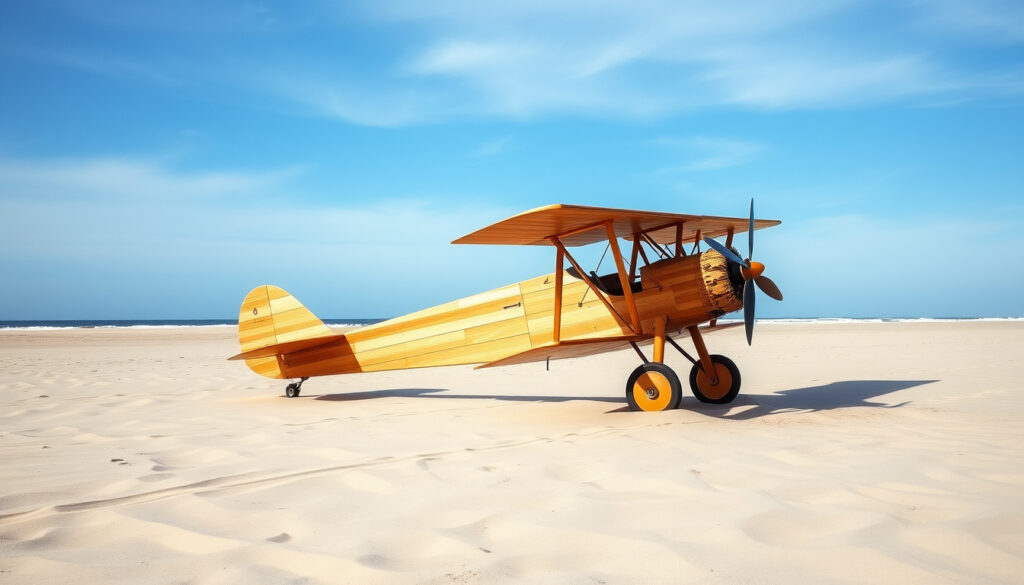
Wright Brothers: Who Made the First Flight
Few moments in history changed the world as quietly as the morning of December 17, 1903, when a fragile wooden aircraft lifted off the sands of Kitty Hawk. Orville and Wilbur Wright, two bicycle mechanics from Dayton, Ohio, had just done what no one had done before — fly a powered, heavier-than-air machine under human control, and this article traces their journey from a small bicycle shop to the birth of aviation, exploring the health challenges that cut their partnership short.
First flight date: December 17, 1903 ·
Distance of first flight: 120 feet (37 m) ·
Duration of first flight: 12 seconds ·
Number of flights on Dec 17, 1903: 4 ·
Orville Wright’s age at first flight: 32 ·
Wilbur Wright’s age at first flight: 36
Quick snapshot
- Date: December 17, 1903 (NASA)
- Location: Kitty Hawk, NC (Smithsonian National Air and Space Museum)
- Pilot: Orville Wright (Smithsonian National Air and Space Museum)
- Distance: 120 ft (NASA)
- Orville Wright (1871–1948) (Smithsonian Institution Archives)
- Wilbur Wright (1867–1912) (Smithsonian Institution Archives)
- Background: bicycle mechanics (NASA)
- Three-axis control system (Smithsonian National Air and Space Museum)
- Wing warping (Smithsonian Magazine)
- Propeller design (NASA)
- Considered fathers of modern aviation (Smithsonian National Air and Space Museum)
- Inspired global aerospace industry (Smithsonian National Air and Space Museum)
- First to achieve sustained powered flight (Smithsonian Magazine)
Who actually flew the first plane?
Was it Orville or Wilbur?
- Orville Wright piloted the first powered, sustained, and controlled flight on December 17, 1903 (Smithsonian National Air and Space Museum)
- Wilbur made the fourth and longest flight that day, covering 852 feet in 59 seconds (Smithsonian National Air and Space Museum)
What about earlier attempts by others?
- Earlier unsuccessful attempts by Samuel Langley and Gustave Whitehead are sometimes debated but not widely accepted by mainstream historians as the first powered flight (Smithsonian National Air and Space Museum)
The implication: Credit for “first flight” often goes to Orville, but the Wrights worked as a seamless team — neither brother could have succeeded alone.
What actually happened on 17 December 1903?
What was the sequence of events?
- Four flights were made from Kill Devil Hills near Kitty Hawk, North Carolina (NASA)
- The first flight by Orville lasted 12 seconds and covered 120 feet (NASA)
- The fourth and longest flight by Wilbur covered 852 feet in 59 seconds (Smithsonian National Air and Space Museum)
- The flights were witnessed by a small group of local men (NASA)
What conditions did the Wright brothers face?
- They faced cold December winds and sand, and the Wright Flyer was damaged in a post-flight gust (Smithsonian National Air and Space Museum)
In just 12 seconds, Orville Wright flew shorter than the wingspan of a modern Boeing 737 — yet that short hop rewrote the boundaries of human movement forever.
The pattern: each flight progressively improved, proving the Wrights were not lucky — they were methodical engineers refining a working system.
Which one of the Wright brothers died?
Which brother died first?
- Wilbur Wright died first on May 30, 1912 from typhoid fever at age 45 (Smithsonian Institution Archives)
- Orville Wright died on January 30, 1948 from a heart attack at age 76 (Smithsonian Institution Archives)
- Both brothers passed away in Dayton, Ohio (Smithsonian Institution Archives)
What were the causes of death?
- Wilbur contracted typhoid fever, likely from contaminated food or water, and died after a short illness (Smithsonian Institution Archives)
- Orville suffered a fatal heart attack, ending a life that had spanned from the bicycle era to the dawn of jet aviation (Smithsonian Institution Archives)
Wilbur’s death from a preventable disease at the peak of his career meant the Wright company lost its strategic thinker, while Orville lived long enough to see his invention transform the world — and fight patent battles that drained the brothers’ energy.
The trade-off: the brothers’ intense work schedule during the 1900-1905 experiments may have weakened Wilbur’s immune system, contributing to his fatal infection.
What are the Wright brothers known for?
What inventions did they create?
- They invented, built, and flew the world’s first successful motor-operated airplane (Smithsonian National Air and Space Museum)
- They developed the three-axis control system essential for stable flight — a system still used in every fixed-wing aircraft today (Smithsonian National Air and Space Museum)
- Their wind tunnel experiments in 1901 gave them accurate lift and drag data that others lacked (Smithsonian Magazine)
What is their legacy in aviation?
- Their work led to the modern aviation industry and inspired aviators worldwide (NASA)
- The Wright Flyer is housed at the Smithsonian National Air and Space Museum, symbolizing the dawn of powered flight (Smithsonian National Air and Space Museum)
Without the Wrights’ three-axis control, flight would have remained a dangerous stunt. Their systematic approach — four years of glider tests, wind tunnel data, and iterative design — turned a dream into an industry. Today, even the most advanced fighter jet relies on the same principles they patented in 1906.
The implication: the Wright brothers didn’t just build a flying machine — they built the intellectual framework for all aviation that follows. Cathay Pacific Ownership, Service & Emirates Comparison (2025) illustrates how the airline industry they made possible now serves billions of passengers yearly.
What disease did Wilbur Wright have?
How did typhoid fever affect him?
- Wilbur Wright contracted typhoid fever likely from contaminated food or water (Smithsonian Institution Archives)
- He died from the disease at age 45 after a brief illness (Smithsonian Institution Archives)
What was his health history?
- His health had been fragile since childhood — he was injured playing hockey as a teenager, which may have affected his heart — but he was generally active until his final illness (Smithsonian Institution Archives)
The catch: a simple waterborne disease — not a crash or engine failure — ended the Wright partnership, reminding us that early aviators faced mortal risks on the ground as well as in the air.
Timeline of the Wright brothers
- 1867 — Wilbur Wright born in Millville, Indiana (Smithsonian Institution Archives)
- 1871 — Orville Wright born in Dayton, Ohio (Smithsonian Institution Archives)
- 1892 — Open bicycle repair and sales shop (Smithsonian Magazine)
- 1900-1902 — Conducted glider experiments at Kitty Hawk (Smithsonian National Air and Space Museum)
- December 17, 1903 — First powered, sustained, controlled flight (NASA)
- 1904-1905 — Continued flight tests at Huffman Prairie (Smithsonian National Air and Space Museum)
- 1908 — Public demonstration flights in US and Europe (Smithsonian National Air and Space Museum)
- May 30, 1912 — Wilbur Wright dies from typhoid fever (Smithsonian Institution Archives)
- January 30, 1948 — Orville Wright dies from heart attack (Smithsonian Institution Archives)
The pattern: the timeline shows a compressed burst of innovation between 1900 and 1905, followed by a long tail of commercialization and litigation. Wilbur’s death in 1912 split the arc abruptly.
What’s confirmed and what’s unclear
Confirmed facts
- The Wright brothers achieved the first powered, sustained, and controlled flight on December 17, 1903 (NASA)
- Orville Wright was the pilot of the first flight (Smithsonian National Air and Space Museum)
- Wilbur Wright died of typhoid fever in 1912 (Smithsonian Institution Archives)
- Orville Wright died of a heart attack in 1948 (Smithsonian Institution Archives)
What’s unclear
- Exact number of earlier unsuccessful attempts by other inventors (e.g., Gustave Whitehead) – not widely accepted by mainstream historians (Smithsonian National Air and Space Museum)
- Whether the Wright brothers were the first to fly in a technically powered sense – some fringe claims exist but lack evidence (Smithsonian National Air and Space Museum)
- The precise source of Wilbur’s typhoid infection is unknown (Smithsonian Institution Archives)
- The extent of patent litigation’s effect on the Wright Company’s growth is debated (Smithsonian Magazine)
The implication: even well-established stories have nuances that challenge the standard narrative.
Voices from the past: what the Wright brothers said
“This flight lasted only 12 seconds, but it was nevertheless the first in the history of the world in which a machine carrying a man had raised itself by its own power into the air in free flight.”
— Orville Wright, diary entry, December 17, 1903 (Smithsonian National Air and Space Museum)
“The machine flew beautifully and behaved perfectly.”
— Wilbur Wright, in a letter to his father after the first flights (Smithsonian Magazine)
The catch: these calm words from Orville and Wilbur belie the years of crashes, financial strain, and physical risk that preceded that 12-second hop. Their understated tone reflects a methodical, almost businesslike approach to invention — a trait that set them apart from showmen like Samuel Langley.
en.wikipedia.org, inventionandtech.com, nasa.gov, en.wikipedia.org, smithsonianmag.com, metroairportnews.com, youtube.com, siarchives.si.edu, instagram.com, nasa.gov, airandspace.si.edu, www1.grc.nasa.gov, nationalreport.uk
For a deeper look into the details of that breakthrough, read more about Orville and Wilbur Wrights historic flight and its lasting impact on aviation.
Frequently asked questions
Are the Wright brothers still alive?
No. Wilbur Wright died in 1912 from typhoid fever, and Orville Wright died in 1948 from a heart attack. Both are buried in Dayton, Ohio (Smithsonian Institution Archives).
How many flights did the Wright brothers make on December 17, 1903?
They made four flights. The first, piloted by Orville, covered 120 feet in 12 seconds. The fourth, piloted by Wilbur, covered 852 feet in 59 seconds (NASA).
What was the Wright brothers’ first aircraft called?
It was called the Wright Flyer (also known as the 1903 Wright Flyer). It is now displayed at the Smithsonian National Air and Space Museum (Smithsonian National Air and Space Museum).
Where did the Wright brothers first fly?
They flew at Kill Devil Hills, about 4 miles south of Kitty Hawk, North Carolina (NASA).
What was the Wright brothers’ nationality?
They were American. They were born in the United States (Wilbur in Indiana, Orville in Ohio) and lived most of their lives in Dayton, Ohio (Smithsonian Institution Archives).
How did the Wright brothers finance their experiments?
They used profits from their bicycle repair and sales shop. They also had some financial support from their father, Milton Wright, a bishop in the Church of the United Brethren in Christ (Smithsonian Magazine).
What did the Wright brothers do before aviation?
They owned and operated a bicycle repair and sales shop in Dayton, Ohio. They also published a local newspaper briefly in their youth (NASA).
The implication: these answers address the most common curiosities about the Wrights’ lives and work.
The Wright brothers turned a bicycle shop into the birthplace of powered flight through relentless experimentation and a refusal to accept conventional wisdom. Wilbur’s premature death from typhoid fever cut their partnership short, but Orville lived to see their creation transform global transportation. For anyone interested in how innovation actually happens, the lesson is clear: methodical iteration, grounded in real data, beats luck and bold claims every time. Coco Chanel: Life, Struggles, WWII Ties, and Legacy offers another example of how a determined inventor reshaped her industry — proof that the Wrights’ story is part of a larger pattern of human ingenuity. The Wright brothers set the standard that remains the foundation on which everything is built.
More related posts
 Vlad Dracula: Historical Facts vs. Vampire Myth
 What Is the Fastest Way to Cure a Stomach Ulcer – Healing in 4-8 Weeks
 Honor Blackman: The Avengers’ Leather-Clad Icon and Bond’s Most Memorable Foil
 The Range East Kilbride: Opening Times & Homebase News
 Sofa Bed with Storage – Top IKEA Picks and Buying Guide
 Raven-Symoné: Net Worth, Wife, Children & Full Bio
 J.P. Morgan: Biography, Net Worth, Dark History & Legacy
 George IV: Mad King, Regency, Children, and Cause of Death