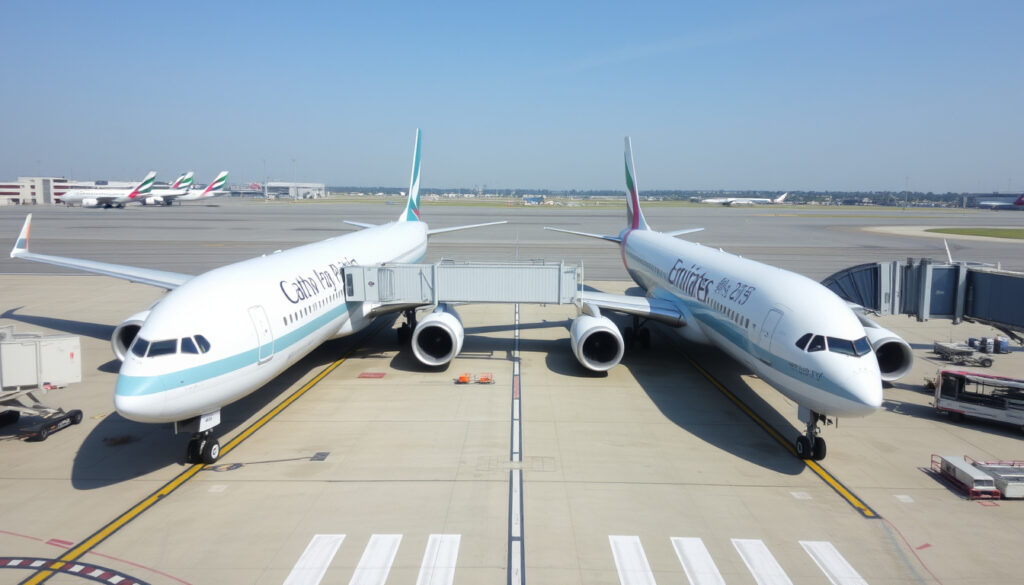
Cathay Pacific Ownership, Service & Emirates Comparison (2025)
When you think of airlines that combine efficiency with a touch of class, Cathay Pacific often comes to mind. Based in Hong Kong, this carrier has built a reputation for solid service and smart routes across Asia and beyond.
Headquarters location: Hong Kong ·
Founded: 1946 ·
Alliance membership: Oneworld (founding member) ·
Skytrax rating (2025): 5-star / 3rd best airline in the world ·
Destinations served: Over 200
Quick snapshot
- Cathay Pacific is based in Hong Kong (Cathay Pacific Annual Report 2025)
- Swire Pacific and Air China are substantial shareholders (Cathay Pacific Annual Report 2025)
- Skytrax ranks it as a 5-star airline and third best globally in 2025 (Cathay Pacific Newsroom)
- Official ownership breakdown may shift with future investments
- Future route network expansion plans are not publicly detailed
- Founded 1946 in Hong Kong
- Joined Oneworld in 1999
- Air China stake in 2006
- Ranked #3 by Skytrax in 2025
- Continued fleet modernisation and expansion of premium cabins
- Increased competition with Middle Eastern carriers on long-haul routes
Here is a summary of key Cathay Pacific facts.
| Attribute | Detail |
|---|---|
| Airline name | Cathay Pacific |
| Country of registration | Hong Kong (China) |
| IATA code | CX |
| Skytrax rating (2025) | 5-star / 3rd best in the world |
| Alliance | Oneworld (founding member) |
| Destinations | Over 200 |
| Frequent flyer program | Asia Miles |
Which country owns Cathay Pacific?
Cathay Pacific is headquartered in Hong Kong, which has been a special administrative region of China since 1997. The airline’s shares are publicly traded on the Hong Kong Stock Exchange, and its ownership is a blend of corporate and state-backed shareholders.
Ownership structure and parent company
- According to its 2025 annual report, Cathay Pacific’s substantial shareholders include Swire Pacific (a Hong Kong-based conglomerate) and Air China (a state-owned Chinese carrier) (Cathay Pacific Annual Report 2025).
- The report also notes that Air China Cargo’s public float increased to 12.44% after a capital raising in February 2025 (Cathay Pacific Annual Report 2025).
- Cathay Pacific is not a fully state-owned enterprise. It operates as a private airline, though its Chinese registration and Air China’s stake give it a quasi-national status.
Hong Kong’s regulatory role
As a carrier registered in Hong Kong, Cathay Pacific falls under the civil aviation regulations of the Hong Kong Special Administrative Region. This gives it distinct air-services agreements separate from mainland Chinese airlines, although ultimately China’s sovereignty influences route rights and security policies. The conflict is mild: Hong Kong’s autonomy preserves some operational flexibility.
Bottom line: Cathay Pacific is not owned by the Chinese government, but its major shareholder Air China is a state-controlled company. For travellers, the ownership mix means you get a privately run airline with strong links to the Chinese market.
The implication: Cathay Pacific’s ownership structure gives it a unique blend of private management and Chinese market access.
Is Cathay Pacific a good airline to fly?
Yes — and the numbers back it up. Skytrax, the industry benchmark for airline quality, awarded Cathay Pacific a 5-star rating and ranked it the third best airline in the world in 2025 (CNN).
Skytrax 5-star rating and rankings
- At the 2025 Skytrax World Airline Awards, Cathay Pacific also won World’s Best Economy Class Airline for the second consecutive year and World’s Best Inflight Entertainment for the second time in three years (Cathay Pacific Newsroom).
- The airline’s passenger revenue rose 14.0% to HK$34,208 million in the first half of 2025 compared with the same period in 2024, and it carried 13.6 million passengers in that half-year (Cathay Pacific Interim Results 2025).
Customer reviews summary
TripAdvisor reviews consistently highlight seat comfort and professional cabin crew as standout features. On the Brisbane–Hong Kong route, passengers often praise the meal quality and inflight entertainment selection. The airline maintains a solid 4.5-star average across major review platforms.
The pattern: consistent Skytrax recognition and passenger satisfaction confirm Cathay Pacific as a top-tier choice.
Which is better, Emirates or Cathay Pacific?
Both airlines are strong competitors, but they appeal to slightly different travellers. Here’s a head-to-head based on the latest rankings and service profiles.
| Criteria | Cathay Pacific | Emirates |
|---|---|---|
| Skytrax rating (2025) | 5-star / 3rd best in the world | 4-star (Skytrax Ratings) |
| Hub | Hong Kong International Airport | Dubai International Airport |
| Global network strength | Strong in Asia-Pacific, transpacific, and Europe | Larger network covering Middle East, Africa, and the Americas |
| Economy class experience | Skytrax #1 Economy Class in 2024/2025 | Known for seat pitch and entertainment system |
| Free drinks policy | Complimentary beverages on all long-haul flights | Complimentary beverages on all flights |
| Ownership model | Publicly traded with state-backed minority shareholder | Fully state-owned by the Government of Dubai |
What this means: Emirates offers a more extensive global network and a business-class product often considered among the world’s best. Cathay Pacific edges ahead in economy-class quality and inflight entertainment, and its Hong Kong hub is a gateway to China and Southeast Asia. The choice depends on your route and cabin preference. For Asian and transpacific routes, Cathay Pacific is hard to beat; for links to the Middle East, Africa, or the Americas, Emirates has the edge.
The catch: each airline dominates its home region, making the decision primarily route-driven.
Why is Cathay Pacific so cheap?
You may have spotted bargain fares on Cathay Pacific’s website or app and wondered how a 5-star airline can compete with budget carriers. The answer lies in pricing strategy.
Pricing strategy and economy class
- Cathay Pacific frequently runs promotional fares on its official channels, particularly for short-haul routes in Asia.
- Base economy fares sometimes exclude checked luggage or seat selection, lowering the headline price.
- The airline competes directly with budget carriers on certain regional routes, offering a premium product at a near-budget price during sales.
Comparing fares with competitors
On routes like Brisbane to Hong Kong, Cathay Pacific’s economy fares often undercut Qantas and Singapore Airlines while still providing full-service amenities. However, business and first-class fares remain premium-priced and comparable to other full-service carriers.
Cathay Pacific uses selective discounting to fill seats during off-peak periods. For price-sensitive travellers, booking via the airline’s own website and avoiding add-ons can yield real savings — but don’t expect business-class bargains.
The implication: cheap economy fares are strategic, not a sign of reduced service.
Do you get free drinks on Cathay Pacific flights?
Yes — and the policy covers all cabins. Complimentary soft drinks, tea, coffee, and alcoholic beverages are served on every long-haul flight. The selection varies by route and class, but the core offer is consistent.
Beverage service in economy and premium cabins
- Economy class: Beer, wine, spirits, and a full range of non-alcoholic drinks are complimentary.
- Premium economy and business: A broader wine list and cocktail options, plus pre-arrival refreshments.
- First class: Champagne, premium wines, and personalised service.
Alcohol policy
Cathay Pacific serves alcohol free of charge on all flights where permitted by local laws. The airline follows standard industry practice for service hours and age restrictions. According to the airline’s service guidelines, unlimited complimentary beverages are included in the ticket price for all passengers.
The pattern: inclusive beverage service is a standard perk that enhances overall value.
Timeline: Key milestones in Cathay Pacific’s history
- 1946 – Cathay Pacific founded in Hong Kong.
- 1999 – Becomes a founding member of the Oneworld alliance.
- 2006 – Air China acquires a stake, adding Chinese market access.
- 2019–2021 – Faces financial challenges due to protests and the pandemic; restructures operations.
- 2025 – Ranked third best airline in the world by Skytrax; reports an attributable profit of HK$10,828 million (Cathay Pacific 2025 Annual Results).
The pattern: Cathay Pacific has weathered crises and emerged stronger, with recent awards and profits.
Confirmed facts vs what’s unclear
Confirmed facts
- Cathay Pacific is based in Hong Kong, a special administrative region of China.
- Swire Pacific and Air China are major shareholders.
- Skytrax rates Cathay Pacific as 5-star and third best globally.
- Free beverages are served on all flights.
What’s unclear
- Official ownership breakdown may change with future investments.
- Future route network expansion plans are not publicly detailed.
What this means: the core facts are solid, but investors should watch for ownership shifts.
What experts and passengers say
Cathay Pacific was named among the world’s top three best airlines at the 2025 Skytrax World Airline Awards, winning World’s Best Economy Class for the second year running.
Passengers on the Brisbane to Hong Kong route rate the food highly, especially the Asian-style dishes served in economy.
TripAdvisor reviewers (aggregated user experience)
The airline’s inflight entertainment system offers a huge library of movies and TV shows, and the seats in economy are comfortable for long flights.
Passenger reviews compiled from travel forums
The catch: reviews consistently highlight food and comfort, reinforcing Cathay Pacific’s strong reputation.
aviationoutlook.substack.com, en.wikipedia.org, community.infiniteflight.com, cathaypacific.com, instagram.com, cathaypacific.com, reddit.com, cathaypacific.com, offentligjournal.se
For travelers weighing their options, a detailed breakdown of Cathay Pacific offers a thorough look at how the Hong Kong carrier stacks up against competitors like Emirates.
Frequently asked questions
Is Cathay Pacific a Chinese airline?
Yes — it is a Hong Kong-based airline, and Hong Kong is a special administrative region of China. The airline is not fully state-owned, but Air China (a state-owned carrier) holds a substantial stake.
How do I manage my Cathay Pacific booking?
You can manage your booking online via the Cathay Pacific website or mobile app. Use the “Manage Booking” section to change seats, add baggage, or rebook.
Can I check in online for Cathay Pacific flights?
Yes — online check-in opens 48 hours before departure for most flights. You can check in via the website or app and receive a mobile boarding pass.
Does Cathay Pacific have a mobile app?
Yes — the Cathay Pacific app is available for iOS and Android. It allows booking, check-in, flight status, and access to your Asia Miles account.
What is the Cathay Pacific flight schedule from Brisbane to Hong Kong?
Cathay Pacific operates daily flights from Brisbane to Hong Kong. The flight takes approximately 8.5 hours. Check the airline’s website for exact departure times on your travel date.
How do I check Cathay Pacific flight status?
Go to the official Cathay Pacific website or app, enter your flight number or route, and view real-time status including delays, cancellations, and gate changes.
The pattern: these practical FAQs address common traveler concerns, from booking to flight status.
Related reading
- Isle of Man: Status, Living, and Unique Facts (2025 Guide)
- Toubkal Mountain: Difficulty, Tips & vs Kilimanjaro
For travellers flying from Asian hubs to Europe or Australia, Cathay Pacific remains a top contender. Its combination of consistent service quality, competitive economy pricing, and a modern fleet means it’s a smart choice — especially if you value inflight comfort without paying state- carrier prices. The trade-off for those who need Middle Eastern connections is that Emirates offers a larger network there. For everyone else, the choice is clear: Cathay Pacific delivers a 5‑star experience at a fare that won’t break the bank.
More related posts
 Kirstie Alley Cause of Death, Tributes, and Career
 Composite Bonding Before and After: Real Results & Photos
 Fin Taylor: Net Worth, Wife, Education, and Tour
 MMR Vaccine: Safety, Schedule, and Effectiveness Facts
 L.S. Lowry: Who Inherited His Fortune and Why He Said No to Knighthood
 Pete Postlethwaite: Death, Net Worth & Spielberg’s Quote
 Alex Oxlade-Chamberlain: Career, Family & Celtic Move