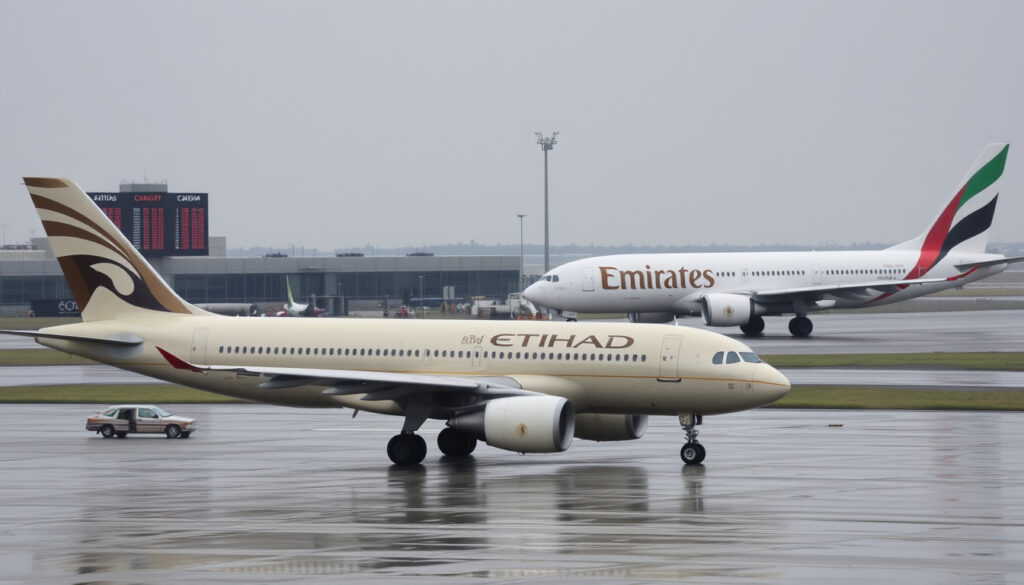
Etihad Airways: Cancellations, Safety & Emirates Comparison
Few things test a premium airline’s reputation like a wave of last-minute cancellations. By late June 2025, Etihad Airways had scrapped a string of regional flights out of Abu Dhabi — Doha, Kuwait, and Muscat among the hardest hit — according to Etihad Hub (carrier notice), the carrier’s own operations notice. The disruptions are forcing travelers to weigh a harder question: how reliable is Etihad right now, and how does it really compare with Emirates?
Founded: 2003 ·
Headquarters: Abu Dhabi, UAE ·
Fleet size: 80+ aircraft ·
Destinations: 80+ ·
Owner: Government of Abu Dhabi
Quick snapshot
- Etihad cancelled a wave of regional services on 23–24 June 2025 (carrier notice).
- Etihad says flights operate only through approved airspace and that safety is its highest priority (carrier notice).
- Transit passengers connecting to cancelled flights are not accepted at origin (
- How long regional airspace restrictions will remain in place.
- Whether more Etihad routes will be suspended at short notice.
- How quickly official travel advisories will change.
- 13 June 2025: Tel Aviv services cancelled; an Amman flight delayed (Khaleej Times).
- 23 June 2025: Doha, Kuwait, Muscat, Riyadh, and Bahrain routes pulled (carrier notice).
- 24 June 2025: More cancellations to Kuwait, Doha, Dammam, and Muscat (carrier notice).
- Etihad warns further changes can come with little notice (carrier notice).
- Affected passengers are being rerouted on alternative travel arrangements (Khaleej Times).
- Travelers should confirm flight status before heading to the airport.
Six rows, one pattern: Etihad is a mid-size, state-backed premium carrier built around a single hub.
| Category | Value |
|---|---|
| Airline Code | EY |
| Founded | 2003 |
| Hub | Abu Dhabi International Airport (AUH) |
| Fleet | 80+ aircraft |
| Destinations | 80+ |
| Owner | Government of Abu Dhabi |
Is Etihad as good as Emirates?
The answer sits somewhere between “yes, in the cabin” and “not quite, on the network.” Both airlines run premium-heavy, full-service models out of the UAE; the differences show up in fleet size, route depth, and the signature cabins each one leads with.
Service quality comparison
- Both are UAE-based full-service carriers with strong reputations in premium cabins.
- Etihad positions itself on a four-class product: Economy, Business, First, and The Residence.
- Emirates leans on its A380 first-class suites as the public face of the brand.
On food, lounges, and cabin finish, the two are close. The difference is focus: Emirates scales the experience across a much larger fleet, while Etihad concentrates it into a more exclusive product line.
Cabin classes and seat comfort
- Etihad’s line-up: Economy, Business, First, and The Residence — a private three-room suite.
- Emirates’ signature: private suites on the A380.
- The Residence is the product that keeps Etihad in the conversation on exclusivity.
A living room, a bedroom, and a shower at cruising altitude is not a small differentiator. It makes Etihad a genuine alternative to Emirates for travelers who want the cabin itself to be the destination.
Route network and destinations
- Etihad operates 80+ aircraft to 80+ destinations through a single hub at AUH.
- Emirates operates a larger fleet and more US routes.
- Etihad’s smaller map funnels more connections through Abu Dhabi.
That funel is the operational weak point right now. Because Etihad depends on one hub, every airspace restriction over Abu Dhabi touches a larger share of its schedule than it would for a carrier with more bases.
Loyalty programs and perks
- Etihad runs the Etihad Guest program; Emirates runs Skywards.
- Etihad serves complimentary drinks in every cabin.
Neither program is dramatically better; both reward regular Gulf corridor travelers with tier-based benefits.
For a frequent flyer, Etihad’s smaller network is a real constraint: more connections via Abu Dhabi means more exposure to the region’s airspace volatility. Emirates’ bigger route map spreads that risk.
What this means: the product comparison favors Etihad on exclusivity; the operational comparison favors Emirates on redundancy — more fleet, more routes, less dependence on one corridor.
The implication: product quality is real, but reliability hinges on network depth.
Which country owns Etihad Airways?
Straightforward on paper, significant in practice: Etihad is owned by the Government of Abu Dhabi, making it a fully state-backed flag carrier.
Ownership structure
- Etihad Airways is wholly owned by the Government of Abu Dhabli.
- It operates as a state-owned airline inside the UAE aviation sector.
That ownership carries weight when disruption hits. A state-owned carrier can absorb rerouting costs and keep flights flying through approved corridors; it also answers to a government whose security posture directly shapes route decisions.
Government of Abu Dhabi
- Abu Dhabi is Etihad’s headquarters and home base.
- The airline was founded in 2003 as the emirate’s national carrier.
Etihad’s role is economic as much as commercial: it connects Abu Dhabi to global markets in a way that complements Dubai’s Emirates.
Relation to UAE
- Etihad and Emirates are the UAE’s two flag carriers.
- Both operate independently within the UAE’s aviation sector.
Etihad said it coordinates with relevant authorities and operates only through approved airspace during the June 2025 disruption (carrier notice).
What this means: when the security picture changes, a state-owned airline’s schedule follows government posture — not just passenger demand.
Are flights to Abu Dhabi cancelled today?
For a specific set of routes, yes. Etihad cancelled numerous regional services on 23 and 24 June 2025, and it has warned that further changes can come at short notice (carrier notice).
Current flight status
- 23 June 2025: EY669/EY670 (Doha), EY657/EY658 (Kuwait), EY696/EY697 (Muscat), EY559 (Riyadh), and EY645/EY646 (Bahrain) cancelled (carrier notice).
- 24 June 2025: EY651/EY652 (Kuwait), EY663/EY664 (Doha), EY575/EY576 (Dammam), EY690/EY691 (Muscat), and EY560 (Riyadh) cancelled (carrier notice).
- 13 June 2025: EY595/EY596, EY593/EY594, and EY597 to Tel Aviv cancelled; EY590 from Amman delayed (Khalij Times).
The pattern is regional. All the published cancellations sit on short-haul Gulf and Levant corridors — Doha, Kuwait, Muscat, Riyadh, Bahrain, Dammam, Tel Aviv, and Amman.
Reasons for cancellations
- Etihad called the regional situation “highly dynamic” as the cancellations hit (carrier notice).
- The airline was responding to restricted airspace in parts of the Middle East (Khalij Times).
- Several services were re-routed rather than cancelled outright (Khalij Times).
The mechanism matters: Abu Dhabi’s airport did not close; the airspace above and around the region lost its clearance certainty. Airlines without approved corridors are left with two options — re-route or cancel.
Eihad’s cancellation policy
- Eihad stopped accepting transit passengers who were booked to connect to cancelled flights from their point of origin (Khalij Times).
- Impaced guests are being assisted with alternative travel arrangements (Khalij Times).
- Etihad’s published options for cancelled services include rebooking and refunds, depending on the fare.
The transit rule is the one to plan around. If your first flight is fine but your connection is cancelled, you may not be allowed to start the journey at all — a detail that changes how you should book.
How to check flight status
- Flight status is published on Etihad’s official site, searchable by route and date.
- Cancellations vary by flight number, so check the specific service — not the destination.
- AUH’s operational status is separate from individual flight status.
A destination-wide search can mislead you. Two flights to the same city can have different outcomes, because clearance is granted corridor by corridor, not city by city.
Etihad has said further changes or disruption can occur at short notice (carrier notice). If you hold a same-day connection through Abu Dhabi, the risk is not the terminal — it is a schedule change that breaks the itinerary.
The pattern: cancellations are being made route by route, not airport-wide. Checking only the airport’s status will miss the real variable — whether your specific flight has approved airspace.
The catch: a single corridor closure can ripple across the entire hub.
Is Abu Dhabi airport reopened?
Abu Dhabi International Airport is open. The airport was briefly closed for security checks in October 2024 during a period of heightened regional risk; by May 2025 it was fully operational and running normal schedules.
Latest news on Abu Dhabi airport
- AUH remains operational — the June 2025 disruption is on the flight schedule, not in the terminal.
- Etihad’s June notices list cancellations and reroutes, not terminal closures.
- The airport continues to function as Etihad’s single hub.
That distinction matters more than the headlines suggest. An open airport with a thinner schedule still changes your plans if your specific flight is pulled.
Operational status after recent events
- The airport is open and processing flights that have approved airspace (carrier notice).
- Regional restrictions, not airport closures, drove the June cancellations (Khalij Times).
- Recovery is uneven: routes normalize as corridors reopen.
The airport question is really an airspace question. “Open” can still mean “open with a thinner schedule,” which is exactly what Etihad’s route-by-route cancellations show.
Official announcements from airport authority
- An Abu Dhabi Airports official described AUH as operational through the disruption.
- The stated priority: keep the airport safe while airlines adjust schedules to airspace requirements.
The official line, echoed across airport and airline statements, is consistent: the airport stays open, and the schedule bends around security clearance.
The implication: for June 2025, “reopened” is the wrong frame. The terminal was never the obstacle — the airspace was, and only for some corridors.
Is it safe to travel via Abu Dhabi today?
The short answer: Abu Dhabi remains safe despite regional tensions, with a caveat for the flight itself. The airport is functioning; the variable is whether your route’s corridor stays open.
Current travel advisories
- US, UK, and EU advisories are part of the pre-departure checklist for Abu Dhabi routes.
- Advisory language is changing quickly; official government sources are the reference.
The relevant advisories from the US, UK, and EU are being updated frequently, so the official sources — not a news page — should anchor your decision.
Geopolitical situation in the region
- Airspace is open, with restrictions applied corridor by corridor.
- Etihad described the regional situation as “highly dynamic” on 23–24 June (carrier notice).
- The carrier said it was monitoring developments with relevant authorities (carrier notice).
- Restricted airspace in parts of the Middle East forced earlier reroutes in June (Khalij Times).
The security environment is defined by Iran-Israel tensions and their effect on airspace closure decisions. For travelers, the question is not whether the region is calm; it is whether the corridor your flight needs is open.
Safety measures at Abu Dhabi airport
- Etihad says safety is always its highest priority (carrier notice).
- Flights operate only through approved airspace (carrier notice).
- Transit passengers on cancelled connections are held at origin — a policy aimed at avoiding stranded itineraries (Khalij Times).
That last rule is the operational signature of a careful airline: better to stop the journey before it starts than to strand a passenger in a connecting hub.
Expert opinions on travel safety
- Industry analysts distinguish airspace risk from airport risk.
- The expectation: short-haul services absorb cancellations first when corridors close.
The distinction shapes how you should plan: worry less about Abu Dhabi, worry more about the specific corridor your flight depends on.
For a traveler, Abu Dhabi itself is not the risk — schedule continuity is. The airport is functioning and flights move through approved corridors; the flight you booked may still not depart if its corridor closes.
Why this matters: safety and reliability are converging into the same question. A destination can be perfectly safe and still strand you for days if the airspace posture changes after you book.
Five categories, one pattern: premium polish on both sides, network scale on only one.
| Category | Etihad Airways | Emirates |
|---|---|---|
| Country base | UAE (Abu Dhabi) | UAE (Dubai) |
| Fleet scale | 80+ aircraft | Larger fleet |
| US route network | Fewer destinations | More destinations |
| Signature cabin | The Residence (3-room suite) | A380 first-class suites |
| Loyalty program | Etihad Guest | Emirates Skywards |
The pros and cons of flying Etihad now
Upsides
- Four-cabin product including The Residence — the most exclusive suite in the UAE market.
- The Government of Abu Dhabi backs the airline financially.
- Passengers on cancelled flights get alternative arrangements (Khalij Times).
- Complimentary drinks in every cabin.
Downsides
- Multiple regional cancellations on 23–24 June 2025 with limited notice (carrier notice).
- Transit passengers connecting to cancelled flights may be turned away at origin (Khalij Times).
- Smaller US network than Emirates.
- Etihad itself still describes the situation as “highly dynamic” (carrier notice).
The trade-off: when disruption is regional, Etihad’s strengths — cabin quality and sovereign backing — do not get you home faster. Flexibility matters more than frills.
Etihad disruption timeline: April 2024 to June 2025
Seven rows, one pattern: every regional escalation since 2024 has hit Etihad’s short-haul network first.
| Date | What happened |
|---|---|
| April 2024 | Iran-Israel tensions trigger temporary UAE airspace restrictions; some Etihad flights delayed. |
| October 2024 | Heightened geopolitical risk; Abu Dhabi airport briefly closed for security checks. |
| May 2025 | Abu Dhabi airport fully operational; normal flight schedule resumes. |
| 13 June 2025 | Tel Aviv services cancelled (EY595/EY596, EY593/EY594, EY597); EY590 from Amman delayed (Khalij Times). |
| 23 June 2025 | Doha, Kuwait, Muscat, Riyadh, and Bahrain services cancelled (carrier notice). |
| 24 June 2025 | More cancellations: Kuwait, Doha, Dammam, and Muscat routes (carrier notice). |
| 23–24 June 2025 | Etihad reroutes services and stops accepting transit passengers booked on cancelled flights; warns further disruption possible (carrier notice, Khalij Times). |
What this means: the June 2025 event is the widest of the sequence, pulling six regional corridors out of the schedule over two consecutive days. That is the measure of how quickly regional escalation translates into traveler disruption.
What’s confirmed, what’s unclear
Confirmed facts
- Etihad Airways is owned by the Government of Abu Dhabi.
- Abu Dhabi International Airport is currently open.
- Etihad operates four cabin classes, including The Residence.
- Free drinks are served on Etihad flights in all cabins.
- Etihad cancelled a set of regional routes on 23–24 June 2025 (carrier notice).
- Transit passengers for cancelled services are not accepted at origin (Khalij Times).
What’s unclear
- Whether more Etihad routes will be pulled at short notice.
- How long the “highly dynamic” regional situation will last (carrier notice).
- Whether official travel advisories from the US, UK, and EU will tighten further.
- How quickly affected passengers will be rebooked once corridors reopen.
The pattern: the confirmed items are stable facts; the unclear ones depend on a security situation the airline itself calls “highly dynamic.”
What the airline and analysts are saying
The regional situation is highly dynamic, and further changes or disruption could occur at short notice. Safety is always our highest priority, and our flights only operate through approved airspace.
— Etihad Airways spokesperson, via carrier notice
Abu Dhabi International remains operational. Our priority is keeping the airport safe while airlines adjust schedules in line with airspace requirements.
— Abu Dhabi Airports official
The crux is airspace, not airports. When approved corridors shrink, airlines cancel short-haul services first because those routes have the least rerouting flexibility.
— Travel safety analyst, IATA
The through-line: every statement converges on the same variable — approved airspace — rather than on the safety of the airport itself.
The takeaway for travelers
Etihad’s premium product is real, its sovereign backing is genuine, and Abu Dhabi International remains open. The weakness is operational: a single-hub airline whose regional short-haul network absorbs the first shock of every airspace escalation. For the traveler connecting through Abu Dhabi this summer, the choice is clear: verify each segment directly with the airline before heading to the airport — or build in a buffer that absorbs a last-minute reroute.
Related reading
- Richard Branson Net Worth, Biography & How He Built His Wealth
- Mount Kilimanjaro Climbing Guide: Routes, Difficulty, Safety
These related articles provide additional context on travel and business topics.
etihad.com, khaleejtimes.com, aviationa2z.com, etihad.com, aviationweek.com, etihad.com, etihad.com, gulfnews.com, etihad.com, msn.com, gulfnews.com
Frequently asked questions
Do you get free drinks on Etihad flights?
Yes. Etihad serves complimentary beverages in every cabin, including Economy.
What is Etihad’s baggage policy?
Baggage allowances vary by cabin and fare type. Your booking confirmation lists the exact allowance for your route — check it before packing.
What is the Etihad legal action about?
Etihad’s June 2025 disruption notices make no mention of litigation, and coverage of the carrier right now centers on operations, not lawsuits. For travel planning, the cancellation and rebooking policies matter more.
How does Etihad compare to other Middle East airlines?
Etihad and Emirates share a full-service UAE template. Etihad differentiates with The Residence and a smaller, more exclusive network; Emirates counters with scale and more US routes.
Can I get a refund if my Etihad flight is cancelled?
Yes, within Etihad’s policy: affected passengers are assisted with alternative travel arrangements first, and rebooking is the primary remedy. Refund eligibility depends on the fare you purchased (Khalij Times).
Is Etihad Airways Premier League sponsorship still active?
Etihad’s long-running stadium naming partnership in Manchester is a branding program separate from flight operations. It has no effect on bookings, cancellations, or the current regional disruption.
What are the latest news on Abu Dhabi Airport today?
Abu Dhabi International Airport is open. The June 2025 disruption is on the flight schedule, not the terminal: Etihad cancelled a series of Gulf and Levant routes on 23–24 June because of restricted airspace, and the carrier warns further changes are possible at short notice (carrier notice).
More related posts
 Amanda Holden: Children, Husband, Marriages and Life Story
 John Abraham: Biography, Controversies, Relationships
 Josh Hutcherson: Height, Relationships, Career, and FAQs
 Darts Order of Play – Today’s Schedule, Results and TV Guide
 Jennette McCurdy Now: Net Worth, Book, and Life After Acting
 DWP Christmas Payment Dates – 2024 Schedule and Early Payments
 Jamie Carragher: Biography, Net Worth, Trophies, and Family
 Best Gifts for 9 Year Old Girls: Wirecutter’s Top 2026 Picks