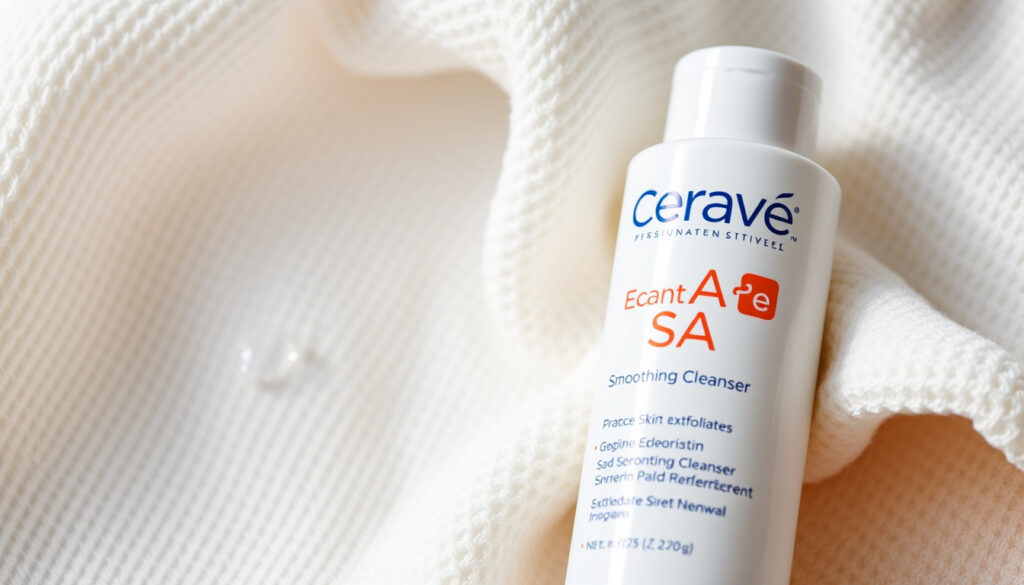
CeraVe SA Smoothing Cleanser: Uses, Benefits & Skin Concerns
Anyone who’s ever dealt with rough, bumpy skin knows the frustration of trying product after product, but CeraVe’s SA Smoothing Cleanser, developed with dermatologists, offers a science-backed approach with salicylic acid and ceramides. This article covers its use for milia, hyperpigmentation, rosacea, daily exfoliation, and a comparison to Aveeno.
Developed with dermatologists: Yes ·
Key active ingredient: Salicylic acid (exfoliant) ·
Ceramides (1, 3, 6-II): Helps restore skin barrier ·
Hyaluronic acid: Provides hydration ·
Fragrance-free & non-comedogenic: Suitable for sensitive skin
Quick snapshot
- Contains salicylic acid (DailyMed database)
- Effectiveness for milia varies by individual (American Academy of Dermatology)
- Fragrance-free claim (CeraVe official product page)
- Non-comedogenic claim (CeraVe official product page)
- Developed with dermatologists (CeraVe official product page)
- Milia often do not respond quickly to cleanser-only routines (American Academy of Dermatology)
- Consider leave-on treatments for hyperpigmentation (American Academy of Dermatology)
Six key specs, one pattern: CeraVe SA Smoothing Cleanser is built around a core of salicylic acid, ceramides, and hyaluronic acid, with a fragrance-free, non-comedogenic formula.
| Specification | Value |
|---|---|
| Active Ingredient | Salicylic Acid (exfoliant) |
| Ceramides | 1, 3, 6-II |
| Hyaluronic Acid | Yes |
| Fragrance | None |
| Formulation | Gel-to-foam |
| Skin Types | Dry, rough, bumpy, normal |
Does CeraVe SA cleanser help with milia?
What causes milia?
Milia are small, keratin-filled cysts that form when dead skin cells become trapped beneath the skin’s surface. According to the American Academy of Dermatology (AAD), they are common in all age groups and often resolve on their own, but can persist without exfoliation.
How does salicylic acid treat milia?
Salicylic acid, a beta hydroxy acid (BHA), penetrates pores and exfoliates inside the follicle, helping to release trapped keratin. The DailyMed database (U.S. drug labeling repository) confirms its use as an exfoliant. CeraVe’s SA Smoothing Cleanser contains salicylic acid at a concentration within the OTC range of 0.5% to 2% as defined by the FDA OTC acne drug monograph.
Can CeraVe SA cleanser be used for milia prevention?
Consistent use may help prevent new milia by keeping pores clear, but the AAD notes that milia often do not respond quickly to cleanser-only routines. The cleanser’s exfoliating action can reduce buildup, but results vary by individual.
Milia patients face a slow process: cleanser-only routines may take weeks to show change, while professional extraction offers faster results but requires a clinic visit.
Which CeraVe helps with hyperpigmentation?
What ingredients in CeraVe target hyperpigmentation?
CeraVe’s SA Smoothing Cleanser contains niacinamide, an ingredient known for barrier support and tone-evening properties, though rinse-off contact time is limited (CeraVe official product page). The brand also offers the Resurfacing Retinol Serum, which is more directly aimed at dark spots.
Is CeraVe SA cleanser effective for dark spots?
The AAD states that leave-on treatments generally have stronger evidence for hyperpigmentation than wash-off cleansers because contact time is limited (American Academy of Dermatology). The SA cleanser can help by exfoliating surface pigmentation, but it is not a dedicated hyperpigmentation treatment.
Which CeraVe products are best for even skin tone?
For hyperpigmentation, CeraVe’s Resurfacing Retinol Serum and Skin Renewing Vitamin C Serum are more targeted. The SA cleanser works as a complementary step to remove dead skin cells and improve product absorption.
Users expecting the SA cleanser alone to fade dark spots may be disappointed. Pairing it with a leave-on treatment like retinol or vitamin C is the evidence-backed route.
Can I use CeraVe SA Smoothing Cleanser everyday?
What happens if you use SA cleanser daily?
CeraVe’s product page states the cleanser is formulated for daily use. However, the AAD cautions that over-exfoliation can compromise the skin barrier, especially for sensitive skin. Starting with once daily and adjusting based on skin response is recommended.
How to incorporate into morning routine?
Use the cleanser in the morning or evening, followed by a moisturizer with ceramides and sunscreen. The AAD emphasizes that sunscreen is essential when using exfoliating acids to prevent UV sensitivity.
Is it safe for sensitive skin?
The formula is fragrance-free and non-comedogenic, making it suitable for many sensitive skin types. However, those with rosacea or very reactive skin may find daily use too harsh. A patch test is advised.
Which CeraVe face wash is best for rosacea?
Can people with rosacea use salicylic acid?
Salicylic acid can be irritating for rosacea-prone skin. The AAD recommends gentle cleansers for rosacea, such as CeraVe Hydrating Cleanser, which contains ceramides and niacinamide without exfoliants.
What CeraVe cleansers are gentle enough for rosacea?
CeraVe Hydrating Cleanser is often recommended by dermatologists for rosacea because it cleanses without stripping the barrier. The SA Smoothing Cleanser may be too harsh for active rosacea flares.
How to choose a cleanser for rosacea-prone skin
Look for fragrance-free, non-comedogenic formulas with ceramides. CeraVe’s Hydrating Cleanser and Foaming Cleanser are better options for rosacea than the SA version.
Rosacea patients who use the SA cleanser risk triggering redness and stinging. The trade-off between exfoliation and barrier protection is not worth it for active rosacea.
What is better, Aveeno or CeraVe?
How do their ingredients differ?
CeraVe SA Smoothing Cleanser focuses on salicylic acid, ceramides, and hyaluronic acid. Aveeno Clear Complexion Foaming Cleanser uses salicylic acid and soybean-derived ingredients (Aveeno official product page). Both are fragrance-free and non-comedogenic.
Which brand is better for dry skin?
CeraVe’s ceramide complex helps restore the skin barrier, making it a stronger choice for dry, rough skin. Aveeno’s colloidal oatmeal (in other products) is known for soothing, but the Clear Complexion cleanser is more targeted at acne.
Which brand is better for acne-prone skin?
Both contain salicylic acid. CeraVe’s additional ceramides may benefit acne-prone skin that is also dry or compromised. Aveeno’s foaming formula may feel lighter for oily skin.
Three key differences, one pattern: CeraVe leans into barrier repair, Aveeno into soothing botanicals.
| Feature | CeraVe SA Smoothing Cleanser | Aveeno Clear Complexion Foaming Cleanser |
|---|---|---|
| Active ingredient | Salicylic acid + ceramides + hyaluronic acid | Salicylic acid + soybean extract |
| Primary claim | Smooths rough, bumpy skin | Treats acne, clears breakouts |
| Best for | Dry, rough, or bumpy skin | Oily, acne-prone skin |
Clarity: What we know and what remains uncertain
Confirmed facts
- CeraVe SA cleanser contains salicylic acid (DailyMed database)
What’s unclear
- Effectiveness for milia varies by individual (American Academy of Dermatology)
- Fragrance-free claim (CeraVe official product page)
- Non-comedogenic claim (CeraVe official product page)
- Developed with dermatologists (CeraVe official product page)
Expert perspectives
Developed with Dermatologists, CeraVe SA Smoothing Cleanser gently exfoliates the face and body.
CeraVe brand statement
For hyperpigmentation, leave-on treatments generally have stronger evidence than wash-off cleansers because contact time is limited.
American Academy of Dermatology
The pattern is clear: CeraVe SA Smoothing Cleanser is a well-formulated exfoliating cleanser, but its role is supportive, not curative, for concerns like milia and hyperpigmentation. For anyone dealing with persistent milia or dark spots, the choice is clear: use the SA cleanser as a daily exfoliating step, but pair it with targeted leave-on treatments for real results.
skinsort.com, skinsort.com, xdmncore.com, skinsort.com, youtube.com, youtube.com
Frequently asked questions
How does CeraVe SA cleanser compare to CeraVe Hydrating Cleanser?
The SA cleanser exfoliates with salicylic acid; the Hydrating Cleanser is non-exfoliating and focuses on moisture with ceramides and hyaluronic acid. Choose based on whether you need exfoliation or gentle hydration.
Can CeraVe SA cleanser be used with retinol products?
Yes, but avoid using both in the same routine to prevent over-exfoliation. Use the SA cleanser in the morning and retinol at night, or alternate days.
What is the pH of CeraVe SA smoothing cleanser?
The pH is not officially disclosed, but salicylic acid cleansers typically have a pH around 3.5–4.5 to remain effective. CeraVe’s formula is likely within this range.
Does CeraVe SA cleanser contain alcohol?
No, the formula is alcohol-free according to the ingredient list on the official product page.
How long does it take to see results from CeraVe SA cleanser?
Results vary, but many users report smoother skin within 2–4 weeks of consistent daily use. For milia or hyperpigmentation, longer use may be needed.
Can CeraVe SA cleanser be used on body rough patches?
Yes, it is formulated for both face and body. Use on elbows, knees, or other rough areas for exfoliation.
Is CeraVe SA cleanser safe during pregnancy?
Salicylic acid in low concentrations (≤2%) is generally considered safe during pregnancy when used topically, but consult your healthcare provider.
Related reading: What Does Salicylic Acid Do? · Salt of the Earth Deodorant: Reviews and Facts
More related posts
 How to Make Naan Bread: Simple, 3-Ingredient & Traditional
 2026 BMW 2 Series Gran Coupe: Smart Buy or Badge Compromise?
 Cast of My Oxford Year – Full Actors and Characters Guide
 What Is a Cute Picture? Definition, Synonyms & Examples
 Mimi Rogers: Age, Movies, Tom Cruise Marriage & Career Today
 GTA 6 Pre Order – Availability Status and Release Details
 Ilia Malinin: Olympic Gold, Quad Axel, Net Worth, Family
 Olga Kurylenko: Biography, Net Worth, Height & Movies