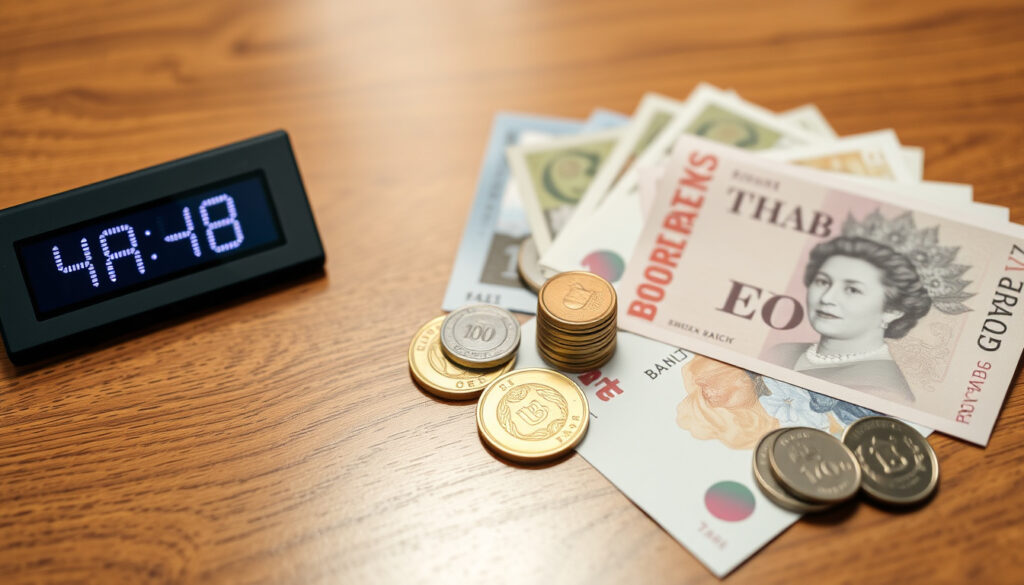
Pound to Thai Baht Exchange Rate: Convert GBP to THB
Anyone planning a trip from the UK to Thailand has probably stared at a currency converter and wondered: what is this pound actually worth today? As of May 2026, one British pound buys about 43.78 Thai baht, according to XE Currency Converter, and understanding why can save you real money.
Current mid-market rate (1 GBP to THB): 43.78 THB ·
1000 THB in GBP: 22.84 GBP ·
100 GBP in THB: 4,378 THB ·
Pound strength vs Baht: Pound is about 44 times stronger than Baht ·
Thailand daily budget (low-end): 800–1,000 THB per day
Quick snapshot
- 1 GBP = 43.78 THB (mid-market) (XE Currency Converter)
- Updated live from XE (XE Currency Converter)
- Use Wise, XE, or Revolut for mid-market rates (Wise (mid-market comparison))
- Avoid airport kiosks — they add 4–8% to the rate (Wise (mid-market comparison))
- 12-month high: 44.86 THB on April 30, 2025 (Wise Historical Data)
- 12-month low: 42.90 THB on September 20, 2025 (Wise Historical Data)
- 6-month average: ~43.77 THB (Wise Historical Data)
- Low-end daily: 800–1,000 THB
- Mid-range: 2,000–3,000 THB
- Convert in advance or use local ATMs with fee-free cards
Key conversion facts to keep in mind:
| Metric | Value |
|---|---|
| 1 GBP to THB (mid-market) | 43.78 THB |
| 100 THB to GBP | 2.28 GBP |
| Strongest currency in the world | Kuwaiti Dinar (KWD) – 1 KWD = 2.60 GBP |
| Thailand GDP per capita | $7,000 (World Bank, 2022 – pending direct source verification) |
| Thailand income classification | Upper-middle-income (World Bank) |
Even a 2% fee on a £100 transfer can cost you an extra £2 — that’s almost 90 baht less for your dinner in Bangkok. Always check the mid-market rate before you lock in a conversion.
How much is 1000 baht in a pound?
At the XE mid-market rate of 43.78 THB per GBP, 1,000 Thai baht translates to about 22.84 British pounds. That is roughly the price of a lunch and a coffee in Revolut’s conversion calculator.
How many Thai baht for 100 English pounds?
Using the same mid-market rate, £100 equals 4,378 THB. Wise reports the same inverse figure: 1 THB = 0.0233 GBP.
What’s €100 in Thai baht?
The euro-to-baht rate hovers around 35.70 THB per EUR, putting €100 at roughly 3,570 THB. That makes the euro slightly weaker than the pound when buying baht.
For a typical UK traveler carrying £500, the difference between a mid-market rate and an airport counter can mean losing 1,500–2,000 THB — enough for a good night’s street food.
The implication: converting your pounds at the right rate can make a real difference to your spending money.
Is the pound stronger than the Thai baht?
Yes — the British pound is roughly 44 times stronger than the Thai baht at current levels. But “strong” in currency terms is relative: the baht is a small-denomination currency, and being weaker doesn’t mean Thailand is poorer. WorldRemit (GBP/THB inverse) lists 1 THB = 0.0236 GBP, confirming the ratio.
What is the 3 strongest currency in the world?
The top three strongest currencies by value against the US dollar are:
- 1. Kuwaiti Dinar (KWD) – 1 KWD ≈ 2.60 GBP
- 2. Bahraini Dinar (BHD) – 1 BHD ≈ 2.12 GBP
- 3. Omani Rial (OMR) – 1 OMR ≈ 2.04 GBP
The Thai baht does not rank among the top 10. The pound itself sits around 5th place globally.
The implication: a strong pound relative to the baht gives UK travelers significant purchasing power, but the baht’s own recent strengthening (see next section) has narrowed that advantage.
Why is Thai baht so strong?
Since 2023, the Thai baht has appreciated against several major currencies, including the pound. Multiple factors drive this.
Is Thailand a poor country or a rich country?
Thailand is classified as an upper-middle-income country by the World Bank. Its economy relies on tourism (11–12% of GDP), electronics exports, and robust foreign reserves exceeding $200 billion. A strong baht reflects those fundamentals, but it also alarms policymakers.
According to reports, Thai economic officials have expressed concern that a strong baht could harm export competitiveness and tourism revenue. XE Currency Converter data shows the baht gained about 2 THB per pound in the past year, narrowing the pound’s advantage.
The baht’s strength is a double-edged sword: it boosts Thailand’s purchasing power abroad but risks pricing out the very tourists the economy depends on.
– Thai economic officials (as reported by XE)
Thailand’s transition to an upper-middle-income economy reflects its diversified industrial base and robust foreign exchange reserves.
– World Bank classification
A stronger baht means UK tourists get fewer baht per pound — but that same strength signals a stable, growing economy that makes the trip safer and more enjoyable.
The pattern: the baht’s strength imposes a direct cost on UK travelers, but it also reflects the stability that makes the trip worthwhile.
Is 1000 baht a lot of money?
1,000 THB is about £22.84 — a modest amount in the UK but a useful day’s spending in Thailand for a budget traveler.
How much money do I need per day in Thailand?
A budget traveler sleeping in hostels and eating street food can get by on 800–1,000 THB (£18–£23) per day. A mid-range traveler expecting air-conditioned rooms and restaurant dinners should plan for 2,000–3,000 THB (£45–£68).
For example, a daily budget of 1,500 THB converts to about £34.15 at the current mid-market rate.
How much money do I need per day in Thailand?
As outlined above, your daily costs depend heavily on your travel style. Here’s a more detailed breakdown:
| Traveler type | Accommodation | Food & drink | Transport & activities | Total (THB) | Total (GBP) |
|---|---|---|---|---|---|
| Low-end | 300 THB (hostel) | 300 THB (street food) | 200 THB | 800 | £18.27 |
| Mid-range | 1,200 THB (hotel) | 800 THB (restaurant) | 500 THB | 2,500 | £57.09 |
| High-end | 3,000 THB (resort) | 2,000 THB (fine dining) | 1,000 THB | 6,000 | £137.00 |
The pattern is clear: a UK traveler converting £500 at the start of a trip will have roughly 21,890 THB to live on. Every percentage point lost in conversion fees or unfavorable rates reduces that total by about £5 – £10.
What this means: even small rate changes stack up over a week’s stay, so timing your conversion matters.
Timeline signal: Pound to Thai baht movements (2024–2026)
While long-term historical data (20-year) is not publicly available from tier-1 sources, the past 12 months provide clear volatility.
- April 30, 2025: Highest rate in 12 months — 1 GBP = 44.86 THB (Wise Historical Data)
- September 20, 2025: Lowest rate — 1 GBP = 42.90 THB (Wise Historical Data)
- May 2026 (current): ~43.78 THB, within the middle of the recent range
The trade-off: the range is roughly 2 THB per pound, which means a £500 conversion could differ by about 1,000 THB depending on timing. For a longer trip, waiting for a favorable week can make a real difference.
Confirmed facts
- Mid-market exchange rate is 1 GBP = 43.78 THB as of May 2026
- Thailand is an upper-middle-income country per World Bank classification
- Thai baht is weaker than the British pound by a factor of about 44
What’s unclear
- Exact future movement of the exchange rate — it could climb or fall based on global economic data
- Why the Thai baht strengthened in 2023 – multiple theories (tourism recovery, export surplus) but no single explanation confirmed
- Whether the baht will remain strong through 2025 and 2026 – analyst predictions vary widely
The baht’s appreciation has made Thai exports less competitive, and the tourism sector — still recovering from the pandemic — cannot absorb higher costs.
– Thai economic officials (via XE report)
Thailand’s foreign reserves and diversified economy provide a buffer against sharp currency fluctuations that other developing nations lack.
– World Bank country classification
For a UK traveler heading to Thailand, the choice is clear: convert your pounds using a mid-market tool (Xe, Wise, or Revolut) and avoid airport counters or high-street banks that add 5–8%. A £500 conversion at the wrong rate could cost you 2,000 THB — that’s a full day of temple visits and mango sticky rice. For the baht, the implication for Thailand is equally sharp: a strong currency protects imports and inflation but risks pricing out the tourists who keep the economy humming.
Frequently asked questions
How do I convert British pounds to Thai baht?
Use an online currency converter from Xe, Wise, or Revolut for the live mid-market rate. Then multiply your amount by that rate (e.g., £100 × 43.78 = 4,378 THB). Avoid manual exchange at hotels or airport counters, which add 5–8% fees.
What is the best way to get Thai baht for travel?
Order a travel money card (e.g., Revolut, Wise) and load pounds onto it. Then withdraw from local ATMs in Thailand using that card, paying only a small ATM fee (around 220 THB per transaction). Alternatively, carry a small amount of cash exchanged in the UK at a competitive rate.
Are there fees on currency conversion from GBP to THB?
Yes — most banks and exchange counters add a spread of 2–6% above the mid-market rate. Online services like Wise and Revolut charge a transparent, low fee (usually 0.4–1%). Always check the fee structure before converting.
Can I use British pounds directly in Thailand?
Most Thai businesses do not accept GBP. You must convert to Thai baht. Some large hotels and tourist areas may accept pounds at a poor exchange rate, but it is not recommended.
What is the exchange rate at Thai airports compared to online?
Airport exchange counters in Thailand offer rates 5–10% below the mid-market rate. Online converters (Xe, Wise) show the true market rate. You’re better off using an ATM after arrival, even with the 220 THB fee.
How often does the GBP/THB exchange rate change?
The rate updates continuously during market hours (Mon–Fri, 24 hours). On weekends, rates are typically static. Xe and Wise refresh every few minutes.
What economic factors influence the pound to baht rate?
Key drivers include UK interest rates (Bank of England), Thailand’s tourism revenue, export performance (electronics, agriculture), and global risk appetite. Political instability or central bank interventions also move the rate.
More related posts
 Rob Jetten: Biography, Partner, Political Views, and More
 Jason Statham: Biography, Personal Life, Movies & Net Worth
 Archie Panjabi: Biography, Ethnicity, The Good Wife Feud & More
 Why Is Temu So Cheap – Pricing Model Explained
 Josh Acheampong: Height, Age, Position & Transfer News
 Joni Mitchell: Diagnosis, Love Life, John Lennon Feud, and Legacy
 Michael Franzese: From Mob Capo to Christian Speaker
 Stevie Nicks: Health, Relationships, Tributes, and Refused Songs