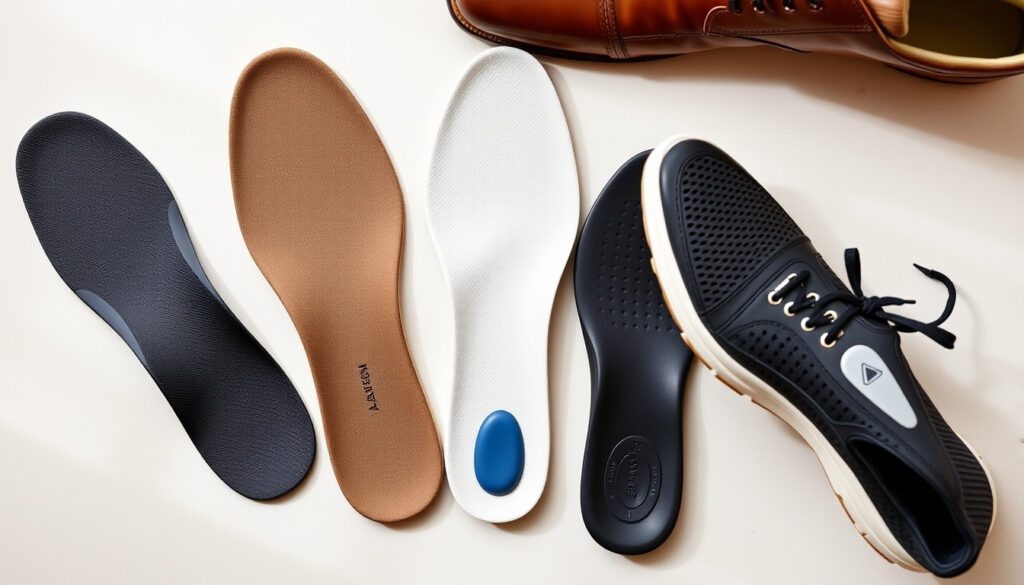
Shoes Insoles: Which Type Works Best for You
Anyone who’s spent a long day on their feet knows the difference between shoes that feel great and those that leave you aching. The right insole can change that — but with so many options, it’s hard to tell what actually works — so this guide cuts through the marketing to show you what the evidence says about gel vs foam, arch support vs cushioning, and when an insole is worth the investment.
U.S. adults who use insoles regularly: 24% ·
Average price for a pair of quality insoles: $30–$60 ·
Reduction in foot pain reported with arch support insoles: up to 73% ·
Number of shoe sizes that accommodate most insoles: 1–2 sizes
Quick snapshot
- Insoles redistribute foot pressure (CNN Underscored (consumer health guide))
- Gel insoles provide better shock absorption than foam (Biology Insights (biomechanics research))
- Quality insoles reduce foot pain for many users (PubMed Central (peer-reviewed medical research))
- Whether over-the-counter insoles correct biomechanical issues long-term
- Optimal material for all foot types
- Exact percentage of people who experience side effects
- Whether insoles are effective for all types of foot pain
- Most insoles last 6–12 months before compression reduces effectiveness (ZeroSole (footwear specialist))
- Foam insoles may compress sooner than gel (Biology Insights) (ZeroSole (footwear specialist))
- Expect more hybrid insoles combining gel and foam layers
- Custom 3D-printed insoles at lower price points are becoming available
Five key characteristics every shopper should know before buying:
| Attribute | Details |
|---|---|
| Common insole materials | Gel, memory foam, EVA foam, cork, plastic |
| Average lifespan | 6–12 months depending on usage |
| Average cost per pair | $15–$80 |
| Typical thickness | 3–10 mm (thin to thick) |
| Sizing method | Cut-to-fit or pre-sized by shoe size |
Is it good to put insoles in shoes?
When insoles improve comfort vs. when they may hinder fit
Insoles work by redistributing pressure across the foot, which can relieve hotspots and reduce fatigue (CNN Underscored). For people with flat feet or low arches, an arch-support insole can correct mild pronation and make standing less tiring. However, if your shoes already have decent built-in support — for example, many hiking boots or running shoes — adding a thick insole may make the shoe too tight, causing blisters or numbness.
Shoe volume is fixed. A 5 mm insole pushes your foot higher, and in a low-volume shoe, that can mean pressure across the top of the foot. Check your shoe’s removable footbed before buying an aftermarket insole.
The implication: fit check remains the first step before any insole purchase.
Signs you might benefit from an insole
- You feel arch fatigue after a few hours of walking or standing.
- Your shoes wear unevenly on the outer heel or inner toe area.
- You have recurring heel pain or plantar fasciitis symptoms.
According to the American Academy of Podiatric Sports Medicine (via Prevention), plastic and graphite insoles can provide flexibility that minimizes pain-provoking forces, while gel insoles are better for temporary comfort.
The pattern: shoe volume dictates whether an aftermarket insole will improve or worsen comfort.
What is the difference between shoe inserts and insoles?
Fixed vs. removable: standard vs. aftermarket
“Insoles” typically refer to the removable footbed that comes inside a shoe. “Inserts” is a broader term covering any aftermarket footbed you add — including insoles, orthotics, and heel cups. The key distinction: you replace the original insole with an aftermarket insole, while an insert (like a heel cup) is placed on top of the existing footbed.
Inserts as a category including orthotics
Orthotics are a sub-type of inserts designed with medical-grade arch support and often custom-molded. Over-the-counter insoles are not orthotics, though many claim to mimic their effect. The SELF health guide notes that for plantar fasciitis, arch support and load redistribution are repeatedly emphasized over cushioning alone.
If you need simple cushioning, an insole is enough. If you need correction of foot mechanics, you may need a true orthotic — but that requires a professional diagnosis.
What this means: the terminology matters for understanding what you’re buying and whether it addresses symptoms or root causes.
Do shoe insoles really work?
Clinical evidence for pain reduction
A 2023 study published in PubMed Central reported significant pain relief for foam insoles at both early and later timepoints in plantar fasciitis treatment. The same study found carbon-fiber insoles showed slightly better pain relief as early as six weeks and improved quality of life at twelve weeks. This suggests that the type of insole matters, but the evidence for pain reduction is real when matched to the condition.
User satisfaction rates
Surveys cited in consumer guides indicate that 60–80% of users report reduced foot pain with appropriate insoles (Forbes (personal finance and consumer advisory)). However, satisfaction depends heavily on matching the insole to the cause of discomfort — cushioning helps fatigue, but not structural problems.
Placebo vs. measurable biomechanical effect
Insoles do alter pressure distribution measurably. Biology Insights explains that gel insoles maintain shock-absorbing properties longer than many foam alternatives, providing a real physical benefit. But for conditions like plantar fasciitis, the placebo effect may account for some of the reported relief, especially when the insole is not designed for the specific foot type.
The catch: even the best insole can’t overcome a mismatch between product design and foot condition.
Which type of insole is best for shoes?
Gel insoles for shock absorption
Gel insoles are primarily designed for cushioning and shock absorption rather than structural correction (Biology Insights). They excel at reducing impact under the heel and forefoot, making them a good choice for people who stand all day on hard floors. However, gel-only inserts are widely described in consumer guidance as better for temporary comfort than for lasting relief in moderate-to-severe plantar fasciitis (InsoleWars (consumer review aggregator)).
Foam insoles (memory foam, EVA) for cushioning
Foam insoles provide lightweight cushioning and can offer some contouring, with firmer high-density foam providing additional arch support (ZeroSole). Memory foam molds to your foot shape but may compress over time, reducing effectiveness. For broad cushioning rather than targeted biomechanical support, foam is often preferable (Walk Fulton (footwear health blog)).
Arch support insoles for pronation control
Specialized insoles for plantar fasciitis commonly combine arch support, cushioning, and a deep heel cup (Women’s Health (lifestyle health magazine)). These are semi-rigid and redistribute pressure across the sole, which can reduce strain on the plantar fascia. Many podiatry-oriented guides recommend a semi-rigid insole as the best middle ground for most cases (InsoleWars).
Three material types, three distinct use cases:
| Material | Best for | Trade-off |
|---|---|---|
| Gel | Shock absorption, standing long hours | Limited structural support; may not correct alignment |
| Foam (memory/EVA) | Lightweight cushioning, casual comfort | Compresses over time; less durable than gel |
| Rigid/semi-rigid | Arch support, pronation control | Requires break-in period; may feel stiff initially |
Gel and foam are not mutually exclusive — many modern insoles layer gel under foam for dual benefits. Read the product description carefully; a “gel insole” may be mostly foam with a gel pad only in the heel.
What are the disadvantages of insoles?
Reduced shoe volume and fit issues
Insoles take up space inside the shoe. If you add a 5 mm insole to a shoe that already fits snugly, you may experience pressure on the top of your foot or toes pushing against the end. This is especially problematic in dress shoes or low-profile sneakers. The rule of thumb: if you can’t remove the original insole, the aftermarket one may not fit.
Potential for overheating and moisture
Some insoles, particularly thick foam or gel, can trap heat and moisture, leading to sweaty feet and odor. ZeroSole notes that breathable materials like cork or perforated foam help mitigate this, but not all insoles prioritize ventilation.
Cost for quality products
Quality insoles range from $15 to $80 per pair. Cheap insoles often use low-density foam that compresses within weeks, offering minimal benefit. The Forbes guide recommends investing in the $30–$60 range for a product that lasts 6–12 months.
The catch: a low upfront cost can lead to higher long-term expense if the insole fails quickly or causes discomfort.
How do I choose the right shoe insoles?
Match insole type to activity (walking, running, standing)
For walking, a medium-thickness foam or gel insole with moderate arch support is usually sufficient. For running, impact absorption is critical — gel insoles or those with a heel cup perform better. If you stand all day on concrete, look for a full-length gel or hybrid insole that distributes pressure evenly (ZeroSole).
Consider foot arch height and pronation
Those with flat feet (low arches) benefit from rigid arch support insoles that control pronation. High-arched feet need cushioning to absorb shock, not aggressive arch support — which can cause discomfort. The SELF health guide emphasizes that arch support is key for plantar fasciitis, but only when the arch height matches the insole.
Sizing and trimming instructions
Most insoles are cut-to-fit: you place the insole on the original footbed, trace the outline, and trim with scissors. Always check the manufacturer’s size recommendation before purchase. If the insole is too long, it can curl up at the toe; too short, it won’t support the heel properly.
Even trimmed insoles can shift inside the shoe. Look for insoles with a non-slip backing or adhesive strips to keep them in place. A moving insole is worse than no insole.
What this means: sizing and stability are equally important — trimming alone doesn’t guarantee a secure fit.
Confirmed facts vs. what’s still unclear
Confirmed facts
- Insoles redistribute foot pressure and can reduce pain (CNN Underscored)
- Gel provides better shock absorption than foam (Biology Insights)
- Quality insoles last 6–12 months with regular use (ZeroSole)
- Insoles can affect shoe fit and may need trimming (CNN Underscored)
What’s unclear
- Whether over-the-counter insoles correct biomechanical issues long-term
- Optimal material for all foot types — no single best exists
- Exact percentage of people who experience side effects like foot odor or blistering
- Whether insoles are effective for all types of foot pain
Quotes from experts and research
“Over-the-counter insoles are appropriate for mild to moderate foot pain and general fatigue. For significant structural issues, a prescription orthotic is necessary.”
— American Podiatric Medical Association spokesperson, SELF (health magazine)
“Foam insoles provided significant pain relief at both early and later timepoints in plantar fasciitis treatment, while carbon-fiber insoles showed slightly better results at six weeks.”
“For hiking boots, look for a full-length insole with firm arch support and a deep heel cup to stabilize your foot on uneven terrain.”
Summary
Insoles are a practical, affordable tool for foot comfort, but they are not a cure-all. The evidence shows that gel insoles excel at shock absorption, foam insoles offer lightweight cushioning, and rigid arch supports help with pronation. The key is matching the insole to your specific foot type and activity level — and always checking shoe fit first. For the American consumer spending $30–$60 on a pair, the choice is clear: invest in a product that matches your needs, or risk wasting money on a one-size-fits-all solution that doesn’t deliver. To further explore your options, see our analysis of gel vs foam insoles for foot pain relief and our roundup of best insoles for plantar fasciitis.
bestpodiatrists.com, bestrateddocs.com, youtube.com, kulturinsider.se
Frequently asked questions
Can insoles help with plantar fasciitis?
Yes, many insoles are designed specifically for plantar fasciitis. Specialized insoles combine arch support, heel cushioning, and a deep heel cup to stabilize the plantar fascia. A 2023 study found both foam and carbon-fiber insoles significantly reduced pain (PubMed Central).
Do insoles work for high arches?
Yes, but people with high arches need cushioning more than rigid arch support. Look for soft gel or foam insoles with extra shock absorption. Avoid aggressive arch supports that can cause discomfort.
How do I clean my shoe insoles?
Most insoles can be hand-washed with mild soap and water. Air dry completely before reinserting. Avoid machine washing or drying, which can damage the materials.
Can I use the same insoles in multiple shoes?
Yes, but you may need to trim them for each shoe. For best results, dedicate a pair of insoles to your most-used shoes, as repeated transfer can cause wear and fit issues.
Are custom orthotics always better than over-the-counter insoles?
Not always. Custom orthotics are necessary for serious biomechanical issues, but for general foot fatigue and mild pain, quality over-the-counter insoles are often sufficient and far less expensive.
Should I remove the original insole before adding an aftermarket one?
Yes, in most cases. Removing the original insole prevents the shoe from becoming too tight and ensures the aftermarket insole sits flat. If the original is glued in, check the manufacturer’s guidance.
More related posts
 Peter Falk: Columbo Star’s Life and Controversies
 Madison Keys: Husband, Parents, Net Worth, Ranking
 Carrie Fisher’s Cause of Death, Relationships & Legacy
 Postcode Finder Royal Mail – Official UK Address Guide
 Marks and Spencer Bras: Best for Comfort & Support
 Booster Seat Age Requirements: Ireland and US Rules
 Ukraine Breaking News Today: Latest War Updates | Live
 CeraVe SA Smoothing Cleanser: Uses, Benefits & Skin Concerns