Saddam Hussein: His Last Words, Hiding Spot, and the US Opposition
Few figures in modern history invite as many conflicting images as Saddam Hussein. He was both a disciplined party man and a ruthless autocrat, a self-styled defender of Arab nationalism and a man who spent his final months in a cramped underground hole. This article sorts through the competing stories about his last words, his survival tactics after Baghdad fell, and the disputed claims that tied him to al-Qaeda — separating what we know for certain from what remains murky.
Born: April 28, 1937 ·
Died: December 30, 2006 ·
Presidency: 1979–2003 ·
Cause of Death: Execution by hanging
Quick snapshot
- Saddam Hussein captured on December 13, 2003 near Tikrit (Defense Intelligence Agency)
- Executed by hanging on December 30, 2006 (CNN)
- Ruled Iraq from 1979 to 2003 (CNN)
- Five children with Sajida Talfah (EBSCO)
- Exact wording of Saddam’s final words — witness accounts differ (CNN)
- Whether Saddam possessed WMD after 1991 (no stockpiles later found) (CNN)
- Nature of any operational link between Saddam and al-Qaeda (CNN)
- Consistent description of his hiding place — “spider hole,” “bunker,” or “crude shelter” (Defense Intelligence Agency)
- July 16, 1979: Becomes president of Iraq (CNN)
- December 13, 2003: Captured near Tikrit (Defense Intelligence Agency)
- November 5, 2006: Sentenced to death (CNN)
- December 30, 2006: Executed (CNN)
- Continuing debate over the legality and ethics of his trial (CNN)
- No WMDs found — intelligence failures still under scrutiny (CNN)
- His legacy remains a divisive symbol in the Middle East (CNN)
Saddam’s execution ended a regime, but the questions it raised — about the legitimacy of the war, the accuracy of pre-invasion intelligence, and the justness of the trial — continue to shape American foreign policy and Iraqi politics today.
Nine key facts about Saddam Hussein, one pattern: a life tightly woven with violence, ambition, and sudden reversals.
| Detail | Value |
|---|---|
| Full Name | Saddam Hussein Abd al-Majid al-Tikriti |
| Born | April 28, 1937, Al-Awja, Iraq |
| Died | December 30, 2006, Baghdad, Iraq |
| Cause of Death | Execution by hanging |
| Spouse | Sajida Talfah (m. 1963) |
| Children | Uday, Qusay, Raghad, Rana, Hala |
| Religion | Sunni Islam |
| Height | 6 ft 2 in (188 cm) |
| Political Party | Arab Socialist Ba’ath Party |
What did Saddam say before he died?
What were his exact last words?
Accounts of Saddam’s final moments vary depending on which witness or video recording is cited. CNN (credible news outlet) reported that he argued with guards and mocked Muqtada al-Sadr moments before the trapdoor opened. NBC News (established U.S. broadcaster) quoted him shouting “We are in Heaven, and our enemies are in Hell” and “Long live the people, long live jihad, and long live the nation.” A secondary source, GAMJI (an online commentary site), claimed he recited the shahada — but that account has weaker corroboration.
Who witnessed his execution?
The execution was carried out on December 30, 2006 in Baghdad, and witnesses included Iraqi government officials and a judge (CNN). An unofficial video that surfaced shortly afterward showed that some attendees taunted Saddam during his final moments (TIME magazine). The discrepancy in the reported words has fed enduring public fascination.
What was the context of his final statements?
Saddam had been convicted for the Dujail massacre and was led to the gallows early on a Saturday morning. CNN noted that he refused a hood and, according to some witnesses, uttered the takbir (“Allahu Akbar”) and referenced Palestine. The exact sequence remains contested.
The implication: the uncertainty around his final words mirrors the broader lack of consensus about his regime’s true nature.
What was Saddam Hussein famous for?
His role as president of Iraq
Seizing full power on July 16, 1979, Saddam quickly consolidated control through a mix of patronage and terror (CNN). He was known for public executions, torture, and a pervasive cult of personality.
His involvement in the Iran-Iraq War
From 1980 to 1988, Saddam fought a devastating war with Iran that cost hundreds of thousands of lives and ended in a stalemate (CNN). Both sides used chemical weapons, and international blame fell heavily on Iraq.
The invasion of Kuwait and Gulf War
On August 2, 1990, Iraq invaded Kuwait, triggering a U.S.-led coalition that expelled Iraqi forces in early 1991 (CNN). The war ended with Saddam still in power but under crippling sanctions.
Suppression of Shia and Kurdish uprisings
After the Gulf War, Saddam crushed rebellions in the Shia south and Kurdish north, using helicopter gunships and, in the case of the Kurds, chemical weapons (EBSCO). The al-Anfal campaign killed tens of thousands of Kurds.
Execution for crimes against humanity
Saddam was convicted by the Iraqi Special Tribunal for the 1982 Dujail massacre, in which 148 Shia villagers were killed after an assassination attempt on his motorcade (CNN). He was sentenced to death and hanged on December 30, 2006.
The pattern: each chapter of his fame deepened the cycle of violence that ultimately consumed him.
Why did the US dislike Saddam Hussein?
US support for Iraq during Iran-Iraq War
During the 1980s, the United States provided intelligence, dual-use technology, and diplomatic backing to Iraq in its war with Iran. CNN notes that the U.S. saw Saddam as a bulwark against Iranian revolutionary expansion — a pragmatic choice that later backfired.
Shift to opposition after invasion of Kuwait
Iraq’s August 1990 invasion of Kuwait directly threatened Saudi oil fields and global energy supplies. The U.S. led a United Nations coalition to push Iraqi forces out and enforce sanctions (CNN).
Weapons of mass destruction allegations
The central justification for the 2003 invasion was that Saddam possessed active WMD programs. CNN reported that no stockpiles were ever found, and the intelligence case collapsed, leading to widespread criticism of the war.
Human rights abuses
Saddam’s regime was notoriously brutal, but this was a secondary concern until the geopolitical calculus shifted. CNN acknowledges that the U.S. overlooked those abuses during the 1980s.
Alleged links to terrorism
The Bush administration argued that Saddam harbored ties to al-Qaeda. CNN notes that the 9/11 Commission found no collaborative relationship. The claim remains one of the most contested justifications for the war.
The U.S. disliked Saddam enough to invade and occupy Iraq, yet it had sustained his regime during the 1980s. That contradiction underscores how foreign-policy interests, not humanitarian concerns, drove the timeline of opposition.
What this means: the U.S. opposition to Saddam was always conditional — shifting from alliance to enmity when regional interests changed.
Who is Saddam Hussein and what happened to him?
His early life and rise to power
Born April 28, 1937, near Tikrit, Saddam joined the Ba’ath Party in 1957 (CNN). He rose through the security apparatus and became president in 1979 after a purge of rivals.
His presidency and rule
For 24 years, Saddam maintained power through a vast intelligence network, oil wealth, and state terror. He led Iraq into the Iran-Iraq War and the invasion of Kuwait (CNN).
His downfall and capture
On March 20, 2003, a U.S.-led coalition invaded Iraq. Baghdad fell on April 9, and Saddam went into hiding. Defense Intelligence Agency reports that he was captured on December 13, 2003, in a “spider hole” on a farm near Ad-Dawr, outside Tikrit.
His trial and execution
His trial for the Dujail massacre began in October 2005. He was sentenced to death on November 5, 2006, and executed on December 30, 2006 (CNN).
How did Saddam Hussein eat in his hiding spot?
Where was his hiding spot?
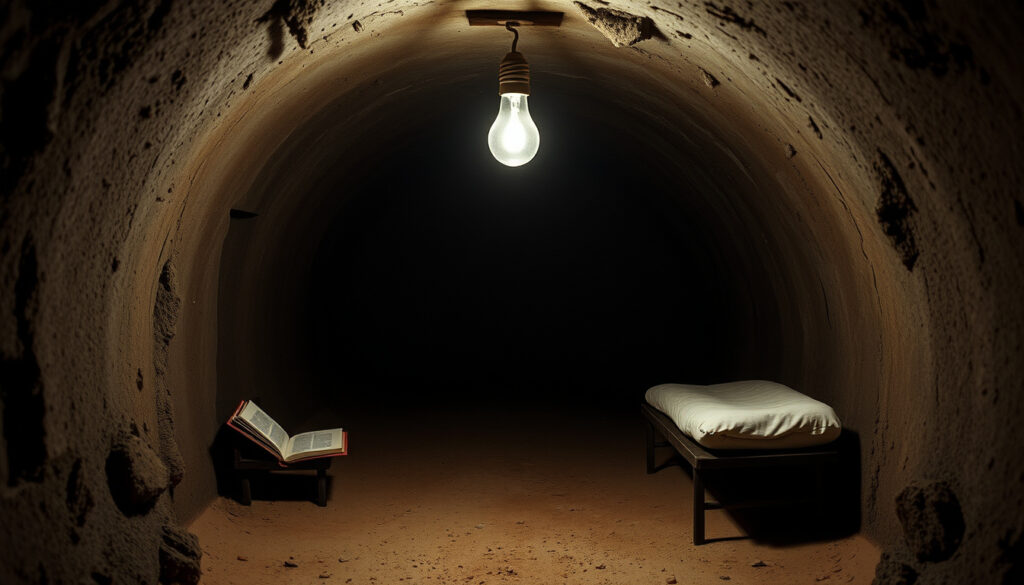
Saddam hid at the bottom of a narrow, dark hole beneath a two-room mud shack on a sheep farm near Adwar, a small town close to Tikrit (CNN (detailed account of Operation Red Dawn)). The space was so cramped that he could barely stand upright.
How did he get food and supplies?
EBSCO (research database covering military history) says he relied on local supporters who brought him food, water, and cash. U.S. troops found bags of currency and weapons near the hideout. The support network was small but effective enough to keep him hidden for eight months.
How long was he in hiding?
From the fall of Baghdad on April 9, 2003, until his capture on December 13, 2003 — a total of about eight months (Defense Intelligence Agency).
What was his daily routine?
Few details about his daily life in hiding are known. CNN reported that he spent most of his time in the hole, emerging only at night. He reportedly had books and a small radio but no direct access to news beyond what his couriers brought.
The catch: the man who once commanded one of the Middle East’s largest armies ended his days dependent on shepherds and couriers for survival.
What did Osama bin Laden say about Saddam Hussein?
Did bin Laden support Saddam?
Bin Laden viewed Saddam as a secular dictator whose Ba’athist ideology contradicted the Islamist vision of al-Qaeda. CNN notes that bin Laden had publicly criticized Saddam on ideological grounds even before 9/11.
Did they cooperate?
The 9/11 Commission concluded that there was no collaborative operational relationship between Saddam’s regime and al-Qaeda (CNN). While there were some contacts in the 1990s, they never led to joint planning.
What was the nature of their statements?
After the 2003 invasion, bin Laden released audio statements praising the Iraqi resistance against U.S. forces. CNN reported that bin Laden viewed the Iraq war as a boon for his recruitment efforts, even though he despised Saddam’s secularism. The two men were tactical enemies of the U.S., but not allies.
Timeline of key events
Fourteen milestones chart Saddam’s trajectory from a village in Tikrit to the gallows in Baghdad.
| Date/Period | Event |
|---|---|
| April 28, 1937 | Born in Al-Awja, Iraq |
| 1957 | Joined the Ba’ath Party |
| 1968 | Ba’ath Party seizes power in a coup |
| July 16, 1979 | Becomes President of Iraq |
| 1980–1988 | Iran-Iraq War |
| August 2, 1990 | Invasion of Kuwait |
| January–February 1991 | Gulf War; Iraqi forces expelled from Kuwait |
| March 1991 | Suppression of Shia and Kurdish uprisings |
| March 20, 2003 | US-led invasion of Iraq begins |
| April 9, 2003 | Baghdad falls; Saddam goes into hiding |
| December 13, 2003 | Captured in Adwar near Tikrit |
| October 19, 2005 | Trial begins for the Dujail massacre |
| November 5, 2006 | Sentenced to death |
| December 30, 2006 | Executed by hanging |
What we know for sure — and what remains uncertain
Confirmed facts
- Saddam Hussein was born on April 28, 1937 (CNN)
- He was executed on December 30, 2006 (CNN)
- He was captured on December 13, 2003 (Defense Intelligence Agency)
- He had five children with Sajida Talfah (EBSCO)
- He led Iraq during the Iran-Iraq War and the Gulf War (CNN)
- He was convicted for the Dujail massacre (CNN)
What remains unclear
- Exact words he spoke moments before execution — conflicting witness accounts (CNN)
- Whether he possessed WMD after 1991 (no stockpiles found) (CNN)
- Nature and extent of any operational link between Saddam and al-Qaeda (CNN)
- Consistent description of his hiding place (“spider hole,” “bunker,” “crude shelter”) (Defense Intelligence Agency)
“We are in Heaven, and our enemies are in Hell” — reportedly shouted by Saddam Hussein during his execution according to NBC News.
In a 2004 audiotape, Osama bin Laden praised the Iraqi resistance, stating that the US invasion had turned Iraq into a “new front” for jihad.
— CNN (credible news outlet)
“The Iraqi regime continues to possess and conceal some of the most lethal weapons ever devised.” — President George W. Bush, March 2003, justifying the invasion.
— CNN (credible news outlet)
The pattern across these three accounts: each speaker — the condemned, the jihadist, the president — used words to frame a narrative long after the facts had moved on. For the United States, the decision to invade based on WMD claims that never materialized remains a costly lesson in the danger of certitude. For Iraq, the aftermath of Saddam’s removal — sectarian violence, a weakened state, and continued foreign intervention — suggests that toppling a dictator is easier than building a stable alternative.
facebook.com, facebook.com, youtube.com, instagram.com, reddit.com, instagram.com, hotelurighid.com
The exact nature of Saddam Hussein’s final words remains disputed, yet Saddam Husseins final words offers a clear synthesis of the available evidence.
Frequently asked questions
Was Saddam Hussein a Sunni or Shia?
He was a Sunni Muslim, belonging to the Tikriti branch of Sunni Islam.
How was Saddam Hussein captured?
U.S. forces found him hiding in a small underground bunker on a farm near Adwar, close to Tikrit, on December 13, 2003 (Defense Intelligence Agency).
What was Operation Iraqi Freedom?
The U.S.-led military campaign launched on March 20, 2003, to overthrow Saddam Hussein’s regime (CNN).
What happened to Saddam Hussein’s sons?
Uday and Qusay Hussein were killed by U.S. forces in a firefight in Mosul on July 22, 2003 (CNN).
Did Saddam Hussein have weapons of mass destruction?
No. After the 2003 invasion, U.S. and coalition inspectors found no active WMD programs or stockpiles (CNN).
How long was Saddam Hussein in power?
He served as president from July 16, 1979, until the U.S. invasion in April 2003 — nearly 24 years.
What was the Dujail massacre?
The 1982 killing of 148 Shia villagers in Dujail after an assassination attempt on Saddam. This massacre formed the basis for his conviction and death sentence (CNN).
What is Saddam Hussein’s legacy?
He is remembered as a brutal dictator who presided over war, repression, and a cult of personality. In parts of the Arab world, however, some still view him as a defiant leader who stood up to the United States. For the Iraqi people, his legacy is deeply tied to the violence and instability that followed his removal.
More related posts
 Claudia Heffner Peltz: Biography, Family, Hefner Link
 Queen Elizabeth II: Last Words, Burial, and Coffin Secrets
 Justin Hartley: Prosthetics, Marriages, Net Worth, and More
 How to Make Ginger Shots – Easy Recipes Without Juicer
 Jared Kushner: Where He Is Now, Health, and Net Worth
 Ni-Ki (ENHYPEN) Profile: Age, Real Name, Nationality, and Facts
 Simpsons Characters: Canon Facts on LGBTQ+ & Neurodiversity