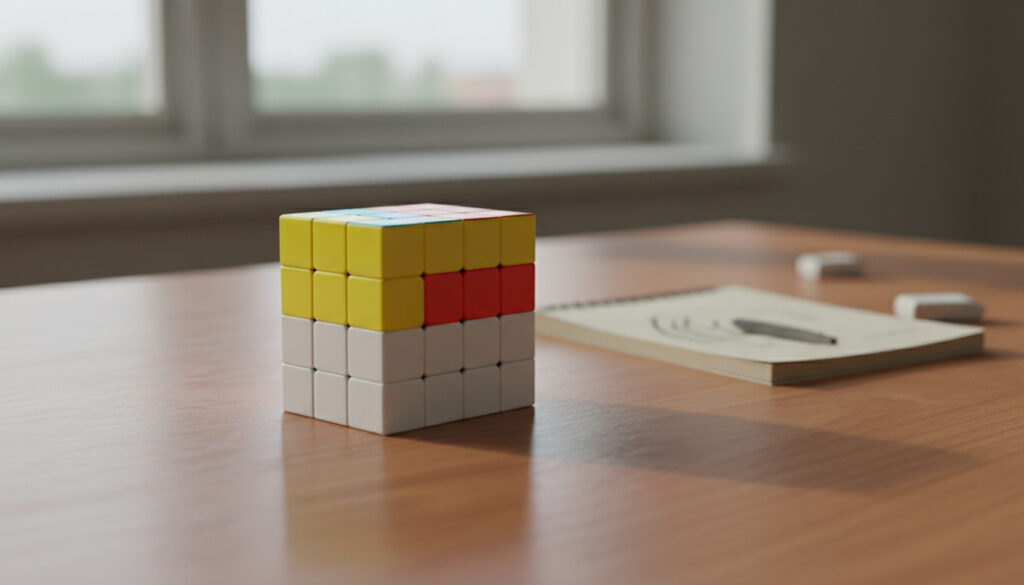
How to Solve a Rubik’s Cube – Beginner Layer-by-Layer Guide
The layer-by-layer method remains the most accessible entry point for beginners learning to solve a 3×3 Rubik’s Cube. This approach divides the puzzle into three sequential stages—bottom, middle, and top—allowing solvers to build upon completed sections without disturbing previous progress.
Unlike attempts to solve by individual colors, which inevitably fail due to the cube’s interconnected piece structure, the layer-by-layer technique provides a systematic pathway from scrambled state to solved completion. Most learners can achieve their first successful solve within one to two hours of focused practice using this methodology.
What Is the Easiest Way to Solve a Rubik’s Cube?
The layer-by-layer method stands as the universal standard for beginners, prioritizing logic over memorization and building spatial awareness progressively. Ruwix and Cubelelo both identify this as the foundational technique taught to novice cubers worldwide.
- Master notation first: F, R, U, and their prime variants denote specific clockwise and counterclockwise rotations.
- Solve layer by layer to avoid frustration; completing one color at a time is structurally impossible.
- Practice one algorithm at a time rather than attempting full memorization upfront.
- Average first solve duration typically ranges between two and five minutes.
- Upgrade to CFOP only after mastering the beginner method for speedcubing.
| Fact | Details |
|---|---|
| Inventor | Ernő Rubik (1974) |
| Pieces | 26 visible, 20 movable |
| World Record | 3.13 seconds (single solve) |
| Colors | 6 faces, 9 stickers each |
| Notation Base | F (front), R (right), U (upper), with primes indicating counterclockwise |
| Permutations | 43,252,003,274,489,856,000 possible configurations |
How Do You Solve a Rubik’s Cube Step by Step?
Executing the layer-by-layer solution requires moving through three distinct stages: establishing the first layer, inserting middle layer edges, and permutating the final layer pieces. GANCUBE’s layer-by-layer documentation emphasizes that maintaining the integrity of previously solved layers remains crucial throughout the process.
How to Solve the First Layer of a Rubik’s Cube?
Begin by positioning the white center piece on the bottom face. Create the white cross by placing the four white edge pieces around this center, ensuring each white edge aligns with its corresponding side center color. This alignment prevents errors during later stages.
Next, address the white corners. Locate white corner pieces in the upper layer, identify their non-white colored stickers, and position each corner between its corresponding center colors. Apply the algorithm R U R’ U’ repeatedly until the corner piece settles correctly into the white layer. This specific sequence rotates the corner into place without destroying the emerging cross structure.
Practice solving the first two layers multiple times before attempting the last layer. Video learning resources confirm that this repetition builds essential muscle memory and reinforces understanding of how pieces interact, making the final algorithms significantly more intuitive.
Solving the Middle Layer
The second layer focuses exclusively on positioning non-yellow edge pieces without disturbing the completed white foundation. Locate an edge piece in the top layer that contains no yellow sticker, then rotate the upper face until its front-facing color matches the center of that color.
Determine whether this edge’s other color belongs to the center on your right or left. If the center sits to the right, execute: U R U’ R’ U’ F’ U F. If the center sits to the left, apply: U’ L’ U L U F U’ F’. Should an edge piece land in the correct slot but face the wrong direction, perform the appropriate algorithm twice to extract and reinsert it correctly.
The cube cannot be solved by completing one color at a time due to how edge and corner pieces are interconnected. The layer-by-layer approach is structurally necessary, not merely a stylistic choice.
How Do You Solve the Last Layer of a Rubik’s Cube?
With the first two layers complete, flip the cube so yellow faces upward. First, create a yellow cross by manipulating yellow edge pieces to match the yellow center, regardless of side alignment. Next, position the top-layer edges to match their side centers using R U R’ U R U2 R’.
For corners, first position them using U R U’ L’ U R’ U’ L, keeping correctly matched corners toward the front-right. Finally, orient each corner correctly by applying R’ D’ R D while rotating only the top layer between repetitions to bring each misaligned corner to the front-right position.
What Is Rubik’s Cube Notation?
Standard notation provides the linguistic framework for algorithms, representing specific face rotations through single-letter abbreviations. Cubelelo’s notation guide establishes the following conventions:
- R (Right): Clockwise rotation of the right face when viewed from that side
- R’ (Right Prime): Counterclockwise rotation of the right face
- L (Left): Clockwise rotation of the left face (downward from left view)
- L’ (Left Prime): Counterclockwise rotation of the left face
- F (Front): Clockwise rotation of the front face
- F’ (Front Prime): Counterclockwise rotation of the front face
- U (Upper): Clockwise rotation of the top face
- U’ (Upper Prime): Counterclockwise rotation of the top face
Understanding these directional indicators proves essential before attempting algorithm execution, as incorrect rotation direction will scramble progress rather than advance it.
What Are the Key Algorithms for Beginners?
Six core algorithms power the beginner layer-by-layer method, each addressing specific piece placement scenarios. Most require memorizing eight-move sequences, a manageable task with repetitive practice.
| Stage | Algorithm | Purpose |
|---|---|---|
| White corners | R U R’ U’ | Position first layer corners |
| Second layer (right) | U R U’ R’ U’ F’ U F | Insert middle layer edges (center right) |
| Second layer (left) | U’ L’ U L U F U’ F’ | Insert middle layer edges (center left) |
| Last layer edges | R U R’ U R U2 R’ | Position top layer edges |
| Last layer corners (place) | U R U’ L’ U R’ U’ L | Arrange corner positions |
| Last layer corners (orient) | R’ D’ R D | Rotate corners to correct orientation |
The speedsolving community notes that while these algorithms suffice for completion, competitors eventually transition to the CFOP method—an advanced system combining Cross, F2L, OLL, and PLL for sub-20-second solves.
Execute each algorithm slowly while speaking the moves aloud. This auditory reinforcement accelerates muscle memory development more effectively than silent repetition alone.
How Has Rubik’s Cube Solving Evolved Over Time?
The puzzle’s history traces from educational tool to competitive sport, with solving methodologies growing increasingly sophisticated alongside hardware improvements.
- : Ernő Rubik creates the Cube as a structural teaching tool in Budapest
- : Global commercial launch triggers international popularity boom
- : First World Championship held in Budapest, establishing competitive solving
- : CFOP method achieves dominance among competitive speedcubers
- : Magnetic cubes and advanced lubricants enable sub-4-second official records
What Certainties and Variables Exist in Rubik’s Cube Solving?
Distinguishing between fixed mechanical facts and variable human factors helps set realistic expectations for new solvers.
Established Facts
- The layer-by-layer method works universally on any standard 3×3 configuration
- Piece interconnection makes color-by-color solving structurally impossible
- Algorithms follow standardized notation regardless of tutorial source
- The puzzle possesses 43 quintillion possible permutations
Variables and Uncertainties
- Individual learning curves vary from 30 minutes to several days for first completion
- Achieving sub-60-second consistency requires weeks or months of daily practice
- No shortcut or single-trick solution exists; algorithmic learning remains mandatory
- Transition timing from beginner to CFOP methods depends on personal retention rates
What Is the Cultural and Mechanical Context of the Rubik’s Cube?
Ernő Rubik’s 1974 invention originally served as a physical model for spatial relationships before becoming the world’s best-selling puzzle, with over 450 million units sold globally. The mechanism relies on a core spindle allowing six center pieces to rotate independently while holding edge and corner pieces in relative alignment.
Modern solving has transformed into a recognized sport governed by the World Cube Association, which maintains official records and competition standards. The community distinguishes between “solving” (any method completion) and “speedsolving” (competitive time-based optimization).
How to Share Location on WhatsApp – Android and iPhone Guide offers insight into sharing accomplishments, while the spatial reasoning developed through cubing transfers to various technical and navigational tasks.
What Do Authoritative Sources Say About Rubik’s Cube Solutions?
Primary documentation from hardware manufacturers and specialized tutorial sites provides the technical foundation for modern solving instruction.
The layer-by-layer method divides the cube into three layers and solves them sequentially without disturbing previously solved pieces.
— Cubelelo Technical Documentation
Video tutorials walk through each scenario of the last layer with step-by-step instructions, including multiple edge-swap configurations.
Official solution guides from Rubik’s provide manufacturer-verified approaches, while community resources document algorithmic variations.
What Should Beginners Remember When Starting?
Success requires patience with the initial notation learning curve, consistent practice of the first two layers before advancing, and acceptance that early solves will feel slow and deliberate. The transition from conscious algorithm execution to automatic muscle memory marks the true breakthrough moment for most learners. For managing other technical step-by-step processes, Nat West Log In – Step-by-Step Online Banking Guide provides analogous structural guidance.
Frequently Asked Questions
Common mistakes when solving Rubik’s Cube?
Attempting to solve by colors rather than layers, rotating faces incorrectly due to notation confusion, and rushing to the last layer before mastering the middle layer mechanics.
Is there a trick to solve Rubik’s Cube fast?
No single trick exists. Speed requires algorithm memorization, finger dexterity training, and hardware optimization. The CFOP method reduces move count but demands months of practice.
How to solve Rubik’s Cube without algorithms?
Complete solving without algorithms is theoretically possible but impractical for beginners. The layer-by-layer method minimizes algorithm count, but basic sequences remain necessary for piece manipulation.
What does F2L mean in Rubik’s Cube?
F2L stands for “First Two Layers,” referring to the technique of solving the bottom and middle layers simultaneously. In beginner methods, these are solved separately; advanced methods combine them.
How long does it take to learn to solve a Rubik’s Cube?
Most learners achieve their first solve within one to two hours of concentrated practice. Consistent sub-three-minute solves typically require one to two weeks of daily 15-minute sessions.
More related posts
 Benson Boone Mystical Magical: The Hit Single Breakdown
 Fiona Phillips Alzheimer’s: Health, Symptoms, and Family
 Nike Blazers: Buying Guide & History 2026
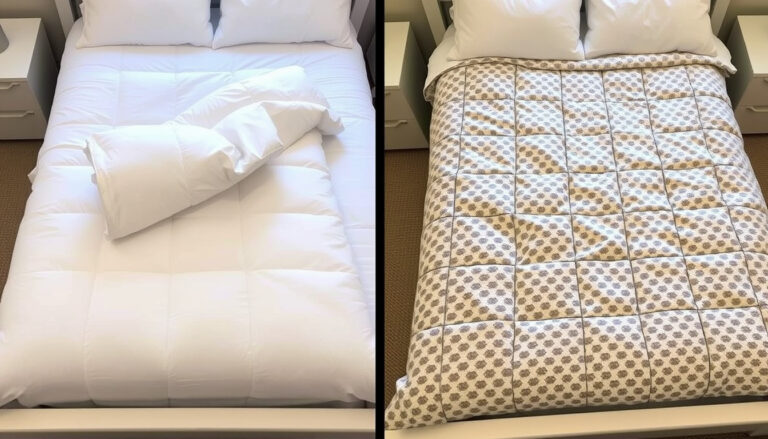 Duvet vs Comforter: What’s the Difference? Which is Better?
 Katharine Hepburn: Essential Tremor, Whiskey & Spencer Tracy
 Dakota Johnson: Chris Martin Split, Depression & Net Worth
 Two Pints of Lager and a Packet of Crisps: Complete Guide
 Project Blue Lock Codes April 2026: All Active List