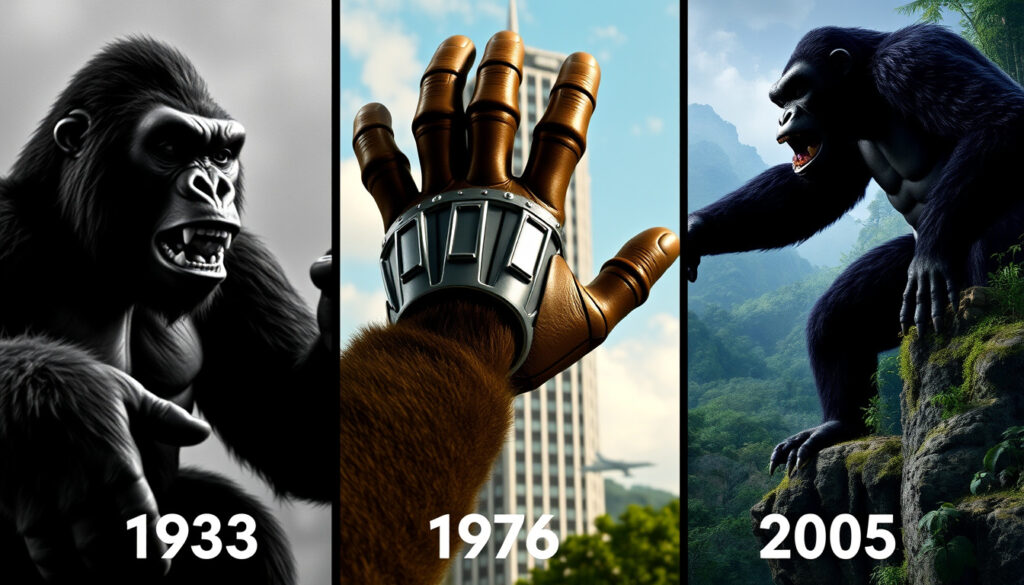
King Kong Movies: 1933 vs 1976 vs 2005 Differences
We’ve all been there—scrolling through a streaming service, landing on a King Kong poster, and wondering: which version should I actually watch? It’s a question with a surprisingly complex answer because the giant ape has stomped through Hollywood three times as a major studio production, and each iteration is very much a product of its era. From the groundbreaking 1933 original to the star-studded 1976 remake and the epic 2005 spectacle, this guide breaks down what each film does differently, how they performed, and where they stand in cinematic history. We’ll cut through the noise and give you the facts on the box office battles, the critical reception, and the legacy of each Kong, helping you decide which take on the Eighth Wonder of the World deserves your screen time.
Snapshot: Key Facts at a Glance
- The original King Kong was released in 1933.
- It was directed and produced by Merian C. Cooper and Ernest B. Schoedsack.
- Peter Jackson directed the 2005 remake.
- It is the second remake of the 1933 film, following the 1976 version.
- Spanning from the 1933 original through the 2005 film.
- Each film reflects a distinct era of filmmaking and visual effects.
- Released in 1976, directed by John Guillermin.
- This version is the first remake of the 1933 classic, as noted by Wikipedia.
The three films might share a title and a giant ape, but they are distinct beasts in terms of runtime, special effects, and cultural footprint. The 1933 original was a technical marvel of stop-motion animation, the 1976 film was a product of 1970s disaster-movie excess and cynical commentary, and the 2005 version was a full-fledged digital epic from a director at the height of his powers.
1933 Runtime: 100 minutes · 1976 Cast: Jeff Bridges, Jessica Lange · 2005 Director: Peter Jackson
Production Contexts: Three Very Different Hollywoods
The 1933 original was produced independently by Cooper and Schoedsack under RKO Pictures, born from a Depression-era fascination with stop-motion animation. In contrast, the 1976 film arrived with the backing of a major studio, Dino De Laurentiis, and was designed as a spectacle event, featuring established stars like Jeff Bridges and Jessica Lange. The 2005 version was a passion project for Peter Jackson, made possible by his towering reputation after the “Lord of the Rings” trilogy.
The original was a low-budget wonder; the 1976 was a package-it-for-the-masses spectacle; the 2005 was a massive-budget epic. Each approach shaped what ended up on screen.
The implication: production context is destiny—each studio’s risk tolerance and each director’s ambition determined not just how Kong looked, but what story the film told.
Box Office and Commercial Performance
The 1933 film was a massive hit, saving RKO from financial trouble at the height of the Great Depression. It was one of the biggest films of the year, but its legacy is often tied to its cheesy, of-its-time approach. The 2005 film, while highly anticipated, was not the runaway box office success that Peter Jackson’s “Lord of the Rings” trilogy was, and it underperformed relative to expectations, leading to questions about the commercial viability of the franchise. Interestingly, the 2005 film was the fourth-highest-grossing film in Universal Pictures history at the time, per Wikipedia, which complicates the “flop” narrative.
The 1933 film is a landmark of cinema, its legacy secured by innovation. The 1976 film is a time capsule of its era. The 2005 film is a feat of filmmaking ambition, a testament to what a director can do when given complete control. It is the raw emotional power of the original, not the volume of its box office, that keeps us talking about a 1933 film.
The 2005 film’s critical success did not fully translate into box office dominance, proving that legacy is built on more than just opening weekend numbers in the modern era.
The pattern: each generation’s Kong reflects its economic moment—Depression-era escapism, 1970s spectacle inflation, and 2000s blockbuster excess—and none more perfectly than the original.
Timeline of the King Kong Franchise
Beyond the three feature films in this comparison, the King Kong franchise has a long and varied history. The 1933 film spawned a sequel, “Son of Kong,” in 1933 itself, though it was a lesser effort. The 1976 film had its own legacy, albeit one that didn’t continue in the same direction. The 2005 version was considered the second remake, a key fact confirmed by Wikipedia, and it attempted to encapsulate every element of the Kong mythos in a single epic.
While the 1976 film is a direct remake of the 1933 original, the 2005 film is a more nostalgic, fan-driven reimagining. It embraced the raw, uncensored nature of the original’s story. The 1976 version, meanwhile, is firmly a product of the post-Watergate, post-Vietnam era of American cinema, where camp and blockbuster sensibility were intertwined.
What we see in these three films is a pattern of remakes getting bigger in scale and more explicit in their storytelling. The 1976 film added a romantic subplot and a contemporary corporate satire. The 2005 film stretched the running time to over three hours, incorporating backstories and subplots that the earlier films never even considered. However, neither of the remakes could ever top the sheer shock of the original’s stop-motion animation, which is truly a technical achievement for its time.
Mini-Summary: The 1933 original is the template; the 1976 film is a commercialized, campy update; the 2005 film is a maximalist homage. Each reflects its era’s approach to spectacle and story.
The 2005 version, while critically acclaimed, is a very different viewing experience, one that requires dedication and a love for world-building. This is the perfect illustration of how each version of Kong is inseparably tied to the audience’s expectations of a blockbuster in its respective decade.
What the 1976 and 2005 Films Have in Common
Both remakes were visual effects showcases for their time. Both feature a romantic subplot between Kong and a blonde actress. Both were made by filmmakers who grew up revering the original. However, where the 1976 film leaned into camp and spectacle, the 2005 film leaned into drama and tragedy.
The takeaway: the 1976 and 2005 films are cousins rather than twins, both owing a debt to the 1933 original while charting different courses toward very different creative destinations.
Where Does the Franchise Go From Here?
If there is one lesson to take from the King Kong franchise, it’s that the King of the Apes is a reflection of the era that animates him. The recent MonsterVerse films have pivoted toward shared-universe spectacle, but the foundational trio remains the essential study.
The 1933 original was edited by the Hays Code shortly after release, yet it remains the purest version of the story. Each remake attempts to give Kong “more” (more script, more effects, more depth) while often losing the simplicity that made him iconic.
What this means: the franchise’s future depends on finding new angles beyond expanding the monster budget—the core story still resonates best in its leanest form.
The Critical Consensus and Director’s Legacy
Critical consensus often rests on the shoulders of the original. The 1933 Kong is routinely listed among the greatest films ever made, not just for its genre importance but for its place in the broader cinematic conversation. The New York Times review of the time highlighted these attributes. However, the 1976 version was critically panned upon release, even though it was a box office hit. This inverse relationship shows that commercial success and critical success are not mutually exclusive, but they are not always aligned with the general audience’s expectations.
John Guillermin is often cited for his work on The Towering Inferno and the 1976 Kong, a film that is now a cult classic despite (or because of) its cheesy elements. Peter Jackson’s legacy with Kong is more complex; his version is a technical marvel but is frequently cited as overlong and self-indulgent, a passion project that got away from him.
The story of King Kong is a 90-year-old property that has been adapted and readapted, initially because it was revolutionary, and later because it was a name brand that audiences knew. The 1976 film was a prime example of “movie packaging,” where the studio sells the premise. The 2005 film was a passion project that was allowed to be more complex.
The implication: each director’s reputation was made or altered by their Kong project—for Cooper, a career-defining triumph; for Guillermin, a mixed legacy; for Jackson, a labor of love that still divides fans.
Deconstructing the King Kong Mythos
What is undeniable is the lasting impact of the 1933 original. Its themes of beauty and the beast, of nature’s revenge against capitalism’s greed, and of the tragedy of a misunderstood monster continue to resonate. The 1933 film is a perfect time capsule of when special effects could still inspire a sense of sheer wonder and dread, a feeling that is often lost in modern filmmaking.
The 1976 film failed to replicate that sense of dread, instead opting for a campy, crowd-pleasing tone that is a product of its time. By contrast, the 2005 film tried to reignite that original sense of fear, but the format of the big-budget blockbuster, with its audience’s jaded expectations, made true wonder a difficult ask. But the question of what King Kong is—a rampaging beast or a tragic hero—remains a debate. The 1976 film, despite its flaws, dared to introduce a romantic subplot that subverted the original’s themes.
Each film is a dialogue with the previous chapters, and they are all the richer for it.
For fans, it’s important to understand the context in which each film was made. The 1933 King Kong is not just a movie; it’s a historical document that tells us how the Great Depression and pre-Code Hollywood viewed film as a form of escapism. The 1976 film is a product of the post-Watergate era, where cynicism ruled and disaster films were the escapist fare of choice. The 2005 film is a modern epic, made in an era of high-budget franchise filmmaking. They all deal with the question of what happens when humanity tries to dominate nature, and they all answer it in vastly different ways, making for a fascinating triple feature for any film buff.
The analysis: the mythos is elastic enough to stretch across three very different cultural eras, but the core tragedy—humanity’s hubris and the beast’s innocent destruction—remains the constant.
Related reading: Frodo Baggins: The Hobbit Who Carried the One Ring · Mr. Krabs: The Greedy Crab of Bikini Bottom – Facts and History
en.wikipedia.org, imdb.com, boxofficemojo.com, boxofficemojo.com, dvdmg.com, the-numbers.com, en.wikipedia.org, rottentomatoes.com, movieparadise.app, cinetalk.in, imdb.com
Frequently Asked Questions
Is King Kong 2005 a remake of 1933?
Yes, the 2005 film is a remake of the 1933 original. Peter Jackson directed it as a faithful but expanded retelling of the classic story.
What are the differences between King Kong 1933, 1976, and 2005?
The 1933 film is a groundbreaking stop-motion classic, the 1976 version is a campy update with a contemporary corporate satire angle, and the 2005 film is a spectacular epic with extensive backstory and character development.
Is the 1933 King Kong a silent film?
No, the 1933 King Kong is a sound film. It was released with music, sound effects, and dialogue, marking a significant early achievement in the sound era.
Which version of King Kong has the longest runtime?
The 2005 version has a runtime of approximately 187 minutes. This is substantial when compared to the 1933 original’s 100 minutes and the 1976 film’s 134 minutes.
Why is King Kong (1976) significant to film history?
King Kong (1976) is historically significant because it is the first major studio remake of a classic monster film, proving that the tentpole “event film” concept was viable in a post-Jaws world. It also launched the career of Jessica Lange and was backed by a major studio.
Does the 2005 film feature a new actor for King Kong?
Yes, Andy Serkis performed as King Kong and voices him in the 2005 film. His motion-capture performance was groundbreaking.
Where does the 2005 King Kong stand in box office history?
At the time of its release, it was the fourth-highest-grossing film in Universal Pictures history, as noted by Wikipedia. However, due to its massive budget, it was considered a box office underperformer, though it has since gained a strong cult following.