Searching for a food warehouse near me leads to a landscape dominated by three membership-based chains: Costco, Sam’s Club, and BJ’s Wholesale Club. These operations require annual fees ranging from $50 to $110 for access to bulk pricing on groceries, household goods, and ancillary services like pharmacies and optical centers.
Unlike conventional supermarkets, warehouse clubs stock items in bulk quantities—often 20-30% cheaper per unit than standard retail. The trade-off involves membership constraints, limited locations, and storage requirements for oversized packages. Shoppers must weigh these factors against household consumption patterns and available freezer space.
This analysis examines the three primary national operators, their geographic footprints, and the specific economics driving their competitive positioning in 2025.
How to Find a Food Warehouse Near Me
| Warehouse Club | Basic Membership | Product Variety | Geographic Focus |
|---|---|---|---|
| Sam’s Club | $50/year | 6,000-7,000 SKUs | Nationwide (~600 locations) |
| BJ’s Wholesale | $55/year | 5,600-7,000+ SKUs | East Coast (~215 stores) |
| Costco | ~$60/year | ~4,000 SKUs | Nationwide |
| Regional Distributors | Variable | Restaurant supply | Urban centers |
- All major chains require paid membership for shopping floor access; no universal free warehouse options exist.
- Sam’s Club operates nearly 600 locations across the U.S. and Puerto Rico, offering the broadest geographic accessibility.
- BJ’s maintains approximately 215 stores, primarily concentrated along the Eastern Seaboard with westward expansion ongoing.
- Store locators on official websites provide the most accurate “near me” results, as inventory and hours vary by specific location.
- Sam’s Club typically offers the lowest prices according to 2024 North Carolina price comparison studies covering 60 items.
- BJ’s accepts manufacturer coupons, providing additional savings unavailable at Costco or Sam’s Club.
- Costco restricts food court access to members only, while Sam’s Club opens food court purchases to non-members.
| Metric | Data Point |
|---|---|
| Lowest Annual Membership Fee | $50 (Sam’s Club) |
| Premium Membership Cost | $110 (all three chains) |
| Sam’s Club U.S. Locations | ~600 |
| BJ’s Store Count | ~215 |
| BJ’s Product SKUs | 5,600-7,000+ |
| Costco Product SKUs | ~4,000 |
| Typical Per-Unit Savings vs. Retail | 20-30% |
| Premium Tier Cash Back | 2% (Sam’s Plus, BJ’s Club+) |
Top Food Warehouses and Warehouse Clubs for Groceries
Sam’s Club
Sam’s Club, owned by Walmart, positions itself as the price leader among the three major operators. A 2024 North Carolina study comparing 60 grocery items found Sam’s Club consistently offered the lowest total cart cost. The chain stocks approximately 6,000 to 7,000 SKUs, emphasizing value over premium selection.
Members gain access to same-day grocery delivery, curbside pickup, and the Scan & Go mobile application for streamlined checkout. The Plus membership tier ($110/year) adds 2% cash back on qualifying purchases, pharmacy and optical savings, and free shipping on online orders. Sam’s Club food courts remain open to non-members, offering pizza, hot dogs, and yogurt at discounted prices.
BJ’s Wholesale Club
BJ’s distinguishes itself through product variety, carrying 35% more items than Costco—approximately 5,600 to 7,000 SKUs. The chain accepts manufacturer coupons, a unique advantage allowing members to stack discounts on bulk purchases. Locations feature Dunkin’ kiosks and comprehensive service centers including gas stations, optometry, and travel booking.
Membership options include a $55 basic Club Card and a $110 Club+ tier offering 2% cash back, gas savings, and travel perks. Military personnel and veterans receive discounted rates. BJ’s permits up to three additional membership cards for $30 each, providing flexibility for extended families or business partners.
Costco
Costco concentrates on quality over quantity, particularly within organic and specialty grocery categories. The retailer carries roughly 4,000 items, curating selections for premium positioning. Unlike competitors, Costco does not offer curbside pickup for groceries, and online prices typically exceed in-store rates.
The food court requires active membership for access, differing from Sam’s Club policy. Costco’s strength lies in per-unit quality metrics, particularly within produce, meat, and private-label Kirkland Signature products.
All three chains enforce membership requirements at checkout. Sam’s Club uniquely allows non-members to purchase food court items, while Costco restricts food court access to cardholders only.
Membership and Costs for Food Warehouses Near Me
Tiered Pricing Structures
Entry-level memberships range from $50 to $60 annually. Sam’s Club offers the lowest barrier at $50 for the basic Club membership. BJ’s charges $55 for the Club Card, while Costco’s basic membership typically runs approximately $60, though specific 2025 pricing was not specified in available data.
Premium tiers cost $110 across all three operators. Sam’s Club Plus provides 2% cash back, pharmacy and optical discounts, and complimentary shipping. BJ’s Club+ mirrors these benefits while adding gas savings. Costco’s premium membership, approximately $120, includes extras like free shipping on many items.
Included Benefits
Basic memberships include two cards per household at all chains. BJ’s offers the most flexible add-on structure, allowing up to three additional memberships for $30 each. All memberships provide access to discounted fuel, tire centers, pharmacy services, and bulk grocery pricing.
BJ’s Wholesale Club provides reduced membership rates for active military personnel and veterans, offering savings on annual fees not currently matched by Costco or Sam’s Club.
What to Expect When Shopping at a Food Warehouse
In-Store Experience
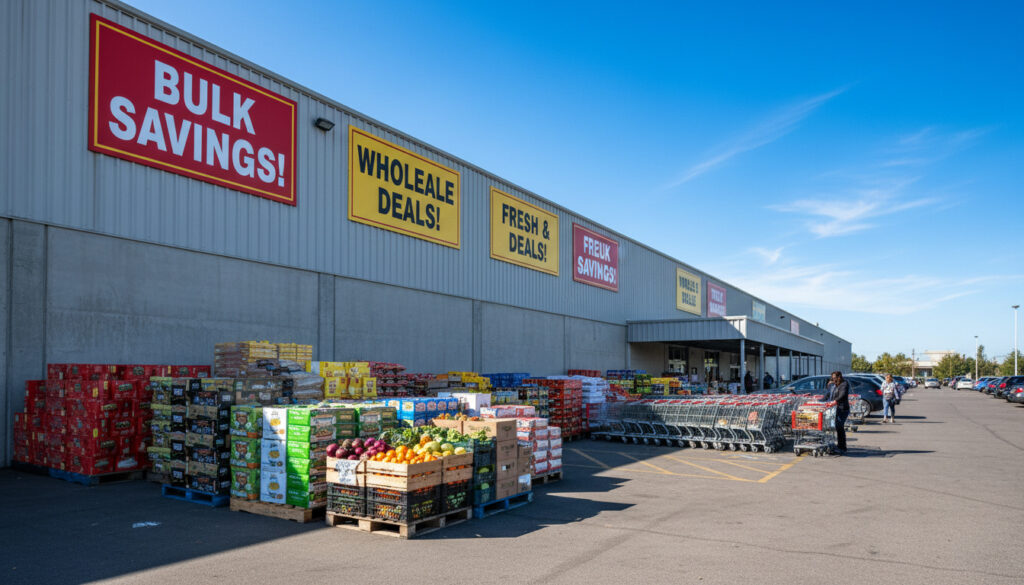
Warehouse floors feature industrial shelving, limited frills, and products displayed in original packaging quantities. Shopping requires navigating large footprints—often exceeding 100,000 square feet—with seasonal rotating inventory. Shoppers should verify storage capacity before purchasing; bulk perishables require substantial refrigerator and freezer space.
Delivery and Pickup Options
Sam’s Club leads in digital convenience, offering same-day grocery delivery and curbside pickup for members. The Scan & Go application allows in-store scanning and bypassing traditional checkout lines. BJ’s provides curbside service for select non-grocery items and online ordering with in-club pickup. Costco currently lacks grocery curbside options, and online pricing typically exceeds physical store tags.
Ancillary Services
All three operators maintain gas stations with membership-discounted fuel, typically 10-20 cents below street prices. Optical centers, hearing aid services, and pharmacy counters operate within most locations. BJ’s and Costco both offer travel booking services with member-exclusive rates.
Bulk purchases require adequate home storage. Studies indicate households without sufficient freezer capacity waste approximately 15% of bulk perishable goods. Verify shelf and refrigerator space before committing to case quantities.
The Evolution of Warehouse Club Shopping
- : Costco founded, establishing the membership-based bulk retail model focused on quality organics and curated selections.
- : Sam’s Club launches as a Walmart subsidiary, targeting small businesses and budget-conscious consumers with aggressive pricing strategies.
- : BJ’s Wholesale Club opens its first location, emphasizing the East Coast market and wider product variety than competitors.
- : North Carolina study confirms Sam’s Club pricing advantage across 60-item grocery basket comparison.
- : Membership fees standardize at $50-$60 for basic access and $110-$120 for premium tiers across all three national chains.
Verifying Local Availability and Access
Established Information
- Sam’s Club operates nearly 600 locations in the United States and Puerto Rico
- BJ’s maintains approximately 215 stores with East Coast concentration
- All three chains require annual membership fees ranging from $50-$110
- Sam’s Club offers the lowest prices according to 2024 comparative studies
Uncertain or Variable Factors
- Exact store counts for Costco remain unspecified in publicly available data
- Regional pricing fluctuates by location and seasonal availability
- Specific inventory varies significantly between individual warehouse locations
- Future expansion plans for BJ’s westward growth remain tentative
How Food Warehouses Fit into Modern Retail
The warehouse club model fundamentally differs from traditional grocery retail through its reliance on membership fees subsidizing lower merchandise margins. By limiting SKUs to high-volume movers and eliminating fancy fixtures, operators reduce overhead while passing savings to members. This approach contrasts with conventional supermarkets carrying 40,000+ items with higher per-unit pricing.
When evaluating local options, consumers apply similar location-based strategies across service categories. Drivers searching for Renault Dealer Near Me – Official Locator Guide utilize the same geographic verification methods—checking proximity, hours, and service availability—as those seeking bulk grocery providers.
Data Sources and Expert Comparisons
Sam’s Club typically has the lowest prices, BJ’s the widest product variety (around 5,600-7,000 items), and Costco excelling in quality organics (about 4,000 items).
— AARP Financial Analysis and Eat This, Not That market research
Shop Sam’s for budget bulk at lowest prices; BJ’s for smaller packs, coupons, supermarket-like fill-ins; Costco for premium quality but higher online costs.
Choosing the Right Warehouse for Your Needs
Selecting a food warehouse requires matching location proximity against household consumption patterns. Sam’s Club suits budget-focused shoppers prioritizing lowest unit costs and digital convenience like curbside pickup. BJ’s serves families wanting variety and coupon opportunities, particularly along the East Coast. Costco appeals to quality-focused consumers willing to sacrifice some variety for premium organics. Ultimately, selecting the right bulk grocery provider requires the same diligence as finding Key Cutting Near Me – Costs, Options and Local Services—comparing specific locations, verifying current membership terms, and calculating break-even points based on actual purchasing habits.
Common Questions About Food Warehouses
Can I shop at a food warehouse without a membership?
Generally no. All three major chains require paid annual memberships for shopping floor access. Sam’s Club uniquely allows non-members to purchase items from the food court, including pizza and hot dogs.
Which warehouse club has the cheapest groceries?
According to 2024 North Carolina price comparison studies analyzing 60 grocery items, Sam’s Club consistently offers the lowest total cart costs among the three major chains.
Do food warehouses offer curbside pickup?
Sam’s Club provides curbside pickup for groceries. BJ’s offers curbside service for select non-grocery items. Costco currently does not offer curbside pickup for groceries.
Can I use manufacturer coupons at warehouse clubs?
BJ’s Wholesale Club accepts manufacturer coupons, allowing members to stack discounts on bulk purchases. Costco and Sam’s Club do not accept manufacturer coupons.
Are warehouse clubs cheaper than regular grocery stores?
Yes. Warehouse clubs typically offer 20-30% savings per unit compared to traditional supermarkets, though this requires purchasing larger quantities and paying annual membership fees.
What is the best warehouse club for organic food?
Costco specializes in organic and premium quality groceries, offering the strongest selection of organic produce and specialty items despite carrying fewer total SKUs than competitors.
How do I find a food warehouse open now?
Use the official store locators for Costco, Sam’s Club, or BJ’s to verify real-time hours, as operating times vary by location and day of week.