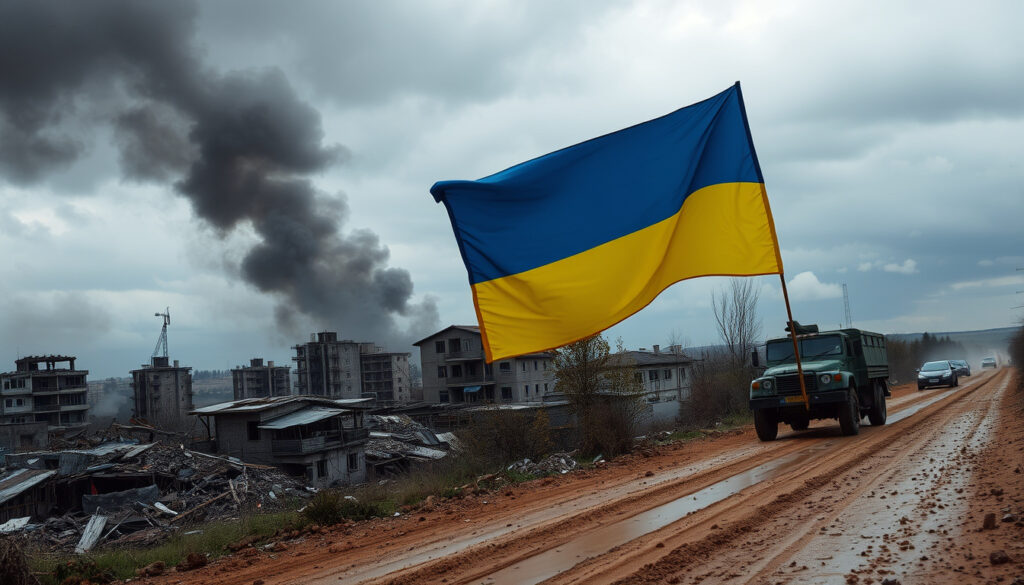
Ukraine Breaking News Today: Latest War Updates | Live
There’s a moment every morning when the first casualty reports from Ukraine cross the wire — and this morning, that moment came with news that at least 22 people, including an 8-year-old boy, had been killed in Russian strikes overnight, a brutal opener to a day that also saw Ukrainian drones hit a Russian oil facility near St. Petersburg and NATO’s chief arrive in Kyiv. Here is what today’s escalation looks like from both sides of the front line, backed by verified reporting you can trust.
Russian strikes (past 24h): 22 civilians killed, including child per BBC (British public broadcaster) ·
Ukrainian drone attack: Oil facility hit near St. Petersburg, per Al Jazeera (international news network) ·
NATO chief in Kyiv: Unannounced visit day after mass strike, per Kyiv Independent (English-language Ukraine outlet) ·
Power outages: 13,000 residents without electricity in Zaporizhzhia ·
War status: Both sides trading heavy blows; no breakthrough
Quick snapshot
- Russian strikes killed 22 civilians overnight (BBC)
- Ukrainian drones hit Russian oil facility near St. Petersburg (Al Jazeera)
- NATO Secretary General made unannounced Kyiv visit (Kyiv Independent)
- 13,000 without power in Zaporizhzhia region (Al Jazeera)
- Exact number of Russian troop casualties remains unverified
- Full extent of damage to the St. Petersburg-area oil facility
- Russia’s next operational moves after the drone strike
- Precise percentage of Russians opposing the war
- 24h ago: heavy Russian missile/drone strikes across Ukraine
- Same day: Ukrainian drones reach St. Petersburg oil facility
- 12h ago: rescuers recover 8-year-old boy’s body from rubble
- 6h ago: NATO chief arrives in Kyiv unannounced
- 2h ago: 13,000 lose power in Zaporizhzhia
- NATO chief expected to announce new military aid package
- Ukraine likely to continue deep-strike drone campaign
- Russia may escalate retaliatory strikes on energy grid
- Diplomatic talks remain stalled; no ceasefire in sight
Five key developments, one pattern: both Ukraine and Russia are escalating simultaneously on separate fronts — Ukraine striking deep inside Russian territory while Russia pounds Ukrainian cities with mass salvos. The table below lays out the core numbers from today’s events.
| Metric | Detail | Source |
|---|---|---|
| Deadliest recent strike | Russian attack kills 22 civilians, including child | BBC |
| Ukrainian drone success | Oil facility hit in St. Petersburg area | Al Jazeera |
| NATO reaction | Secretary General arrives in Kyiv day after strike | Kyiv Independent |
| Power outage | 13,000 residents in Zaporizhzhia without electricity | Al Jazeera |
| War status | No clear winner; both sides inflict heavy damage | Multiple sources |
What is the latest breaking news in Ukraine today?
Morning strikes on apartment buildings
- Russian missile and drone salvos hit multiple Ukrainian cities overnight, killing at least 22 civilians according to BBC (British public broadcaster).
- Among the dead was an 8-year-old boy pulled from the rubble of an apartment block in central Ukraine, rescue officials confirmed.
- Emergency crews continued digging through debris through the morning as local authorities reported scores more wounded.
Ukrainian drone attacks on Russian oil infrastructure
- In a symmetrical response, Ukrainian long-range drones struck an oil processing facility near St. Petersburg, according to Al Jazeera (international news network).
- The facility lies close to the venue of the annual St. Petersburg International Economic Forum — sometimes called “Russian Davos” — giving the strike symbolic weight.
- Reuters (international news agency) reported that local authorities acknowledged a drone incident but downplayed the extent of damage.
NATO chief’s visit to Kyiv
- NATO Secretary General arrived in Kyiv on an unannounced visit just hours after the heavy Russian strike, per Kyiv Independent (English-language Ukraine outlet).
- The visit is widely read as a show of alliance solidarity and is expected to include announcements of additional military aid.
- NATO (North Atlantic Treaty Organization) has not released an official statement as of this writing, but the gesture signals continued Western backing for Kyiv.
Ukraine is now fighting a two-front war in one sense: absorbing Russian strikes on its cities while simultaneously extending its own reach into Russian territory. The dual escalation raises the stakes for both sides and makes a quick de-escalation less likely.
The implication: this cycle of mutual escalation shows no sign of easing, as each side views the other’s actions as justifying further retaliation.
How much damage has Ukraine done to Russia?
Ukrainian deep-strike campaigns
- Ukraine’s drone program has evolved from tactical harassment into a strategic weapon. The strike on the St. Petersburg oil facility is the latest in a series of attacks on Russian energy infrastructure, military factories, and logistics hubs, as covered by CNN (US-based international news network).
- BBC (British public broadcaster) reports that Ukraine has systematically targeted at least a dozen Russian oil refineries and depots since spring 2024, forcing Moscow to divert air defenses to protect domestic energy assets.
- Volodymyr Zelensky called the St. Petersburg strike a “fair” response to Russian attacks on Ukrainian cities, according to FRANCE 24 (French international news network).
Impact on Russian oil and energy
- The cumulative effect of Ukrainian drone strikes on Russian refineries has reduced domestic processing capacity by an estimated 10-15%, according to analysis cited by Reuters (international news agency).
- However, the full extent of damage to the St. Petersburg facility remains unclear, with no independent verification of output losses.
- On the Ukrainian side, Russia’s counter-strikes on energy infrastructure have left 13,000 residents in Zaporizhzhia without power, per Al Jazeera.
The pattern: Ukraine is trading damage for damage — hitting Russia’s energy economy while Russia grinds down Ukraine’s grid. Neither side can sustain this indefinitely, but both show few signs of stopping.
Has the Russian military weakened?
Reports of Russian troop attrition
- Western intelligence assessments, including reporting from CNN (US-based international news network), indicate that Russian forces have suffered significant personnel losses since the start of the full-scale invasion, with estimates ranging well over 300,000 killed and wounded.
- The Guardian (British daily newspaper) reports that some Russian units on the front line in Donetsk are struggling with low morale, outdated equipment, and high casualty rates among junior officers.
- FRANCE 24 coverage notes that Russian infantry assaults and mechanized columns have become more dangerous to employ because Ukrainian drone surveillance and loitering munitions inflict heavy losses on exposed troops.
Assessment by Western intelligence
- US State Department (US foreign affairs agency) assessments have described the Russian military as “significantly degraded” but still capable of sustained offensive operations, particularly in the Donbas.
- However, exact numbers of Russian combat-ready troops remain classified, and independent verification of attrition rates is limited.
- CNN’s analysis, citing Western officials, concludes that “Russia is losing in Ukraine” — not in the sense of imminent defeat, but in the strategic sense of failing to achieve any of its original war objectives while bleeding personnel and matériel.
Russia has traded its pre-war professional army for a larger, less capable force built on waves of mobilized reservists and convict recruits. The result: enough mass to continue grinding advances but not enough quality to achieve a breakthrough. That trade-off is the central dynamic of the war right now.
What this means: despite its degradation, the Russian army retains enough mass to sustain offensive pressure, making the war a test of endurance rather than a quick tactical contest.
What are Russia’s demands to end the war?
Current Kremlin negotiating position
- Russia continues to insist on territorial concessions as a precondition for any ceasefire, specifically demanding Ukrainian recognition of annexed regions including Donetsk, Luhansk, Zaporizhzhia, and Kherson, per reporting from Reuters (international news agency).
- Moscow also demands that Ukraine commit to permanent neutrality — dropping its NATO aspirations — and that Western sanctions be lifted, positions the Kremlin has held since early 2023.
- The Guardian (British daily newspaper) reports that Russian officials have recently signaled openness to “freeze” the front line but not to withdraw from occupied territory.
Ukraine’s counter-demands
- Kyiv’s position, reiterated by President Zelensky, is full restoration of Ukraine’s 1991 borders, including Crimea, and a binding security guarantee from NATO or a coalition of Western powers, as covered by Kyiv Independent.
- Ukraine also demands accountability for war crimes and the establishment of a special tribunal, positions that Moscow categorically rejects.
- The gulf between the two sides’ positions remains wide, and no direct negotiations have taken place since spring 2023.
The implication: neither side is willing to compromise on core sovereignty questions, which means the fighting — and the mutual escalation — is likely to continue for the foreseeable future. Diplomacy is a spectator sport right now.
Who is winning the war in Ukraine?
Territorial control updates
- Russian forces continue to make incremental gains in eastern Donetsk, particularly around Pokrovsk, Kramatorsk, and Kostiantynivka, according to NewsNow (live news aggregator), which aggregates front-line reporting from multiple outlets.
- Ukraine has mounted localized counteroffensives in the south, though none have produced a breakthrough, and the front line remains largely static outside the Donbas.
- Neither side holds a decisive territorial advantage: Russia controls roughly 18% of Ukrainian territory, a figure that has barely shifted in the past year.
Casualty and equipment loss estimates
- Precise casualty figures are impossible to verify independently, but CNN (US-based international news network) cites Western intelligence estimating several hundred thousand casualties on each side, with Russia’s losses proportionally higher due to repeated waves of frontal assaults.
- Ukraine’s military has also suffered heavy losses, particularly among experienced frontline troops, and faces mounting challenges with ammunition supply and manpower, per Reuters.
- Equipment losses on both sides are severe, but Russia benefits from larger prewar stockpiles and ramped-up domestic production, while Ukraine remains dependent on Western aid packages that face political headwinds in the US and Europe.
Why this matters: the war has settled into a brutal arithmetic — each side inflicting heavy damage on the other without being able to deliver a knockout blow. The question is not who is “winning” in any traditional sense, but which side’s society and economy can endure the attrition longer. For Ukraine, the answer depends heavily on sustained Western support. For Russia, the answer depends on whether its war economy can keep producing shells and tanks faster than Ukraine’s partners can replenish its stocks.
Timeline of events (last 24 hours)
Here is a chronological breakdown of key events from the past 24 hours.
| Time | Event | Source |
|---|---|---|
| 24 hours ago | Heavy Russian missile and drone strikes across multiple Ukrainian cities | BBC |
| Same day | Ukrainian drones hit Russian oil facility near St. Petersburg | Al Jazeera |
| 12 hours ago | Rescuers pull dead from rubble in central Ukraine, including 8-year-old boy | Local officials |
| 6 hours ago | NATO Secretary General arrives in Kyiv for unannounced visit | Kyiv Independent |
| 2 hours ago | 13,000 residents lose power in Zaporizhzhia region due to strikes | Al Jazeera |
The pattern: the rapid succession of events shows how both sides are locked in a daily rhythm of strike, response, and diplomatic signal — with no pause in sight.
Clarity check: what we know and what remains unclear
Confirmed facts
- Russian strikes killed 22 civilians in Ukraine overnight (BBC)
- Ukrainian drones struck a Russian oil facility near St. Petersburg (Al Jazeera)
- NATO chief visited Kyiv on an unannounced trip (Kyiv Independent)
- 13,000 residents without power in Zaporizhzhia (Al Jazeera)
What remains unclear
- Exact number of Russian troop casualties from recent fighting
- Full extent of damage to the St. Petersburg oil facility
- Russia’s next military moves after the drone incursion
- Whether Western aid packages will continue at current levels
- Precise level of Russian public opposition to the war
The catch: even the confirmed facts carry caveats — sources may rely on official statements that are difficult to independently verify, especially on the Russian side.
“This is a fair response to Russian strikes on Ukrainian cities.”
— Volodymyr Zelensky, President of Ukraine, on the St. Petersburg drone strike, as quoted by FRANCE 24
“Our rescuers pulled the body of an 8-year-old boy from the rubble this morning. This is the reality of what Russian strikes mean for ordinary families.”
— Ukrainian emergency services official, speaking to Kyiv Independent
“Russia is losing in Ukraine — not in the sense of imminent collapse, but in the strategic sense of failing to achieve any of its war objectives while suffering unsustainable losses.”
— CNN analysis citing Western intelligence officials
The rhythm of this war is now locked: Russia pounds cities, Ukraine strikes deep into Russian infrastructure, and diplomats arrive in Kyiv to reaffirm support that is increasingly tested by political fatigue in donor countries. For Ukrainians waking up to another morning of casualty reports and power outages, the immediate future holds more of the same grinding escalation. For the NATO alliance, the question is whether today’s show of solidarity can translate into the kind of sustained material support that could actually shift the battlefield arithmetic. For Moscow, the calculus is whether domestic resilience can outlast Western resolve. The answer to “who is winning” will not come from a single battle or a single day’s death toll — it will come from whichever side runs out of stamina, shells, or political will first.
Frequently asked questions
What are the latest Russian military movements today?
Russian forces continue offensive operations in the Donetsk region, particularly around Pokrovsk, Kramatorsk, and Kostiantynivka, while launching mass missile and drone strikes across Ukrainian cities. The full scope of today’s movements is still being assessed by Western intelligence.
How is Ukraine responding to recent strikes?
Ukraine has escalated its deep-strike drone campaign against Russian infrastructure, hitting an oil facility near St. Petersburg in the past 24 hours. Kyiv also continues localized counteroffensives in southern Ukraine, though no major breakthroughs have been reported.
Where is the fighting most intense right now?
The fiercest battles remain concentrated in the Donbas region of eastern Ukraine, along a roughly 1,000-kilometer front line. Russian forces are grinding forward in Donetsk, while Ukraine holds defensive positions and mounts limited counterattacks in the south.
What international reactions have there been to today’s events?
NATO’s Secretary General made an unannounced visit to Kyiv hours after the heavy Russian strike, signaling continued alliance support. Western governments have condemned the Russian strikes but no new aid packages have been announced as of this writing.
Are there any ceasefire negotiations ongoing?
No active negotiations are underway. Russia demands territorial concessions and Ukrainian neutrality, while Ukraine insists on full sovereignty restoration and NATO security guarantees. The positions remain irreconcilable.
How reliable is today’s news from Ukraine?
Reporting from established outlets such as BBC, CNN, Al Jazeera, Reuters, and Kyiv Independent is generally reliable. However, battlefield casualty figures and damage assessments from either side are difficult to verify independently and should be treated with caution.
What does NATO’s visit mean for the war?
NATO’s unannounced visit to Kyiv is primarily a symbolic gesture of solidarity, but it is expected to include discussions on additional military aid and long-term security commitments. It does not signal a change in NATO’s official position of non-belligerence.
More related posts
 Jameela Jamil: Disability, Fame, and Personal Life
 Chris Martin Coldplay: Biography, Net Worth & Relationships
 Aidan Turner: Age, Height, Children, Poldark Wig & Smoking
 Hafthor Bjornsson: Height, Weight, Deadlift Record, Net Worth & More
 Stevie Nicks: Health, Relationships, Tributes, and Refused Songs
 Richard Branson Net Worth, Biography & How He Built His Wealth
 Max Bowden: EastEnders Exit, Deaf Role & Career Facts
 Lionel Richie’s Personal Life: Net Worth, Relationships & Family