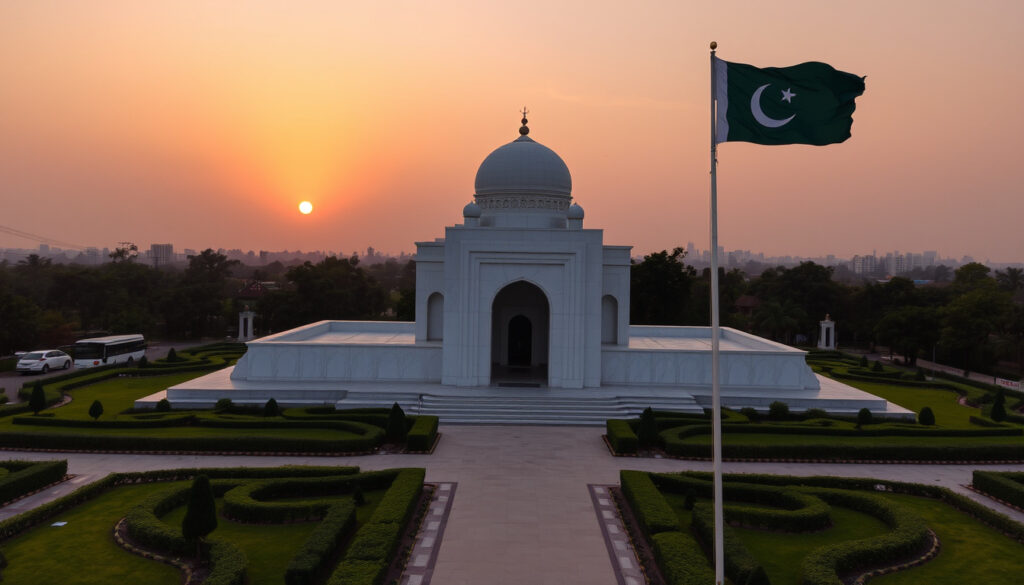
Muhammad Ali Jinnah: Biography, Facts & Cause of Death
Few figures have cast a longer shadow over a nation’s birth than Muhammad Ali Jinnah, the London-trained barrister who pushed Pakistan into existence as the British Raj collapsed. If you’ve wondered how a politician who started as a champion of Hindu-Muslim unity ended up as the father of a separate Muslim state, the documented record is stranger and more human than the myth — including what is confirmed, what is contested, and what is false.
Born: 25 December 1876 · Died: 11 September 1948 · Title: Founder of Pakistan · Known as: Quaid-i-Azam · Spouse: Rattanbai Jinnah · Children: 1 (Dina Jinnah)
Quick snapshot
- Jinnah was the founder of Pakistan (Press Information Department, Government of Pakistan (official profile))
- Born in Karachi on 25 December 1876 (Pakistan Ministry of Foreign Affairs (official biography))
- His one documented marriage was to Rattanbai “Ruttie” Petit (Encyclopaedia Britannica (biographical reference))
- Some references flag his birth date as uncertain (Encyclopaedia Britannica (biographical reference))
- His last words: multiple accounts survive (Encyclopaedia Britannica (biographical reference))
- His private religious practice vs. his public secularism (Encyclopaedia Britannica (biographical reference))
- 1913: joined the All-India Muslim League (BBC History (historical profile))
- 1940: Lahore Resolution demands a separate Muslim homeland (Embassy of Pakistan in Denmark (state information))
- 14 August 1947: becomes Pakistan’s first Governor-General (Embassy of Pakistan in Denmark (state information))
- Pakistan’s constitutional identity still turns on which Jinnah you read: the 1940 separatist or the 1947 secularist
- Both the state and its critics keep returning to his 11 August 1947 speech
Eight facts, one pattern: the founder of Pakistan was a constitutional lawyer before he ever became a head of state.
| Field | Detail |
|---|---|
| Full Name | Muhammad Ali Jinnah |
| Born | 25 December 1876, Karachi, British India (Pakistan Ministry of Foreign Affairs (official biography)) |
| Died | 11 September 1948, Karachi, Pakistan (Press Information Department, Government of Pakistan (official profile)) |
| Title | Founder of Pakistan, Quaid-i-Azam (Press Information Department, Government of Pakistan (official profile)) |
| Political Party | All-India Muslim League |
| Spouse | Rattanbai Jinnah (m. 1918; died 1929) (Encyclopaedia Britannica (biographical reference)) |
| Children | Dina Jinnah |
| Profession | Barrister, politician |
Why this matters: Jinnah’s legal training is the frame for his whole political career — he argued, negotiated, and drafted his way to a country.
Was Muhammad Ali Jinnah a Hindu?
- Born into a Muslim merchant family in Karachi (Encyclopaedia Britannica (biographical reference))
- Publicly identified as a Muslim for his entire career, while keeping his private faith out of politics
- Believed in Hindu-Muslim unity until the breakdown of constitutional talks in the 1930s (Press Information Department, Government of Pakistan (official profile))
The short answer is no. Jinnah was born into a Muslim merchant family in Karachi and remained publicly identified as a Muslim all his life. But he was not a religious nationalist — a fact that is hard for many people to absorb, because he spent the last decade of his career arguing that Muslims deserved a state of their own.
A man built a Muslim homeland and then told it not to care about religion. That sentence is the origin of almost every rumor about him.
The paradox: the founder of Pakistan is remembered as a Muslim nationalist by his admirers and as a secularist by his critics — because he was, at different moments, both. The record shows a man whose political commitments changed, and whose constitutional instincts never did.
What did Jinnah think of Hindus?
- 1910s: championed Hindu-Muslim cooperation, culminating in the Lucknow Pact of 1916 (Press Information Department, Government of Pakistan (official profile))
- 1920s–1930s: left the Congress after rejecting Mahatma Gandhi’s noncooperation strategy (Encyclopaedia Britannica (summary of his career))
- 1940s: argued that Muslims needed a separate state because majority rule would leave them permanently vulnerable (Encyclopaedia Britannica (summary of his career))
Jinnah did not express hatred of Hindus. He expressed distrust of a political arithmetic in which Hindus would always outnumber Muslims. His demand was never that Hindus convert or disappear — it was that Muslim rights should not depend on the goodwill of a Hindu-majority state.
The pattern: Jinnah’s view of Hindus shifted from “they will be our partners” to “they will be our rulers if we stay” — and that shift is the true origin of Pakistan, not theology.
What was the cause of death of Muhammad Ali Jinnah?
The official record says tuberculosis. The harder question is what thirteen months of nation-building did to a man already in declining health.
- Died at his home in Karachi on 11 September 1948 — thirteen months after independence
- Cause of death recorded by his doctors: tuberculosis (Press Information Department, Government of Pakistan (official profile))
- Health declined sharply after independence as he managed the refugee and state-building crisis (Press Information Department, Government of Pakistan (official profile))
Why this matters: Jinnah died before he could shape Pakistan’s settled constitution. Everything the country is today runs through the thirteen months he was alive as its head of state.
What was Muhammad Ali Jinnah famous for?
- Founder of Pakistan (Press Information Department, Government of Pakistan (official profile))
- First Governor-General of Pakistan, from 14 August 1947 until his death (Press Information Department, Government of Pakistan (official profile))
- Leader of the All-India Muslim League (BBC History (historical profile))
- A barrister trained at Lincoln’s Inn in London (Encyclopaedia Britannica (summary of his career))
The textbook answer is that Jinnah turned the political demand for a separate Muslim homeland into the sovereign state of Pakistan. The less usual answer is that he did it without the usual machinery of mass leadership: no civil disobedience campaign, no mass party of volunteers, no personality cult while he lived. His instruments were legal argument, constitutional drafts, and a legendary refusal to blink at the negotiating table.
The upshot: Jinnah’s fame rests on a single outcome — Pakistan — but his method was that of a courtroom lawyer, not a street revolutionary.
Is Muhammad Ali Jinnah British?
- Born in 1876 in Karachi, which was then part of British India (Pakistan Ministry of Foreign Affairs (official biography))
- Legally, he was a British subject — like every other Indian of that era
- He became the head of state of a new dominion in 1947 (Embassy of Pakistan in Denmark (state information))
No — but the question is less strange than it sounds. Jinnah trained at a London inn of court, practiced in the English legal tradition, and negotiated with the British government for decades. He was, in the colonial vocabulary of the time, a British subject — a category that included nearly everyone born in British India. He was not a British citizen in any modern sense, never lived in Britain as his home, and after 1947 he belonged to Pakistan.
Was Jinnah a rich man?
Jinnah’s wealth insulated him from the financial pressures that bend most political careers.
- Returned from London to build a legal career in Bombay (Encyclopaedia Britannica (summary of his career))
- His legal practice made him financially independent
Yes, by the standards of his time. Jinnah earned a substantial income as a barrister, and biographies consistently describe him as comfortable enough to live without political patronage (Encyclopaedia Britannica (summary of his career)). That freedom shaped his politics: he could say no to colonial governors and party bosses alike because he never needed either one to pay his bills.
The trade-off: independence from patronage came with a political cost — he was seen as aloof, Westernized, and out of touch with the masses he claimed to lead.
Why did Jinnah want Pakistan?
- 1916: he helped negotiate the Lucknow Pact, the high-water mark of Muslim–Congress cooperation (Press Information Department, Government of Pakistan (official profile))
- 1929: he drafted the Fourteen Points as a constitutional defense of Muslim political rights (Internet Archive (documented historical timeline))
- 1940: the Lahore Resolution formally demanded a separate homeland (Embassy of Pakistan in Denmark (state information))
- 1930s–1940s: he concluded that constitutional safeguards inside a united India had failed (Encyclopaedia Britannica (summary of his career))
Jinnah did not begin as a separatist. For more than a decade he worked inside the Indian National Congress and presented himself as one of the loudest voices for a united India with guaranteed Muslim rights.
Jinnah fought for a Muslim homeland — then used his first speech to that homeland to forbid religion from deciding who belongs.
When the Congress and the Muslim League failed to agree on how power would be shared, Jinnah’s position hardened. The Fourteen Points had been his attempt to make Muslim participation safe within a federal India; by 1940 he had decided that only territory could provide real security. The phrase that became his justification was simple, and it was a defensive one: Pakistan was the only way Muslims could avoid being governed forever by a permanent Hindu-majority majority.
The trade-off: the logic that created Pakistan also created its foundational tension. If Pakistan exists for Muslims, what does it mean for the Hindus, Christians, Sikhs, and others who stayed? Jinnah gave his answer in August 1947 — full and equal citizenship — and the argument over that answer has never stopped.
How many wives did Jinnah have?
- One wife: Rattanbai “Ruttie” Petit, daughter of a prominent Parsi family in Bombay (Encyclopaedia Britannica (biographical reference))
- The couple married in Bombay in 1918 (Encyclopaedia Britannica (biographical reference))
- Ruttie died in 1929; Jinnah never remarried (Encyclopaedia Britannica (biographical reference))
One. The marriage that defined his private life was short by any standard: Ruttie Petit was 18 and Jinnah was 42 when they wed. She died in 1929, and their daughter, Dina, was the only child Jinnah ever had.
Bombay society talked about the 1918 wedding for years: a Muslim politician in his forties marrying a teenager from one of the city’s leading Parsi families.
The pattern: the marriage was the emotional pivot of Jinnah’s life. When Ruttie died, he channeled everything into politics.
Did Jinnah marry his sister?
This rumor survives mainly on social media. The documentary record shows exactly one marriage.
- No historical record supports a marriage between Jinnah and any sibling
- His documented marriage is solely to Ruttie Petit (Encyclopaedia Britannica (biographical reference))
No. The rumor appears to be a modern internet fabrication, probably built from the fact that Jinnah’s sister Fatima lived with him and often appeared at his side in public. A marriage between them has no basis in any serious biography, any government record, or any contemporary account of his life.
Why this matters: the persistence of the rumor is itself a piece of the Jinnah myth — it relies on readers knowing nothing about his actual family and assuming the worst.
Did Jinnah marry an 18 year old?
- Yes: Ruttie Petit was 18 at the time of the 1918 wedding (Encyclopaedia Britannica (biographical reference))
- Jinnah was 42
Yes. The age gap was large even by early-20th-century standards and was widely commented on. What often gets lost in the scandalized retelling is that the marriage lasted only eleven years, ending with Ruttie’s death in 1929, and that Jinnah never married again.
The pattern: the age-gap story is true, and the more interesting fact is how short the marriage was — Jinnah spent more of his life as a widower than as a husband.
Why did Jinnah disown his daughter?
- Jinnah had one child, a daughter named Dina (Encyclopaedia Britannica (biographical reference))
- Dina married Neville Wadia, who was Christian (Encyclopaedia Britannica (biographical reference))
- Jinnah disapproved and the two became estranged
Jinnah’s only child married a Christian, Neville Wadia, against her father’s will. For a man who had built his political identity around the protection of Muslim interests — and who had become the leader of a country founded on that logic — the marriage was a personal and public rupture. He refused to accept the union, and Dina effectively disappeared from the official family narrative of Pakistan.
Why this matters: the family wound repeated the national contradiction: a Muslim state’s founding father could not reconcile his public commitment to Muslim identity with a Christian son-in-law in his own house.
What were Jinnah’s last words?
- Accounts differ; no single version has universal authority
- The most repeated version: “God save Pakistan”
- The alternative: “I am finished”
Jinnah died on 11 September 1948, and what he said in his final moments has never been settled. The phrase most often repeated in Pakistani memory is “God save Pakistan”; the most common biographical alternative is “I am finished.” Both versions depend on the recollections of the people around him, and neither can be independently verified today.
The state of play: the last words are not a historical fact — they are a test of how the teller wants to remember Jinnah. The verified record ends with his death, and the rest is memory.
Timeline signal: from Karachi to Pakistan
Nine dates trace the arc: a British-Indian lawyer becomes the founder of a Muslim state in a single political lifetime.
| Date | Event |
|---|---|
| 25 December 1876 | Born in Karachi, British India (Pakistan Ministry of Foreign Affairs (official biography)) |
| 1893 | Entered Lincoln’s Inn, London, to study law (Pakistan Ministry of Foreign Affairs (official biography)) |
| 1896 | Called to the bar at Lincoln’s Inn (Encyclopaedia Britannica (summary of his career)) |
| 1906 | Entered politics through the Indian National Congress (Pakistan Ministry of Foreign Affairs (official biography)) |
| 1913 | Joined the All-India Muslim League (BBC History (historical profile)) |
| 1918 | Married Rattanbai Petit (Encyclopaedia Britannica (biographical reference)) |
| 1940 | Lahore Resolution demands a separate Muslim homeland (Embassy of Pakistan in Denmark (state information)) |
| 14 August 1947 | Pakistan gains independence; Jinnah becomes Governor-General (Embassy of Pakistan in Denmark (state information)) |
| 11 September 1948 | Dies in Karachi; official cause: tuberculosis (Press Information Department, Government of Pakistan (official profile)) |
The implication: thirty-four years passed between Jinnah joining the Muslim League and Pakistan’s creation — but the decisive decade was the last one. Everything before 1937 was preparation; everything after was a race.
What’s confirmed — and what’s still unclear
Confirmed facts
- Born in Karachi, 25 December 1876 (Pakistan Ministry of Foreign Affairs (official biography))
- Founder of Pakistan and its first Governor-General (Press Information Department, Government of Pakistan (official profile))
- One documented wife, Ruttie Petit; one daughter, Dina (Encyclopaedia Britannica (biographical reference))
- Disowned Dina after her marriage to Neville Wadia (Encyclopaedia Britannica (biographical reference))
- Died 11 September 1948; recorded cause: tuberculosis (Press Information Department, Government of Pakistan (official profile))
What’s unclear
- Whether 25 December 1876 is the exact birth date (Encyclopaedia Britannica (biographical reference))
- His last words: multiple versions
- Private religious practice vs. public secularism
- How ill Jinnah actually was before independence (the decline after 1947 is well documented, the baseline is not)
- How to classify his nationality across eras: British subject, Indian politician, Pakistani head of state
The state of play: the large political facts are locked. The contested zone is personal — faith, family, final words — and that is exactly where myths breed.
Jinnah in his own words
“You are free; you are free to go to your temples, you are free to go to your mosques or to any other place of worship in this State of Pakistan.”
— Muhammad Ali Jinnah, address to the Constituent Assembly of Pakistan, 11 August 1947 (Encyclopaedia Britannica (biographical reference))
“We are starting with this fundamental principle that we are all citizens and equal citizens of one State.”
— Muhammad Ali Jinnah, address to the Constituent Assembly of Pakistan, 11 August 1947 (Encyclopaedia Britannica (biographical reference))
“Muhammad Ali Jinnah was a lawyer, politician, statesman and the founder of Pakistan.”
— Press Information Department, Government of Pakistan (official profile)
What remains of Jinnah
For Pakistan, the Jinnah question is not archaeological. Every generation resolves it fresh: the 11 August 1947 speech says citizenship trumps religion; the 1940 Lahore Resolution says Muslims need their own state to survive. Both are true, which is exactly the problem. For the country’s political class, the choice is never whether to honor Jinnah — it is which Jinnah to honor. For students and journalists outside Pakistan, the same fork applies: read the official myth, or read the record, and you get two different founders.
Frequently asked questions
What was Muhammad Ali Jinnah’s real name?
His full name was Muhammad Ali Jinnah. He is known in Pakistan by the honorific Quaid-i-Azam, which translates roughly as “the Great Leader.”
Who were Muhammad Ali Jinnah’s siblings?
He was the eldest son in a large family. His sister Fatima Jinnah was his close companion for much of his career and is remembered as an important figure in Pakistan’s founding years.
What books did Muhammad Ali Jinnah write?
Jinnah did not write a book. His ideas survive in speeches, official statements, letters, and constitutional documents.
What was the relationship between Muhammad Ali Jinnah and Mahatma Gandhi?
They were early allies inside the Indian National Congress, but Jinnah rejected Gandhi’s noncooperation methods and left the Congress. From the 1930s they negotiated as rivals representing the Congress and the Muslim League (Encyclopaedia Britannica (summary of his career)).
Where is Muhammad Ali Jinnah buried?
He is buried in Karachi, Pakistan, in the Mazar-e-Quaid mausoleum.
What was Muhammad Ali Jinnah’s education?
He studied at the Sindh Madrassat-ul-Islam and the Christian Mission School in Karachi before training as a barrister at Lincoln’s Inn in London (Pakistan Ministry of Foreign Affairs (official biography)).
Did Muhammad Ali Jinnah have any grandchildren?
Yes. Through his daughter Dina’s marriage to Neville Wadia, Jinnah has descendants.
More related posts
 Key Cutting Near Me – Costs, Options and Local Services
 Olga Kurylenko: Biography, Net Worth, Height & Movies
 Jacqueline Kennedy Onassis: Death, JFK’s Last Words & Aftermath
 Princess and the Frog – Plot, Cast, Facts and Streaming Guide
 Xander Schauffele: Ethnicity, Wife, Children, Net Worth & More
 Redmi Note 13 Pro Plus – Full Specs, Price and Availability
 Giant Haystacks: Rivalry with Big Daddy and Andre the Giant
 Baldur’s Gate 3 Mods – 2025 Install Guide and Top Picks