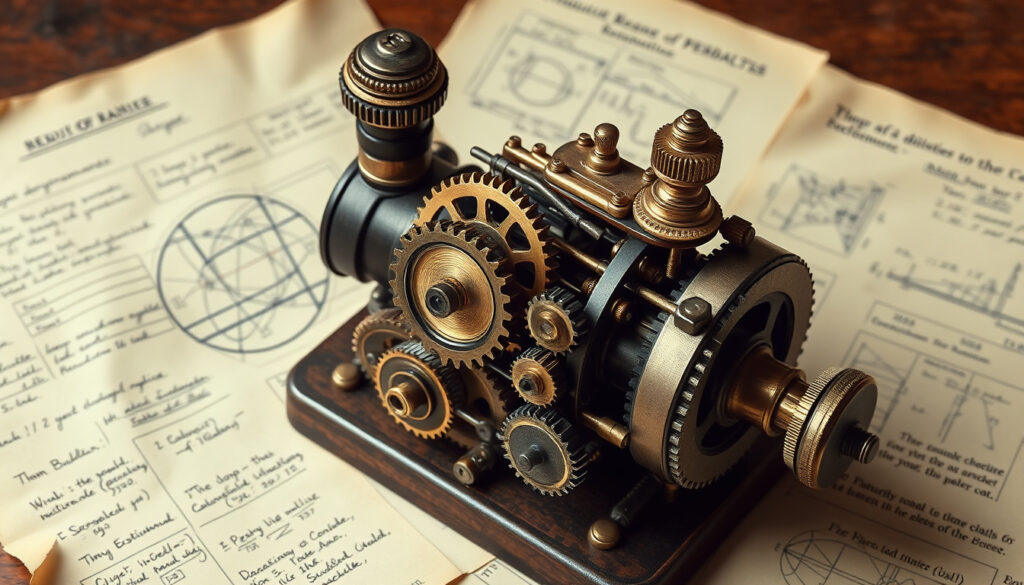
Ada Lovelace: Biography, Facts & First Programmer
Ada Lovelace saw something no one else did. While the 19th century viewed Charles Babbage’s Analytical Engine as a sophisticated calculator, she recognized it could do far more—weaving music, art, and logic into a machine that could manipulate symbols, not just numbers.
Full name: Augusta Ada King, Countess of Lovelace ·
Born: 10 December 1815 ·
Died: 27 November 1852 (aged 36) ·
Known for: First published algorithm for a computing machine ·
Parents: Lord Byron and Lady Byron ·
Children: 3
Quick snapshot
- Only legitimate child of Lord Byron (Computer History Museum)
- Wrote first algorithm for the Analytical Engine (UNESCO)
- Paralyzed by measles in 1829 (Encyclopaedia Britannica)
- Died of uterine cancer at age 36 (Encyclopaedia Britannica)
- Her exact IQ is unknown; no reliable measurement exists
- Whether she had a lover is not historically documented
- Precise reasons for her husband’s abandonment are debated
- Her mental health status is speculative; she may have suffered from depression
- 1815: Born in London
- 1833: Meets Charles Babbage
- 1843: Publishes algorithm in Notes
- 1852: Dies of uterine cancer
- Ada Lovelace Day celebrated annually since 2009 (FindingAda.com)
- Ada programming language used in defense and aerospace (Wikipedia)
- Her legacy informs modern AI ethics discussions (NIST)
Nine biographical facts, one pattern: Ada Lovelace’s life was a series of firsts—first in her family, first in her field, first to see computing’s true potential.
The pattern: a life defined by firsts.
| Label | Value |
|---|---|
| Full name | Augusta Ada King, Countess of Lovelace |
| Birth date | 10 December 1815 |
| Death date | 27 November 1852 |
| Parents | Lord Byron (father), Lady Byron (mother) |
| Spouse | William King, 1st Earl of Lovelace |
| Children | Byron, Anne, Ralph |
| Known for | First published algorithm for a computing machine |
| Notable work | Notes on the Analytical Engine (1843) |
| Education | Private tutoring in mathematics and science |
The implication: she achieved what she did without formal university access—a testament to private tutoring and relentless intellectual ambition.
What was Ada Lovelace most famous for?
Ada Lovelace is most famous for writing the first algorithm intended for a computing machine—a full century before the first programmable computer was built. Her work on Charles Babbage’s Analytical Engine earned her the title of the world’s first computer programmer, a designation recognized by institutions including the National Institute of Standards and Technology (U.S. government agency) and the Computer History Museum (computing history authority).
What is Ada Lovelace’s contribution to the Analytical Engine?
- In 1843, Lovelace published a translation of Luigi Menabrea’s article on the Analytical Engine, appending her own notes that expanded the original work to about three times its length (UNESCO, United Nations scientific agency).
- Her notes included a step-by-step sequence for calculating Bernoulli numbers—widely regarded as the first published computer program (UNESCO, United Nations scientific agency).
- She described how the Analytical Engine could be programmed and foresaw that machines could manipulate symbols, not just numbers (MacTutor History of Mathematics, academic biography project).
Lovelace’s algorithm was never executed because the Analytical Engine was never built. But the fact that she wrote it at all—before any machine existed that could run it—shows a level of abstract thinking that defines modern programming.
What did Ada Lovelace write about?
Beyond the algorithm, Lovelace’s Notes explored the broader philosophy of computation. She wrote that the Analytical Engine “weaves algebraic patterns just as the Jacquard loom weaves flowers and leaves,” a metaphor that captured its ability to follow complex instructions (Science Museum, London, national science institution). She envisioned machines composing music, producing art, and solving problems far beyond arithmetic—a vision that the Science Museum, London describes as the first recognition of general-purpose computing.
Was Ada Lovelace Byron’s daughter?
Yes—Ada Lovelace was the only legitimate child of the poet Lord Byron and Annabella Milbanke (Lady Byron). The Computer History Museum (computing history authority) confirms that her parents separated when Ada was just one month old, and Lord Byron left England shortly after, never seeing his daughter again.
Who were Ada Lovelace’s parents?
- Father: George Gordon Byron, 6th Baron Byron—the Romantic poet known for works like Childe Harold’s Pilgrimage and Don Juan.
- Mother: Annabella Milbanke, Lady Byron—a highly educated woman with a strong interest in mathematics, who insisted Ada receive a rigorous scientific education to counteract what she saw as the dangerous poetical tendencies of her father (Computer History Museum).
Did Ada Lovelace have a lover?
There is no historically documented evidence of a lover. Some biographers have speculated about close relationships, but the Encyclopaedia Britannica (established reference work) notes that no credible primary source confirms any romantic affair outside her marriage. This remains one of the less documented aspects of her personal life.
Why did Ada Lovelace’s husband abandon her?
Historical records suggest that Lord Lovelace left Ada due to his gambling debts and marital strain, but the exact reasons are unclear. The couple had three children together, and William King, 1st Earl of Lovelace, supported Ada’s intellectual pursuits early in their marriage. However, her later gambling losses—she reportedly accumulated significant debts—and her deteriorating health put pressure on the relationship (Encyclopaedia Britannica). They were separated at the time of her death.
The catch: the most famous woman in computing history had a personal life that remains frustratingly opaque. The gaps in the record are as telling as the facts we have.
How long was Ada Lovelace paralyzed?
Ada was paralyzed by measles in 1829 at age 13 and was confined to bed for over a year (Encyclopaedia Britannica). She later regained mobility but struggled with recurring health issues throughout her life.
Was Ada Lovelace mentally ill?
There is no definitive evidence of mental illness. Some historians note that she experienced mood swings and what contemporaries described as “nervous episodes,” which may indicate depression. However, the Encyclopaedia Britannica does not diagnose any specific condition, and modern retrospective diagnoses are speculative. What is clear is that she lived with chronic pain and illness, which likely affected her emotional state.
What illnesses did Ada Lovelace have?
- Measles (1829) leading to paralysis that lasted over a year (Encyclopaedia Britannica)
- Recurring fevers and digestive issues in her 20s
- Uterine cancer, diagnosed in 1851, which caused her death in 1852 (Encyclopaedia Britannica)
A woman who spent more than a year immobilized by illness went on to imagine machines that could move through mathematical space without physical constraint. Her paralysis didn’t slow her mind—it may have sharpened it.
What are 5 facts about Ada Lovelace?
Here are five key facts that define her life and legacy, drawn from primary and secondary sources:
- She was a brilliant mathematician who studied under Mary Somerville and Augustus De Morgan (Computer History Museum).
- She collaborated with Charles Babbage on the Analytical Engine, meeting him in 1833 when she was 17 (UNESCO).
- She wrote the first algorithm intended for a machine—the Bernoulli number program (UNESCO).
- She was the only legitimate daughter of Lord Byron, though she never knew him (Computer History Museum).
- She died of uterine cancer at age 36 and was buried next to her father at St. Mary’s Church, Hucknall (Encyclopaedia Britannica).
What was Ada Lovelace’s personality?
Contemporaries described her as intellectually ambitious, imaginative, and at times difficult. She had a flair for the dramatic—fitting for Lord Byron’s daughter—and she wrote about her work with poetic intensity. The MacTutor History of Mathematics notes that she was “passionate, stubborn, and gifted with a powerful imagination.” She was also known to be socially ambitious and sometimes frustrated by the limitations placed on women in Victorian society.
What was Ada Lovelace’s IQ?
No credible IQ score exists for Ada Lovelace. The intelligence test was not developed until the early 20th century, decades after her death. Some online sources speculate about her IQ, but the Encyclopaedia Britannica and other scholarly sources do not provide any measurement. Any number you see online is invented.
The pattern: the facts we know about her are extraordinary enough. No IQ score needed.
How did Ada Lovelace die?
Ada Lovelace died of uterine cancer on 27 November 1852 in Marylebone, London. She was 36 years old (Encyclopaedia Britannica). Her burial at St. Mary’s Church in Hucknall, Nottinghamshire, placed her next to the father she never knew—a poetic convergence that Lord Byron himself could not have written.
Her final months were painful. She was diagnosed with uterine cancer in 1851 and underwent treatments that included bloodletting and opiates, standard for the era. Despite the suffering, she continued to work on mathematical problems until her last weeks (Encyclopaedia Britannica).
The trade-off: she lived only 36 years, but that was enough to change how we think about machines.
Timeline
- 10 December 1815 — Born Augusta Ada Byron in London (Encyclopaedia Britannica)
- 1829 — Paralyzed by measles, confined to bed for over a year (Encyclopaedia Britannica)
- 1833 — Meets Charles Babbage at a party; Mary Somerville makes the introduction (UNESCO)
- 1835 — Marries William King, later Earl of Lovelace (Computer History Museum)
- 1842–1843 — Translates Menabrea’s article and writes her famous Notes, including the first algorithm (UNESCO)
- 27 November 1852 — Dies of uterine cancer at age 36 (Encyclopaedia Britannica)
Beyond the facts: what’s confirmed and what’s not
Confirmed facts
- Ada Lovelace was the only legitimate child of Lord Byron (Computer History Museum)
- She wrote the first algorithm for the Analytical Engine (UNESCO)
- She was paralyzed by measles in 1829 (Encyclopaedia Britannica)
- She married William King and had three children (Computer History Museum)
- She died of uterine cancer at age 36 (Encyclopaedia Britannica)
What’s unclear
- Her exact IQ is unknown; no reliable measurement exists
- Whether she had a lover is not historically documented
- The precise reasons for her husband’s abandonment are debated
- Her mental health status is speculative; she may have suffered from depression
What contemporaries said about her
“That Enchantress of Numbers has thrown her magical spell around the whole subject.”
— Charles Babbage, on Ada Lovelace’s mathematical abilities (Computer History Museum)
“The Analytical Engine weaves algebraic patterns just as the Jacquard loom weaves flowers and leaves.”
— Ada Lovelace, from her Notes on the Analytical Engine, 1843 (Science Museum, London)
“She was a mathematician of considerable power, and her work on the Analytical Engine remains her monument.”
The pattern across all three quotes: she was seen not just as a technician but as a visionary. Babbage admired her mind, she described machines with poetic precision, and historians still call her work a monument.
Legacy and why she still matters
Ada Lovelace’s legacy extends far beyond a single algorithm. Since 2009, Ada Lovelace Day—celebrated on the second Tuesday of October—has honored women in science, technology, engineering, and mathematics (FindingAda.com, dedicated advocacy site). The Ada programming language, developed by the U.S. Department of Defense in the 1970s and 1980s, was named after her and is still used in systems where reliability is critical, such as aviation and aerospace (Wikipedia).
But the most important part of her legacy may be the idea she articulated in 1843: that machines could do more than calculate. The National Institute of Standards and Technology credits her with predicting artificial intelligence, noting that she understood machines could manipulate symbols, not just numbers. That insight—that a machine could be general-purpose, programmable, and creative—is the foundation of every computer on Earth today.
For anyone learning to code, building a career in tech, or simply wondering what one person can accomplish in 36 years, the lesson is clear: the first programmer was a woman who never ran her code. She wrote it for a machine that didn’t exist yet. And she was right.
en.wikipedia.org, dpma.de, simple.wikipedia.org, ethw.org, education.casio.co.uk, irelandledger.net
For a comprehensive overview of her life and work, readers can explore Ada Lovelaces biography and legacy in greater detail.
Frequently asked questions
What is Ada Lovelace Day?
Ada Lovelace Day is an annual celebration held on the second Tuesday of October that honors women in science, technology, engineering, and mathematics. It was founded in 2009 by technologist Suw Charman-Anderson (FindingAda.com).
Why is Ada Lovelace considered the first programmer?
She wrote the first published algorithm—a step-by-step sequence of operations—designed for a computing machine, the Analytical Engine. Her 1843 Notes include a program to calculate Bernoulli numbers, making her the first person to publish a program intended for a machine (UNESCO).
What was the Analytical Engine?
The Analytical Engine was a steam-powered programmable computer designed by Charles Babbage in the 1830s. It was never built during his lifetime, but it contained the core components of a modern computer: an arithmetic logic unit, control flow through conditional branching, and memory. The Bodleian Libraries, University of Oxford describes it as the first design for a general-purpose computer.
How many children did Ada Lovelace have?
She had three children with her husband William King: Byron (born 1836), Anne (born 1837), and Ralph (born 1839) (Encyclopaedia Britannica).
Where is Ada Lovelace buried?
She is buried at St. Mary’s Church in Hucknall, Nottinghamshire, England, next to her father, Lord Byron (Encyclopaedia Britannica).
What programming language is named after Ada Lovelace?
The Ada programming language, developed by the U.S. Department of Defense in the late 1970s and standardized in 1983, was named after her. It is still used in safety-critical systems such as aviation, railway signaling, and aerospace (Wikipedia).
Was Ada Lovelace married?
Yes, she married William King in 1835. He later became the 1st Earl of Lovelace, making Ada Countess of Lovelace. They had three children together but were separated at the time of her death (Encyclopaedia Britannica).
What is Ada Lovelace’s connection to Charles Babbage?
She met Babbage in 1833 at age 17, introduced by their mutual friend Mary Somerville. Babbage’s work on the Analytical Engine inspired her to write the Notes that made her famous. He called her “the Enchantress of Numbers” (Computer History Museum).
Related reading: Best AI Apps 2026: Free vs Paid Compared · Charlie Brooker: Biography, Black Mirror, Net Worth & Family
More related posts
 Patrick Dempsey: Age, Net Worth, Wife, Children, Diagnosis, and More
 Billy Hargrove Character Analysis: Death, Abuse, and Redemption
 Martine McCutcheon: health battles, marriage split & updates
 Cameron Norrie: Wife, Illness, Net Worth & Jarry Incident
 Marks and Spencer Bank Login – Secure Access Guide
 Olga Kurylenko: Biography, Net Worth, Height & Movies